
1888-1927·Feast November 20
Blessed Anacleto González Flores
Lay Martyr, Lawyer, and Father
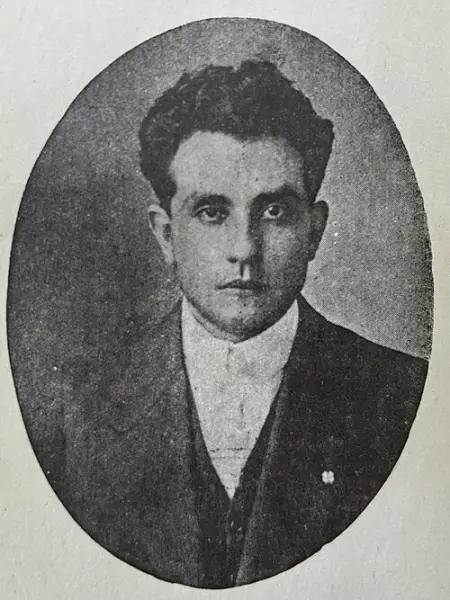
Overview
Anacleto González Flores, born on 13 July 1888 at Tepatitlán in Jalisco, was the second of twelve children of a poor family receiving baptism within a day of his birth. A family friend who was a priest noticed the boy's brightness and steered him toward the minor seminary, where his classmates nicknamed him Maestro; realizing he lacked a vocation to orders, he turned to law instead, qualifying in 1922, a year that also brought his marriage to María Concepción Guerrero and, in time, two children. A daily Mass-goer, he taught catechism and visited prisoners. As the Calles persecution tightened, he led the Catholic Association of Mexican Youth, founded the magazine La Palabra to answer the anticlerical articles of the 1917 constitution, and built the Popular Union to organize Catholic resistance. Having first studied Gandhi's methods and favored nonviolence, he shifted after the 1926 murder of four ACJM members, backing the League that had formed to defend religious liberty and rallying aid for the Cristeros, though he never carried a weapon. Arrested on a fabricated murder charge, he was tortured savagely — thumbs wrenched from their sockets, shoulder broken, soles slashed — and shot on 1 April 1927, crying that God does not die.
The Complete Life
Early Life
Anacleto González Flores was born on 13 July 1888 at Tepatitlán in Jalisco, the second of twelve children of Valentín González Sánchez and María Flores Navarro, a poor couple who had him baptized the day after his birth. A priest friendly to the family noticed how unusually bright the boy was and put him forward for the minor seminary, where he did brilliantly and where his classmates gave him the nickname Maestro, the teacher, that stayed with him for life. Discerning that he had no vocation to Holy Orders, he left the seminary for the Escuela Libre de Derecho in Guadalajara, qualified as a lawyer in 1922, married María Concepción Guerrero that same year, and became the father of two children. The law was his trade; the faith was his life. He heard Mass daily, taught catechism, and made a discipline of visiting prisoners, whose cause nobody else in Guadalajara's courts was taking up.
§ Early life
Conversion and Vocation
What turned a pious attorney into a national Catholic figure was the revolution's war on the Church. The constitution of 1917 had written anticlerical provisions into law, and by the early twenties President Plutarco Elías Calles was enforcing them with a severity Graham Greene would later call the fiercest persecution of religion since Elizabethan England. González Flores answered as a layman and an intellectual: he taught, organized, and wrote. He led the Catholic Association of Mexican Youth (the ACJM), founded the magazine La Palabra to answer the anticlerical press article by article, and built the Popular Union, a civic association that rallied Catholics against the church's persecution. He had studied the methods of Mahatma Gandhi and argued publicly for passive resistance, maintaining that the country's Catholics should not imitate the violence of their rulers. Of the government he wrote that it had made the country a jail for the Catholic Church, and that while material interests come and go, the spiritual interests worth defending were necessary for salvation.
§ Career
Mission and Ministry
In 1926 news reached González Flores that four members of the Catholic Association of Mexican Youth had been murdered, and his dedication to passive resistance gave way: he entered the National League for the Defense of Religious Liberty and threw his weight behind the coming rebellion. When the Cristero rising began in January 1927 he did not himself take up arms; instead he toured and spoke, urging Catholics to keep the Cristeros supplied with money, food, lodging and clothing, and he wrote pamphlets setting out the Catholic case against the anticlerical state. The government, seeking to stamp out the rising, moved against the leadership of the Popular Union and the National League, and González Flores was seized and framed: he was charged with the murder of an American, Edgar Wilkens, though the authorities knew the killing had been the work of a robber named Guadalupe Zuno. Wilkens's widow, who knew the accusation was false, wrote a letter of protest to Washington that in fact exonerated him — a reprieve that arrived only after he was dead.
§ Career
Trial and Final Years
González Flores was tortured with methodical cruelty — hung by his thumbs until they were pulled from their sockets, his shoulder broken with a rifle butt, the soles of his feet slashed — to make him betray the movement's leadership. He gave nothing. On 1 April 1927 he was executed by firing squad in Guadalajara, aged thirty-eight. His last words, echoing the assassinated Ecuadorian president Gabriel García Moreno, were a farewell to the hemisphere, bidding the Americas listen once more: 'I die, but God does not! Viva Cristo Rey!' A letter ordering a stay of his execution arrived only moments after the shots had been fired.
§ Martyrdom
Canonization
The Caldera Law closed the Cristero War in 1929 and the martyrs of the persecution passed into the devotional memory of Mexican Catholicism, kept alive in Jalisco above all. The cause that eventually bore fruit was that of the martyrs of the Cristero era as a group with individual causes attached. Benedict XVI beatified Anacleto González Flores as a martyr at Guadalajara on 20 November 2005, Cardinal José Saraiva Martins presiding; the same ceremony raised his companions of 1 April 1927. His liturgical memorial is kept on 20 November, and devotion to him in the Archdiocese of Guadalajara — at Tepatitlán and at the sites of the persecution — remains strong. At the time of writing he is Blessed rather than saint, and canonization is a matter for a future process.
§ Introduction
Legacy
Among the martyrs of the Calles persecution, González Flores stands for the intellectual and legal resistance: the man who organized a Catholic public, ran a counter-press, tried every lawful means, and paid for the Cristero cause he came to support with his life. Mexican Catholic lawyers and Catholic Action groups claim him as a model of the engaged lay intellectual, and his nickname Maestro has become an emblem of that vocation. The details of his death — the torture that extracted no names, the execution on a framed charge, the reprieve that came too late — are the core of his cult, and his story reached a wide audience through the film For Greater Glory, in which he was portrayed by Eduardo Verástegui.
§ Introduction
Timeline
- 13 Jul 1888
Born at Tepatitlán, Jalisco, second of twelve children; baptized the next day
§ Early life
- 1922
Qualifies as an attorney and marries María Concepción Guerrero, with whom he has two children
§ Early life
- 1926
After four ACJM members are murdered, joins the National League for the Defense of Religious Liberty
§ Career
- Jan 1927
The Cristero War breaks out; he urges Catholics to back the rebels with money and supplies
§ Career
- 1 Apr 1927
Tortured and executed by firing squad at Guadalajara on a framed murder charge
§ Martyrdom
- 20 Nov 2005
Beatified as a martyr by Pope Benedict XVI at Guadalajara
§ Introduction
In Their Own Words
The country is a jail for the Catholic Church... We are not worried about defending our material interests because these come and go; but our spiritual interests, these we will defend because they are necessary to obtain our salvation.
Hear Americas for the second time: I die but God does not! Viva Cristo Rey!
The Record
- Major works
- Founded and edited the magazine La Palabra·Founder and president of the Popular Union (UP)·Pamphlets and speeches in defense of religious liberty
- Patron of
- Catholic lawyers·Lay activists·Fathers of families facing persecution
- Symbols
- Layman's dress (lawyer)·Palms of martyrdom·Cristero-era banner of Christ the King
- Canonization
- Beatified as a martyr by Pope Benedict XVI on 20 November 2005 at Guadalajara (Cardinal José Saraiva Martins presiding)
Prayer
Bibliography
Show 12 sources
- ↑ Benedict XVI (2005). "Apostolic Letter by which The Supreme Pontiff Benedict XVI has Raised to The Glory of The Altars" . Libreria Editrice Vaticana. Archived from the original on June 25, 2015.
- ↑ Lopez-Menendez, Marisol (2012). The Holy Jester: Martyrdom, Social Cohesion and Meaning in Mexico The story of Miguel Agustin Pro SJ, 1927–1988 (Thesis). ProQuest 924485046 . [ page needed ]
- ↑ López-Menéndez, Marisol (2016). Miguel Pro: Martyrdom, Politics, and Society in Twentieth-Century Mexico . Lexington Books. p. 159. ISBN 978-1-4985-0426-3 .
- ↑ Greene, Graham. The Lawless Roads , Prologue (Penguin Classics 1993)
- ↑ Cruz 2003 , p. 40.
- ↑ "FamilySearch.org" . ancestors.familysearch.org . Retrieved January 17, 2024 .
- ↑ "José Anacleto Gónzalez Flores and eight Companions - biography" . www.vatican.va . Retrieved January 17, 2024 .
- 1 2 3 Cruz 2003 , p. 41.
- 1 2 3 4 Cruz 2003 , p. 42.
- 1 2 3 José Anacleto González Flores and eight Companions Vatican News Services November 20, 2005
- ↑ Parsons, Wilfrid Mexican Martyrdom p. 38 2003 Kessinger Publishing, ISBN 0-7661-7246-5
- ↑ Cristiada (2011) IMDb, accessed October 8, 2010
Profile text adapted from the Wikipedia article, licensed CC BY-SA 4.0.
Pray with this saint every day
Save Blessed Anacleto González Flores to your favorites, read the full profile, and get feast-day reminders in the Saints app.
Get the Saints AppFree on the App Store for iPhone and iPad