
c. 1135 – 1205·Feast August 4
Blessed Joan of Aza
Mother of Saint Dominic and of Blessed Mannes
Overview
Joan of Aza is the name that hagiographical tradition gradually gave to the mother of Saint Dominic Guzman and of Blessed Mannes. The oldest life of Dominic, written by Jordan of Saxony, does not name his parents, but a later thirteenth-century source identifies the mother as Juana and the father as Felix; a local author writing nearly a century after Dominic's birth calls the father an honored and wealthy man of his village, and later hagiographers attached him to the noble Guzman family and his wife to the neighboring house of Aza. Tradition settles her birth around 1135 at Haza, in Castile. Of her girlhood nothing is recorded; she probably married young, as custom then dictated, and bore Felix four sons and a daughter. When her two eldest boys were grown she walked to the church of the Silos abbey to implore God for another son, and a dream of Saint Dominic of Silos promised her one who would be a light to the Church — the child she named Dominic and who would found the Order of Preachers. Her death came at Caleruega — the village of Dominic's birth — on 4 August 1205, and Pope Leo XII confirmed her cult in 1828.
The Complete Life
A Saint Reconstructed by Tradition
The historical record of Joan of Aza is a record of gradual reconstruction. In the earliest life of Dominic, composed by Jordan of Saxony, the parents are left unnamed — though Jordan does tell the famous story that before Dominic's birth his mother dreamed that a dog sprang from her womb with a blazing torch in its jaws and set the world alight. Jordan adds only that the boy was raised by his parents and by a maternal uncle who was an archbishop. A later source, still from the thirteenth century, supplies the names: Juana for the mother and Felix for the father. Almost a hundred years after Dominic's birth, a local writer portrayed the father as an honored and wealthy man in his village, and later hagiographers, embroidering on this, gradually built identities for both parents — making the father a member of the local noble house of Guzman and attaching the mother to the neighboring noble family of Aza, from whom her traditional surname comes. Nothing at all is known of Joan's childhood; the tradition can only say that she probably married at the customarily young age of her time and place. Her story, in other words, has always been told through her sons.
§ Introduction
Prayer at the Abbey of Silos
What the tradition does preserve is a picture of Joan as wife and mother. She bore Felix four boys and a girl, and the family's life centered on Caleruega, the village tradition honors as Dominic's birthplace. When the two older boys were grown, Joan journeyed to the church of the Silos abbey to petition God for another son. There, according to the story, she had a dream in which Saint Dominic of Silos — the eleventh-century abbot whose shrine nearby was her favorite place of prayer — assured her she would bear a son destined to illumine the Church. She resolved to give the child the abbot's own name, Dominic. The son of that prayer became the founder of the Order of Preachers; another son, Mannes, is himself honored among the blessed of the Dominican family. The account presents a mother whose holiness expressed itself in petition, in pilgrimage to a beloved shrine, and in the dedication of her children to God's service — a domestic vocation from which, as the tradition delights in showing, the whole Dominican order was born.
§ Legend
Dreams, Omens, and a Name
The spirituality preserved in Joan's legend is one of signs received in prayer. The dream at Silos promised a son who would illuminate the Church, and Dominican tradition wove around his coming a whole fabric of portents. Before his birth his mother was said to have seen the moon upon his forehead; at his baptism his godmother perceived a star instead. The image of the dog bearing a flaming torch, first told by Jordan of Saxony, became the order's emblem: the preachers who would set the world alight with the Word. Joan's own devotion clustered around the shrine of Saint Dominic of Silos, and the boy was probably named after that abbot precisely because the nearby sanctuary was his mother's favorite. Behind these stories stands a recognizably medieval piety — trust in the intercession of a local saint, confidence that dreams might carry God's purposes, and the practice of praying at a shrine for the children still to come. In the tradition's final form, the mother's faith is the hidden source of the son's mission: the light foretold at Silos became the preaching of the Order of Preachers, and the torch its emblem.
§ Legend
Beatification and Veneration
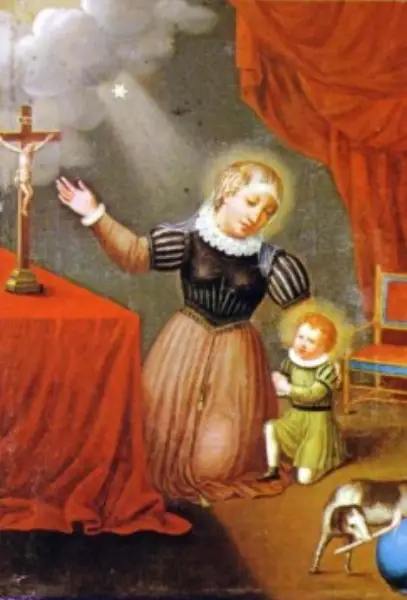
Joan of Aza is venerated in the Roman Catholic Church as the mother of Saint Dominic. Her cult was confirmed by Pope Leo XII on 1 October 1828 in Rome — the form of beatification by which the Holy See ratifies an ancient and continuous devotion — and her feast is kept on 4 August. The iconography assembled in her honor gathers the symbols of her story: she is shown with a halo, often wearing a crown or tiara as a noblewoman, holding a book, and accompanied by her two celebrated sons, Saint Dominic and Blessed Mannes, most often depicted as young boys at her side. The dog with the torch in its mouth — the emblem drawn from her dream — belongs to her imagery as well, and she is sometimes shown resting on a chair in the manner of a matriarch of the Guzman house. In the calendar of the Dominican order she stands among the beatified whose cult arose from the family and friars who remembered them, a mother honored not for writings or foundations of her own but for the sons she raised and the prayer that raised them.
§ Introduction
Mother of the Order of Preachers
Joan's legacy is inseparable from that of her sons. Dominic went on to found the Order of Preachers, one of the great evangelizing and intellectual families of the Church, and Blessed Mannes de Guzman, whose cause is joined to hers in her iconography, became one of the early lights of the Dominican friars. The story of the mother's dream entered the order's tradition at its very source — Jordan of Saxony's Libellus on the beginnings of the Order — and it fixed for centuries the image of Dominic as the torch-bearer whose preaching set the world aflame. Later hagiographers, from Pedro Ferrando to Rodrigo de Cerrato, added the names and social identities that tradition still uses: Juana of Aza, Felix of the Guzmans, the honored and wealthy household of Caleruega. Modern scholarship, catalogued in dictionaries of saints and in the Dominican Province of Saint Joseph's own histories, keeps a careful distinction between the documented mother — attested by Jordan and the thirteenth-century sources — and the elaborations of later devotion. Yet the Church has beatified her, and the order honors her as the woman whose prayer at Silos, in the tradition's own words, obtained for it its founder.
§ Legend
Timeline
- 1135
Is born at Haza, in Castile, according to the final form of the hagiographical tradition
§ Introduction
- 4 Aug 1205
Dies at Caleruega, the birthplace of her son Dominic, at about seventy years of age
§ Introduction
- 1 Oct 1828
Has her cultus confirmed by Pope Leo XII in Rome, and is beatified
§ Introduction
In Their Own Words
vir venerabilis et dives in populo suo
The Record
- Symbols
- halo, depicted with her sons Dominic and Mannes as boys·dog carrying a torch in its mouth·crown or tiara·book
- Canonization
- Beatified by Pope Leo XII on 1 October 1828 (confirmation of cultus) in Rome
Prayer
Bibliography
Show 6 sources
- "History of St. Dominic". The Dominican Province of St. Joseph.
- Jordan of Saxony, Libellus de principiis 4.
- Pedro Ferrando, Legenda Sancti Dominici 4.
- Rodrigo de Cerrato, Vita S. Dominici.
- Walsh, Michael J., "Joan of Aza", A New Dictionary of Saints, Liturgical Press, 2007. ISBN 9780814631867.
- Butler, Alban, and Burns, Paul, "Blessed Joan of Aza", Lives of the Saints, A&C Black, 1998. ISBN 9780860122579.
Profile text adapted from the Wikipedia article, licensed CC BY-SA 4.0.
Pray with this saint every day
Save Blessed Joan of Aza to your favorites, read the full profile, and get feast-day reminders in the Saints app.
Get the Saints AppFree on the App Store for iPhone and iPad