
1891 – 1904·Feast 22 January
Bl. Laura Vicuña
Chilean child who offered her life for her mother
Overview
Laura del Carmen Vicuña Pino, who lived only from 1891 to 1904, was a Chilean child remembered for extraordinary religious devotion and for the heroic offering of her short life. Born in Santiago into an aristocratic family driven from the capital by revolution, she lost her father young and was taken by her mother, Mercedes Pino, across the Andes to the Argentine province of Neuquén. To pay for Laura's schooling at the school of the Daughters of Mary Help of Christians, her mother entered into a demeaning liaison with Manuel Mora, the owner of the hostel where she worked; Mora's violence fell on mother and daughters alike. At school Laura grew into a fervent pupil of the faith, praying daily before the Blessed Sacrament for her mother's conversion. Remembering Christ's words that no one has greater love than to lay down life for one's friends, and with her bishop's authorization, she offered her life to God for her mother's salvation. Weakened by pulmonary tuberculosis and by a final beating from Mora, she died on 22 January 1904, aged twelve, after securing her mother's promise of repentance. Pope John Paul II beatified her in 1988.
The Complete Life
Flight from Santiago
Laura del Carmen Vicuña was born on 5 April 1891 in Santiago, the Chilean capital, into a family of the Chilean aristocracy. Her father, José Domingo Vicuña, served in the military, while her mother, Mercedes Pino, kept the home. The security of that world collapsed when revolution forced the family out of Santiago: they sought refuge in Temuco, in the south of the country, and there, soon afterwards, José Domingo died suddenly. Widowed and threatened, Mercedes took her two daughters and left Chile altogether, crossing the Andes into Argentina. The move severed the children from their native land and their extended family, and it placed the household's survival entirely on the shoulders of a single mother in a foreign province. Laura's childhood was thus marked from the beginning by upheaval, loss and displacement — circumstances that made her later attachment to the faith and her sensitivity to the sufferings of her mother all the more striking. In the Argentine borderlands of Neuquén, far from the aristocratic comforts of Santiago, the rest of her brief life would unfold.
§ Escape from Chile
A Pupil of the Daughters of Mary Help of Christians
In the Argentine province of Neuquén, Mercedes sought a way to educate her daughters and took work at the Quilquihué Hostel. The hostel's owner, Manuel Mora, propositioned her, offering to pay for Laura's education in exchange — the beginning of an arrangement that would poison the family's life. Laura entered the school of the Hijas de Maria Auxiliadora, the Daughters of Mary Help of Christians, and there, under the care of the nuns, the girl's interest in the Catholic faith deepened into ardent devotion. Her classmates did not share it and took a dislike to her for it; Laura responded not by softening her faith but by spending her free hours in prayer before the Blessed Sacrament in the school chapel. Two intentions dominated her prayer: her mother's salvation, and her mother's liberation from Manuel Mora, for whom she begged God's mercy every day. She had one close friend, Mercedes Vera, in whose confidence she placed her longing for religious life. Even as a schoolgirl, then, her inner life had taken the shape it would keep: love of the Eucharist, intercession for a troubled parent, and a longing to give herself wholly to God.
§ Early years in Argentina
Violence Endured, Faith Unbroken
The conflict at home reached into Laura's own body. During one of her school vacations Manuel Mora beat her twice, demanding that she abandon her intention of becoming a nun. She would not. When Mora retaliated further by cutting off the payments that funded her education, the nuns of her school, once they learned of the struggle, gave Laura and her sister scholarships, so that the vocation the abuser sought to strangle was preserved by the charity of the community. Laura remained grateful to her teachers, but her mind was fixed on a greater worry: her mother's situation, bound as it was to Mora by the bargain over schooling. She had absorbed the Salesian spirit of her Educators — cheerful endurance, devotion to Mary Help of Christians, daily prayer — and from it she drew a resolve beyond her years. Remembering the Lord's teaching that the greatest love of all is to lay down one's life for those dear to him, she resolved, with the authorization of her bishop, to offer her own life to God in exchange for her mother's salvation. It was the decision of a child, made with the gravity of a saint.
§ Problems at her home
The Offering Completed
Laura's health failed as her offering took effect. She became seriously ill with pulmonary tuberculosis, and in her weakness Mora assaulted her yet again — a beating that hastened her decline. Before the end, she gathered her mother to her side and told her plainly that she had asked the Lord to accept her life in exchange for Mercedes' salvation, begging for the joy of seeing her repent before the end came. Mercedes, weeping, swore before God that she would do whatever her daughter asked. Laura smiled her thanks to Jesus and to Mary, bade her mother farewell, and said that now she could die content. On 22 January 1904 she died in Junín de los Andes, destroyed by disease and by the abuse she had endured, having given her life for her mother's conversion. Her body rested from 1937 to 1958 in the Neuquén graveyard and was then moved to Bahía Blanca. Later scholarship, following Ciro Brugna and Bernhard Maier, has suggested revisions to the traditional account — that her parents never married, that her father outlived the family's flight to Argentina, and that her offering was made for both parents.
§ The sacrifice
From Viedma to Saint Peter's Square
Laura's cause was begun by her own congregation. The Salesian Sisters of Don Bosco started the process in the 1950s, entrusting the work to Sister Cecilia Genghini, who spent years gathering information about Laura's life but died in the very year the process opened. Encouragement came from the beatification of Dominic Savio on 5 March 1950 and the canonization of Maria Goretti on 24 June 1950, which showed that the young could be raised to the altars. The cause advanced in the city of Viedma, though observers doubted: Laura could not be reckoned a martyr, and her extreme youth seemed to leave little hope. The application was completed in 1981. The requisite miracle concerned Sister Ofelia del Carmen Lobos Arellano, whom doctors diagnosed in August 1955 with fatal lung cancer; after she confidently invoked Laura's prayers, the disease vanished. Laura was declared Venerable on 5 June 1986, and on 3 September 1988 Pope John Paul II beatified her in Saint Peter's Square. The 2004 Roman Martyrology lists her under 22 January, recording the oblation of her life for her mother's conversion.
§ Beatification process
Shrines in the Andes and Beyond
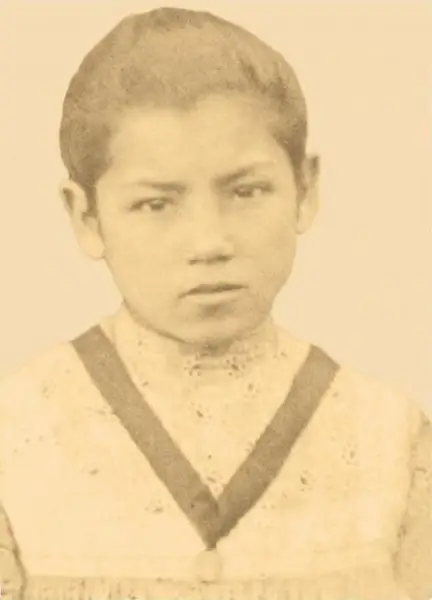
Devotion to Laura Vicuña took root in the landscapes of her life. Her primary shrine stands on Renca Hill, a park of thirty hectares between the communes of Quilicura and Renca in Santiago, where the chapel holds a hundred worshippers. At Junín de los Andes, the town of her death, a shrine dedicated to her memory was inaugurated on 9 December 1999. In the village of El Durazno, near Combarbalá in the Coquimbo Region, where she passed part of her early childhood, local families each contributed two hundred adobe blocks to build a small sanctuary. Her memory travelled across the Pacific as well: statues and memorials honour her in the Philippines, at Makati, Parañaque and Canlubang, and the Laura Vicuña Women Development and Training Center in Victorias City, Negros Occidental, run by the Daughters of Mary Help of Christians, bears her name. Her face itself was recovered for devotion: long known only through a portrait painted by the Italian artist Caffaro Rore from her sister Julia's descriptions, she was shown in a discovered school photograph to have been a serious-looking mestizo child, and church depictions have since been corrected accordingly.
§ Shrine
Timeline
- 5 Apr 1891
Born in Santiago, Chile, to José Domingo Vicuña and Mercedes Pino.
§ Escape from Chile
- 22 Jan 1904
Died in Junín de los Andes, Argentina, of tuberculosis hastened by abuse, having offered her life for her mother's salvation.
§ The sacrifice
- 1937
Her remains were laid in the Neuquén graveyard, where they rested until 1958.
§ The sacrifice
- Aug 1955
Sister Ofelia del Carmen Lobos Arellano, told she was dying of lung cancer, was cured after invoking Laura's prayers — the miracle for her beatification.
§ Beatification process
- 1981
The Salesian Sisters completed the application process for Laura's beatification.
§ Beatification process
- 5 Jun 1986
Declared Venerable in recognition of her heroic virtue.
§ Beatification process
- 3 Sep 1988
Beatified by Pope John Paul II in Saint Peter's Square.
§ Beatification process
- 9 Dec 1999
A shrine in her memory was inaugurated at Junín de los Andes.
§ Shrine
In Their Own Words
Suffer silently and Smile always
Born in the city of Santiago, Chile, and a pupil of the Institute of Mary Help of Christians; for the conversion of her mother, she made an oblation of her life to God at the age of 13
The Record
- Patron of
- abuse victims
- Symbols
- depicted as a serious-looking mestizo child after the discovery of her school photograph
- Canonization
- Beatified 3 September 1988 by Pope John Paul II in Saint Peter's Square; not yet canonized
Prayer
Bibliography
Show 6 sources
- Martyrologium Romanum, 2004, Vatican Press (Typis Vaticanis), page 112.
- Maier, Bernhard. Laura del Carmen Vicuña. Kleine Heldin und Heilige. Einige Ergebnisse der neueren Lauraforschung. Hollabrunn: Verlag MBC, 2004; 2018, 2nd ed. ISBN 3-9500764-4-1.
- Lappin, Peter. The Falcon and the Dove. The story of Laura Vicuña. New York, Don Bosco Publications 1984; 1985. ISBN 0899440673, 9780899440675.
- Brugna, Ciro. Aportes para el conocimiento de Laura Vicuña. Buenos Aires, Instituto Salesiano de Artes Gráficas, 1990.
- Heinlein, Michael R., "Blessed Laura Vicuña A patroness for abuse victims", Our Sunday Visitor, February 7, 2017.
- Giovanni Paolo II, Omelia di Beatificazione di Laura Vicuña, Colle Don Bosco (Torino) il 3 settembre 1988.
Profile text adapted from the Wikipedia article, licensed CC BY-SA 4.0.
Pray with this saint every day
Save Bl. Laura Vicuña to your favorites, read the full profile, and get feast-day reminders in the Saints app.
Get the Saints AppFree on the App Store for iPhone and iPad