
first century (c. 18 BC - after c. AD 33)·Feast August 15 (Assumption)
Blessed Virgin Mary
Mother of God, Ever-Virgin
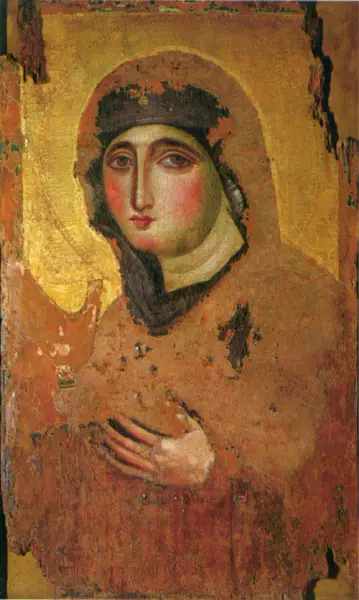
Overview
Mary of Nazareth was a first-century Jewish woman, married to Joseph of the line of David, when — according to Matthew and Luke — the angel Gabriel announced that she would conceive a son through the Holy Spirit. Her answer, 'let it be done to me according to your word,' and the song of praise Luke records as the Magnificat have framed Christian prayer ever since. She gave birth at Bethlehem, presented her child in the Temple at Jerusalem, fled with him to Egypt under Herod's threat, and raised him at Nazareth; the twelve-year-old disputing among the teachers in the Temple is the only Gospel glimpse of his youth. At a wedding in Cana, it was at her prompting that Jesus gave the first sign of his ministry, water made wine. She stood near the cross at the crucifixion, and after the Ascension was named among those praying with the apostles in the upper room (Acts 1:14). Scripture records nothing of her end; Catholic and Orthodox tradition confess her bodily Assumption, called the Dormition in the East. She is often counted the holiest and greatest of the saints, is venerated across the Christian traditions, and holds the highest place among women in Islam, which devotes a surah of the Quran to her.
The Complete Life
Early Life
Mary of Nazareth was a Jewish woman of Galilee in the first century, married to Joseph, a craftsman of the town, and known to history through the event that made her the subject of more writing, art, and devotion than any other human being. The New Testament, nearly contemporary with her and the fullest historical source, says little of her origins: no birthplace, no parents, no age. The earliest reference, Paul's letter to the Galatians, names her only indirectly: the Son sent by God came from a woman, under the law. Luke's infancy narrative gives her a home in Nazareth, a kinswoman Elizabeth of priestly family, and the annunciation of the angel, the scene that fixed her identity in Christian memory: the handmaid of the Lord who consented. Matthew adds the flight into Egypt and the threatened child. The later apocryphal gospels filled the silence with names, Anne and Joachim, a temple childhood, a girlhood of vowed virginity, pious constructions the church received as legend rather than history. The woman behind all of it was a poor Galilean, Aramaic-speaking, observant of the law, who would have counted for nothing in the records of her age.
§ External links
Mission and Ministry
Mary's mission in the Gospels is entirely relative to her Son. She carries him, bears him, presents him in the Temple, loses him and finds him among the teachers, and then recedes: at Cana she prompts the first sign, at the cross she stands, in the upper room after the ascension she prays with the apostles, and there the New Testament leaves her. Each of the scenes became a foundation in later theology: Cana for her intercession and for the word Woman, the cross for her motherhood of the beloved disciple and so of the church, the upper room for her presence at the church's birth. Her adult son treats her with a distance the evangelists do not soften, and she appears in his ministry chiefly as a questioner and a listener, the woman who heard the word of God and kept it, his own answer to the woman who blessed his mother's womb. The church that grew from those apostles remembered her as the first believer and kept her memory in its liturgy from the earliest recoverable layers.
§ New Testament
Spirituality and Teaching
Mary left no teaching, and all Marian spirituality is the church's meditation on the attitudes the Gospels record. The Magnificat, the song Luke gives her at the encounter with Elizabeth, is the great text: a young woman's thunderous prophecy that God has put down the mighty and exalted the lowly, words that have made her, in every century since, the mother of the poor and the patroness of revolutions pious and impious. Her other recorded words are few and practical, the instruction at Cana to do whatever he tells you, the treasuring of things in her heart, the obedience at the annunciation. From these fragments the tradition built the whole edifice of Marian spirituality: her faith as the model of the church's, her silence as contemplative, her sorrow at the cross as compassion, her yes as the hinge of redemption. The doctrine that grew from the reflection, virginity in birth, her freedom from sin, her assumption, is the church's attempt to state what it found already present in her memory.
§ New Testament
Trial and Final Years
The New Testament records nothing of Mary's death. She appears last in the first chapter of Acts, among those devoted to prayer in the upper room, and the apostolic generation that wrote the remaining books of the canon mentions her no more. The traditions of her end come from the second and third centuries: the accounts of her dormition and assumption, which tell of her falling asleep at Jerusalem, of the apostles gathered, of Christ receiving her soul, and, in some versions, of her body taken to heaven. The traditions located her house at Ephesus in another strand, connected with the tradition that John, to whose care she was committed, ended his life there. The silence of scripture and the richness of the traditions produced the one doctrine the churches still divide over, her bodily assumption, defined as Catholic dogma in 1950 and honored in the East for fifteen centuries before that as the dormition.
§ External links
Canonization
Mary, being the mother of the Lord, is not a canonized saint but the queen of all the saints, and her cult precedes and outranks every process of canonization the church has devised. The earliest Christian prayer outside the New Testament, the Sub tuum praesidium of the third century, addresses her as the Mother of God, the title the Council of Ephesus in 431 defined against Nestorius and that made her dogmatic standing part of christology itself. The eastern churches built the cycle of her feasts through the byzantine centuries, and the western calendar followed, the Assumption on 15 August becoming the greatest feast of the medieval year. In 1854 Pius IX defined her Immaculate Conception, and in 1950 Pius XII defined her Assumption, the two exercises of papal definition that state her place in Catholic doctrine. Protestant churches, while rejecting much of this development, have continued to honor her as the mother of the Lord, and the Koran names her more often than the New Testament does, so that she stands at the meeting point of three religions.
§ Christian
Legacy
No human being has shaped civilization so widely. The greatest churches of Christendom are hers, from Santa Maria Maggiore to the cathedrals of the Marian ages, and the largest pilgrimage movements on earth still move toward her shrines, Guadalupe, Lourdes, Fatima, Czestochowa, each with its tradition of apparition and its millions of pilgrims. Half the music of the Renaissance and a great portion of all Christian art exists to depict her, from the mosaics of Ravenna to the Pietas of Michelangelo. Theology has argued about her in every age, Protestant suspicion of the Marian cult, Catholic definitions of her privileges, Orthodox devotion to the Theotokos, and in every age her figure has returned as a resource of the poor and the threatened, the woman of the Magnificat invoked in contexts her devotees never imagined. The historical Mary of Nazareth, a Galilean peasant whose consent changed the world, stands behind and beneath the whole immense structure, and the persistence of that simple figure at the center of the most developed devotional tradition in history is the deepest fact of her legacy.
§ External links
Timeline
- -18
Her birth is placed around 18 BC, inferred from the consensus dating of Jesus' birth near 4 BC
§ Introduction
- -4
After King Herod dies, the family returns from Egypt and settles in Nazareth
§ Birth of Jesus
- 41
Hippolytus of Thebes records that she died about eleven years after her son
§ Apocryphal accounts and later writings
- 250
The oldest known prayer to Mary, Sub tuum praesidium, is already in circulation by this date
§ Catholic
- 431
The Council of Ephesus formally grants her the title Theotokos, Mother of God
§ Catholic
- 456
The Church of the Seat of Mary rises in Judea, built by the widow Ikelia
§ History
- 553
The Second Council of Constantinople affirms her perpetual virginity
§ Catholic
- 1531
An image of Our Lady of Guadalupe is imprinted on Juan Diego's tilma during an apparition
§ Clothes
- 1571
The Feast of Our Lady of Victory is grounded in the Papal States' triumph at the Battle of Lepanto
§ Feasts
- 1854
Pope Pius IX proclaims the Immaculate Conception of Mary as Catholic dogma
§ Catholic
- 1917
The text of Sub tuum praesidium comes to light again on a papyrus found in Egypt
§ History
- 1950
Pope Pius XII defines her bodily Assumption into heaven as Catholic dogma
§ Catholic
In Their Own Words
Behold, I am the handmaid of the Lord; let it be to me according to your word.
My soul doth magnify the Lord... and my spirit hath rejoiced in God my Saviour.
Do whatever he tells you.
The Record
- Symbols
- Blue mantle·Lily·Crown (invoked under many titles of the Litany of Loreto)·Icon of the Madonna del Rosario in Rome
- Canonization
- Venerated since the earliest centuries of Christianity; the Assumption was defined as Catholic dogma in 1950
Prayer
Bibliography
Show 11 sources
- ↑ Per the Jewish customs surrounding marriage at the time, Mary, at the time of her betrothal to Joseph, was 12–16 years old. [ 1 ] [ 2 ] [ 3 ] [ 4 ] [ 5 ] Her year of birth is therefore contingent on that of Jesus , and, though some posit
- ↑ The Protoevangelium of James presents Mary’s parents as Joachim and Anne, but this claim is generally rejected in contemporary scholarship. [ 10 ]
- ↑ Hebrew : מִרְיָם , romanized : Mīryām ; Classical Syriac : ܡܪܝܡ , romanized: Maryam ; Arabic : مريم , romanized : Maryam ; Ancient Greek : Μαρία , romanized : María ; Latin : Maria ; Coptic : Ⲙⲁⲣⲓⲁ , romanized: Maria
- ↑ Ancient Greek : παρθένος , romanized : "parthénos" ; Matthew 1:23 [ 17 ] uses the Greek parthénos , "virgin", whereas only the Hebrew of Isaiah 7:14, [ 18 ] from which the New Testament ostensibly quotes, as Almah – "young maiden". See ar
- ↑ See Sabine R. Huebner 's succinct analysis of the issue: "Jesus is described as the 'first-born son' of Mary in Mt 1:25 and Lk 2:7. From this wording alone we can conclude that there were later-born sons ... The family ... had at least fi
- ↑ To give a few examples, Our Lady of Good Counsel , Our Lady of Navigators , and Our Lady Undoer of Knots fit this description. [ 46 ] [ 47 ] [ 48 ] [ 49 ]
- ↑ This event is described by some Christians as the Annunciation.
- ↑ The historicity of this census' relationship to the birth of Jesus continues to be one of scholarly disagreement; see, for example, p. 71 in Edwards, James R. (2015). [ 86 ]
- ↑ Includes the Catholic Church , Eastern Orthodox Church , Oriental Orthodox churches , Anglican Communion , Lutheran Churches
- ↑ Alternately: "It cannot even be denied that God conferred the highest honour on Mary, by choosing and appointing her to be the mother of his Son." [ 191 ] [ 192 ]
- ↑ See the following verses: 5:114 , 5:116 , 7:158 , 9:31 , 17:57 , 17:104 , 18:102 , 19:16 , 19:17 , 19:18 , 19:20 , 19:22 , 19:24 , 19:27 , 19:28 , 19:29 , 19:34 , 21:26 , 21:91 , 21:101 , 23:50 , 25:17 , 33:7 , 39:45 , 43:57 , 43:61 , 57:
Profile text adapted from the Wikipedia article, licensed CC BY-SA 4.0.
Pray with this saint every day
Save Blessed Virgin Mary to your favorites, read the full profile, and get feast-day reminders in the Saints app.
Get the Saints AppFree on the App Store for iPhone and iPad