
1550 – 1583·Feast February 4
Bl. Rodolfo Acquaviva
Jesuit missionary at the court of Akbar
Overview
Rodolfo Acquaviva was an Italian Jesuit priest and missionary in India, remembered as one of the five martyrs of Cuncolim. Born on 2 October 1550 at Atri in the Abruzzo, he was the son of Giangirolamo Acquaviva, tenth Duke of Atri, and a cousin of Aloysius Gonzaga on his mother's side. Inspired in April 1568 by his uncle Claudio Acquaviva, later the fifth General of the Society of Jesus, he entered the Jesuits as a novice at Sant'Andrea al Quirinale in Rome alongside Stanislas Kostka. Chosen for the Indian missions begun by Francis Xavier in Goa, he was ordained in Lisbon and sailed for India in 1578. After teaching at Saint Paul's College in Goa, he was appointed leader of the mission requested by the emperor Akbar to his court, where from 1580 to 1583 he took part in the religious debates of the Ibadat Khana at Fatehpur Sikri. Finding the emperor's interest oriented toward a synthetic faith and his efforts fruitless, he withdrew after three years, though Jesuits maintained the Mughal mission for two more centuries. Returning to Goa, he led a mission to the Hindu Kshatriyas of Salcette, whose incitement helped spark the Cuncolim Revolt of July 1583. There, on 25 July 1583, his throat was cut as he knelt in prayer. In 1893 Pope Leo XIII beatified him together with the four Jesuits who died beside him.
The Complete Life
A Duke's Son of Atri
Rodolfo Acquaviva was born on 2 October 1550 at Atri in the Abruzzo, heir to one of the most illustrious houses of southern Italy. His father, Giangirolamo Acquaviva, was the tenth Duke of Atri, and the family traced its presence in the Kingdom of Naples to the twelfth century, claiming Germanic origin and numbering among its forebears Andrea Matteo Acquaviva, the condottiere and man of letters who was Rodolfo's great-grandfather. His mother, Marguerite Pio, connected him by blood to another celebrated religious figure: through her he was a cousin of Aloysius Gonzaga, the Jesuit saint of the next generation. The world into which Rodolfo was born offered him nobility, letters, and influence, but a stronger pull came from within the family itself. His uncle Claudio Acquaviva would rise to lead the Society of Jesus as its fifth General, and the example of that vocation marked the direction the young nobleman's life would take, turning the ambitions of a great house toward the missions of the Church. In the Neapolitan nobility to which he belonged, careers at court and in the Church stood side by side, and the house of Acquaviva had long supplied both.
§ Family
Novice in Rome, Priest in Lisbon
In April 1568, moved by the example of his uncle Claudio, Rodolfo entered the Society of Jesus. He became a novice at Sant'Andrea al Quirinale in Rome, where he lived alongside Stanislas Kostka, one of the order's young saints in the making. After completing his studies he was singled out by his superiors for one of the Society's most prestigious and demanding assignments: the Asian mission field that Francis Xavier had opened in Portuguese Goa. The road to India ran through Lisbon, the port from which the eastern voyages departed, and there Rodolfo was ordained a priest before sailing in 1578. His formation thus joined the highest aristocratic culture of Naples to the rigorous discipline of the Jesuits and the hard practical schooling of the sea voyage to Asia. By the time he reached Goa he was equipped, as the following years would show, with languages, theology, and the composure needed to stand before princes — gifts that would soon be tested at the most glittering court in the East. Sharing the noviceship with Stanislas Kostka gave his first months in the Society a place beside one of its youngest and best-remembered saints.
§ Priesthood
Before the Great Mughal
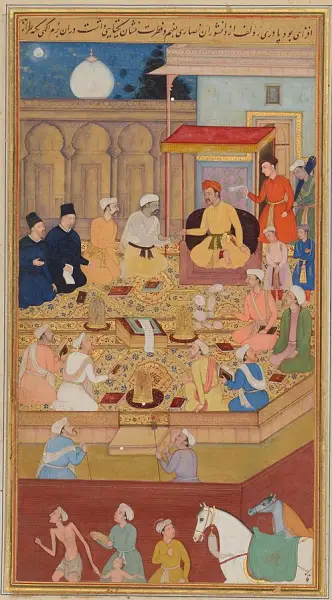
Acquaviva first taught at Saint Paul's College in Goa, but he was soon assigned to lead a mission unlike any other in Asia. The emperor Akbar had himself requested missionaries, and the Jesuits were sent to his court. In his new palace at Fatehpur Sikri, Akbar had built the Ibadat Khana — the House of Worship — to which he called teachers of Islam, Hinduism, and the other faiths of his empire to contend over the truths of religion. There Acquaviva, with his fellow Jesuit António de Monserrate and their young Persian-speaking translator Francisco Henriques, argued the Christian cause before the most powerful ruler in India. Akbar treated the Jesuit with sympathetic personal attention, yet the emperor's curiosity served another design: he hoped to create a pantheistic creed of his own, assembled out of many traditions — the Din-i-Ilahi, the Faith of the Divine. Acquaviva came supplied with the Bible translated into many languages, though not yet Persian. The mission, in his own estimate, bore no fruit — the emperor's dislike of monogamy stood squarely in the way — and once three years had passed Robert chose to leave. Other Jesuits, however, maintained the mission at the Mughal courts and at Agra for the next two centuries.
§ At Akbar's Court
Martyrdom at Cuncolim
On his return to Goa, in keeping with his missionary commitments, Acquaviva took up a different field: a mission to the Hindu Kshatriyas of Salcette, south of Goa itself. This work was seen by the local population as a provocation, and resentment against the missionaries mounted until it broke out in the Cuncolim Revolt of July 1583. In the outbreak that followed, Acquaviva and four brother Jesuits were slain on 25 July 1583. A seventeenth-century painting in a church at Colva depicts the massacre of the five Jesuits, with Acquaviva at the center, uncovering his neck to his killers. One detail of his end fixed it in the order's memory: his throat was cut while he was at prayer to God. He was thirty-two years old, an aristocrat who had debated with an emperor and died among villagers whose trust his presence had failed to win. The five Jesuits of Cuncolim were remembered together as martyrs of the Indian missions, their story passed down in Jesuit houses and in the churches of Goa. The revolt that ended his life grew from the same friction between mission and local society that shadowed the whole Portuguese enterprise in India.
§ Martyrdom
Beatified by Leo XIII
The Church's recognition of Acquaviva and his companions came three centuries after their deaths. In 1893 Pope Leo XIII beatified Acquaviva together with his four Jesuit companions, the martyrs of Cuncolim, confirming a devotion that had endured in the Society of Jesus and in Portuguese India since 1583. The order keeps his commemoration on 4 February, when he is remembered with the Jesuit martyrs of the missions, and the Jesuit Institute's liturgical calendar preserves this observance for the order and its institutions. The delay between martyrdom and beatification did nothing to dim the figure's attraction: the young noble who debated at Akbar's Ibadat Khana and died at prayer in Salcette remained one of the most vivid of the early modern Jesuit missionaries, illustrated in the Akbarnama of his own era and painted in the churches of Goa. As a beatus of the Roman Catholic Church he stands among the first witnesses of the Church in northern India, remembered both for the intellectual daring of the Mughal mission and for the blood in which it was later sealed. With the martyrs of Cuncolim he shares his place among the blessed of the Society of Jesus, named in its calendars with the missionaries who died abroad.
§ Beatification
Timeline
- 2 Oct 1550
Born at Atri in the Abruzzo, son of Giangirolamo Acquaviva, tenth Duke of Atri.
§ Family
- Apr 1568
Entered the Society of Jesus as a novice at Sant'Andrea al Quirinale in Rome, inspired by his uncle Claudio Acquaviva.
§ Priesthood
- 1578
Ordained a priest at Lisbon and sailed from there for the mission fields of India.
§ Priesthood
- 1580
Assigned as leader of the Jesuit mission to the court of the Mughal emperor Akbar, serving there until 1583.
§ At Akbar's Court
- 25 Jul 1583
Killed at Cuncolim in Goa during the Cuncolim Revolt, his throat cut while he was praying.
§ Martyrdom
- 1893
Beatified with his four Jesuit companions by Pope Leo XIII.
§ Beatification
The Record
- Major works
- Jesuit mission to the court of Akbar (1580–1583)·Mission to the Kshatriyas of Salcette
- Canonization
- Beatified in 1893 by Pope Leo XIII
Prayer
Bibliography
Show 8 sources
- "Blessed Rodolfo Acquaviva | The Society of Jesus". www.jesuits.global. June 2020. Retrieved 6 February 2021.
- "Acquaviva - Famiglia napoletana, che ricorda come suo capostipite Rinaldo d'A., il quale ebbe feudi da Enrico VI di Svevia nella regione teramana (1195)." Dizionario Biografico degli Italiani
- D'Souza, Anthony. "Martyrs of Cuncolim." The Catholic Encyclopedia Vol. 4. New York: Robert Appleton Company, 1908.
- Gordon, Nickel. "Rodolfo Acquaviva". ReferenceWorks
- "The Jesuit Institute - Jesuit Liturgical Calendar".
- Daniello Bartoli, Missione al Gran Mogor del p. Ridolfo Acquaviva della Compagnia di Gesu, sua vita e morte (1663)
- Sir Edward Maclagan, The Jesuits and the Great Mogul (1932)
- Youri Martini, Akbar e i Gesuiti. Missionari cristiani alla corte del Gran Moghul, Il Pozzo di Giacobbe, Trapani 2018, ISBN 978-8861246911
Profile text adapted from the Wikipedia article, licensed CC BY-SA 4.0.
Pray with this saint every day
Save Bl. Rodolfo Acquaviva to your favorites, read the full profile, and get feast-day reminders in the Saints app.
Get the Saints AppFree on the App Store for iPhone and iPad