
1897-1946·Feast March 12
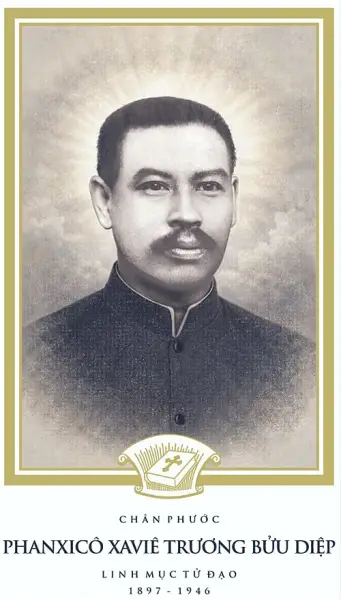
Blessed Francis Xavier Trương Bửu Diệp
Priest and Martyr
Overview
Phanxicô Xaviê Trương Bửu Diệp — Cha Diệp, 'Father Diep', as the Mekong Delta still calls him — was born on 1 January 1897 in what is now An Giang province. Schooled at the major seminary in Phnom Penh, he was ordained a priest in 1924, then taught in a local seminary and served sixteen years as pastor of Tắc Sậy parish, founding parishes in both Cambodia and Vietnam. His death came amid the chaos that followed Japan's 1945 surrender, when French rule had collapsed and armed bands contested the countryside. Two Japanese soldiers who had defected to the Cao Đài resistance leader Cao Triều Phát seized the priest; an encroacher named Cận had accused him to Phát of colluding with the French surveyors once hired to reclaim church land. The Christians of the area were shut into a barn under threat of being burned alive together; Diệp offered his own life on condition that they be spared. He was killed on 12 March 1946 and his naked, almost decapitated body thrown into a shallow pool, from which it was later drawn out and buried. Venerated by Christians and non-Christians alike, he was beatified at Tắc Sậy in 2026, the first Vietnamese martyr of the twentieth century so honoured.
The Complete Life
Early Life
Francis Xavier Truong Buu Diep came into the world on 1 January 1897, at An Giang province in the Mekong Delta of Cochinchina, into the Catholic minority of French Indochina. His family belonged to the network of old Christian villages of the south, communities descended from conversions going back to the seventeenth and eighteenth centuries, which had survived the persecutions of the Nguyen emperors and were now, under French rule, rebuilding parish life openly. Diep's childhood thus fell in a period of transition: the church was no longer illegal, but it was still poor, and the clergy were few. Gifted boys from Catholic families were recruited early for the minor seminary, and Diep's path followed that pattern. His studies took him across the colonial border, since there was no major seminary serving the region: he completed his theology at the major seminary in Phnom Penh, in Cambodia, an arrangement typical of the small and scattered church of French Indochina.
§ Introduction
Conversion and Vocation
Diep's vocation ran the ordinary course of a diocesan priest of the southern Vietnamese church, formed for a life of village ministry. He was ordained in 1924, at the age of twenty-seven. Rather than being sent to a town parish he was drawn into the work of formation and foundation: he taught for a time at a local seminary, and he devoted himself to establishing new parishes in the frontier zone where Vietnam met Cambodia, districts of recent settlement where Catholic families were scattered and unchurched. In 1930 he was appointed to Tac Say, a poor parish in Bac Lieu province deep in the Delta, and there he remained as pastor for sixteen years, the center of his priestly identity. The parish became famous simply because he stayed with it through everything that followed.
§ Biography
Mission and Ministry
At Tac Say, Diep built up a parish of the poor. The Delta's Catholics lived among Buddhists, Hoa Hao Buddhists, and Cao Dai, in a religiously crowded countryside where the church was one community among several, and where the 1930s and 1940s brought wave after wave of political upheaval. Diep's pastorate embraced the ordinary works of a Vietnamese country priest, the sacraments, catechesis, schools, and the settling of disputes, and also the defense of his people's livelihood. One episode of that defense had consequences: he engaged French land surveyors to help the parish recover land that had been encroached upon, and so earned the lasting enmity of the local boss who had taken the land, a man named Can. Such collisions between parish priests and local strongmen were common in the Delta, but this one became part of the chain of events that led to Diep's death.
§ Introduction
Trial and Final Years
Diep's death came in the chaos that followed the collapse of the Japanese occupation and the return of the French in 1945 to 1946, when anticolonial insurgency, sectarian armies, and banditry overlapped across the Delta. Two Japanese soldiers who had refused to surrender had defected to the Cao Dai resistance leader Cao Trieu Phat, whose forces had joined with the Viet Minh. Can, the boss Diep had crossed over the parish land, went to Phat and accused the priest of colluding with the French against the Cao Dai. Men of Phat's force seized Diep's Christians and imprisoned them in a barn with the intention of burning them alive. Diep offered his own life in exchange for theirs, and the offer was taken: on 12 March 1946 the two Japanese killed him, mutilating his body and throwing it into a shallow pool. His body was recovered and buried by the faithful. The date of his death, 12 March, became his feast.
§ Biography
Canonization
Diep's cause was among the most popular in modern Vietnamese Catholicism. For decades he was venerated as a martyr of charity at Tac Say, which became a major pilgrimage site drawing hundreds of thousands, including Protestants and non-Christians from the Delta. The formal process moved slowly, as Vietnamese causes do, but the beatification was celebrated on 2 July 2026 at Tac Say church in Ca Mau, with Cardinal Luis Antonio Tagle presiding on behalf of Pope Leo XIV. The rite recognized what pilgrims had long affirmed: a pastor who died offering himself for his flock. He is honored as Blessed Francis Xavier Truong Buu Diep, and the movement of devotion that preceded his beatification is itself part of his story.
§ Introduction
Legacy
Truong Buu Diep's legacy rests on a single act, the exchange of his life for his parishioners, and on the extraordinary devotion that act generated. Tac Say remains the great shrine of the southern Delta, and the annual pilgrimage on the anniversary of his death is one of the largest Catholic gatherings in Vietnam. His appeal crosses confessional lines in a region where the church is a small minority, a fact often noted by observers of Vietnamese religion. Within the Catholic community he is invoked as a model of the pastor who does not abandon his people, and his life, spanning French rule, Japanese occupation, and the first insurgencies, ties the memory of the Vietnamese church's missionary era to the sufferings of the twentieth century, distinct from the imperial persecutions but no less deadly for its clergy.
§ Introduction
Timeline
- 1 Jan 1897
Born at Long Xuyên in An Giang Province, Cochinchina, French Indochina
§ Biography
- 1924
Ordained a priest after completing his studies at the Phnom Penh Major Seminary in Cambodia
§ Biography
- 12 Mar 1946
Killed at Bạc Liêu by Japanese soldiers serving Cao Đài forces after offering his life so captive Christians could live
§ Biography
- 2012
An investigation is made to prepare for his beatification
§ Beatification
- 31 Oct 2014
The Congregation for the Doctrine of the Faith issues a nihil obstat approving his beatification process
§ Beatification
- 12 Mar 2016
The Diocese of Cần Thơ marks the 70th anniversary of his death with bishops from across Vietnam
§ Veneration
- Nov 2024
Pope Francis signs a decree of martyrdom, granting him the title of Venerable
§ Beatification
- 18 Dec 2025
The Bishop of Cần Thơ announces that the Holy See has confirmed his beatification
§ Beatification
- 2 Jul 2026
Beatified at Tắc Sậy Church in Cà Mau by Cardinal Luis Antonio Tagle on behalf of Pope Leo XIV
§ Introduction
The Record
- Symbols
- Priest's stole·Palm of martyrdom
- Canonization
- Nihil obstat from the Congregation for the Doctrine of the Faith, 31 October 2014; decree of martyrdom signed by Pope Francis, November 2024; beatified 2 July 2026 at Tắc Sậy by Cardinal Luis Antonio Tagle on behalf of Pope Leo XIV
Bibliography
Show 1 sources
- ↑ Mistakenly called "Cao Trường Phát" by two interviewed witnesses [ 5 ]
Profile text adapted from the Wikipedia article, licensed CC BY-SA 4.0.
Pray with this saint every day
Save Blessed Francis Xavier Trương Bửu Diệp to your favorites, read the full profile, and get feast-day reminders in the Saints app.
Get the Saints AppFree on the App Store for iPhone and iPad