
killed 1939-1945·Feast June 12
The 108 Martyrs of World War II
Blessed Polish Martyrs of the Second World War
Overview
These 108 Catholic martyrs, Poles put to death by the German Nazi regime during the Second World War, were beatified together by John Paul II in Warsaw on 13 June 1999 and are given liturgical honor on 12 June. The company spans the whole Polish church: three bishops — Antoni Julian Nowowiejski, Leon Wetmański, and Władysław Goral — seventy-nine priests, seven male religious, eight women religious, and eleven laypeople. They died across the camp system of the Third Reich: Dachau above all, where so many Polish clergy were herded together, but also Auschwitz, Sachsenhausen, Mauthausen, Stutthof, and Soldau, and in shootings and burnings in occupied Poland and Belarus. Among them are religious of nearly every family — Capuchins, Franciscans, Dominicans, Salesians, Oblates, Pallottines, Marians, and the Conventual Franciscans of Maximilian Kolbe's Niepokalanów, the saint's own closest collaborators. The Marian Fathers Antoni Leszczewicz and Jerzy Kaszyra were burned to death at Rosica in Belarus; others were beaten, gassed, shot, or worked to exhaustion. Two Polish parishes, at Powiercie in Koło County and at Malbork, bear their name. They stand for the thousands of Polish clergy and laity who died for the faith between 1939 and 1945.
The Complete Life
Early Life
The one hundred and eight men and women remembered as the Martyrs of World War II were Polish Catholics killed by the German Nazi regime between 1939 and 1945. They were not a community forged before the war but a company assembled by death: bishops, diocesan priests, members of religious congregations, sisters, and lay faithful whose only common bond was Poland and the faith their occupiers had set out to break. Three of them were bishops — Antoni Julian Nowowiejski and his auxiliary Leon Wetmański, both dead in the Soldau camp, and Władysław Goral, who perished at Sachsenhausen. The great majority, seventy-nine, were diocesan priests, men who had spent peaceful decades as parish clergy, professors, deans and confessors before the invasion scattered them into cells and cattle trucks. Seven were male religious and eight women religious — Capuchins, Franciscans, Carmelites, Salesians, Pallottines, Missionary Oblates, Dominicans and others. Eleven were lay people, whose witness came without title or office. Most were born in the last decades of the nineteenth century or the first of the twentieth; the youngest were in their late twenties when the war began, the oldest, Bishop Nowowiejski, was past eighty.
Mission and Ministry
The ministry of these martyrs was, in almost every case, the ordinary work of the Church carried on under extraordinary pressure. Priests continued to say Mass, hear confessions and teach after such acts had been criminalised; sisters nursed the sick and hid the vulnerable; lay members kept parishes alive when their pastors had been seized. Several names stand for the range of their labours. Józef Cebula, a Missionary Oblate, had rebuilt his congregation's Polish province as its provincial and secretly baptised and celebrated the sacraments after his arrest warrant was issued. Anicet Kopliński, a Warsaw Capuchin known for his kindness to the poor of the capital, continued to serve them in the occupied city. Marian Skrzypczak and Antoni Beszta-Borowski were country priests, deans and pastors of rural deaneries. Józef Kowalski was a young Salesian youth worker; Jan Franciszek Czartoryski a Dominican of aristocratic birth who served as chaplain; Hilary Paweł Januszewski a Carmelite prior who volunteered for care of the dying at Dachau. Whatever their office, the Nazi occupation made their ministry itself an act of resistance.
Spirituality and Teaching
The camps became the place where the group's spirituality was written, largely without words. At Dachau, where the largest number of them died, priests were forbidden the sacraments and yet passed consolation from bunk to bunk. Survivors recorded small acts that carried the whole tradition: Franciszek Drzewiecki, condemned to heavy labour in the plantation, would bend over the soil as if in adoration of the consecrated hosts he kept hidden in a small box before him, and on his way to the gas chamber told his companions that they were offering their lives for God, for the Church and for their country. Others said rosaries on string, heard last confessions in whispers, and shared bread as the Eucharist's pale echo. Their teaching is not in books but in this: that the priesthood is not a privilege to be defended but a gift to be spent, and that the Mass is worth a man's whole life. The Marian Fathers Antoni Leszczewicz and Jerzy Kaszyra, who chose to stay and burn with their people at Rosica in Belarus, expressed the same conviction in fire.
Trial and Final Years
Their trials were brief or nonexistent; their deaths stretched across the whole map of the camps. Bronisław Komorowski and Marian Gorecki were among the earliest, shot or worked to death at Stutthof in March 1940. Franciszek Rogaczewski of Gdańsk was shot in the Piaśnica massacres of 1940. The transport lists of 1942 carry the largest single group, dozens of priests killed at Dachau in the summer of that year, many by lethal injection or gas under the pretence of medical examination. Józef Jankowski was beaten to death by a kapo at Auschwitz in October 1941; Jan Antonin Bajewski and Ludwik Pius Bartosik, close collaborators of Maximilian Kolbe at Niepokalanów, died at Auschwitz in May 1941. The burnings at Rosica came in 1943, the murder of the Pallottine Józef Stanek in the ruins of Warsaw in September 1944, and Bishop Goral's death at Sachsenhausen in 1945, within weeks of liberation. Each died alone; the Church would later count them together.
Canonization
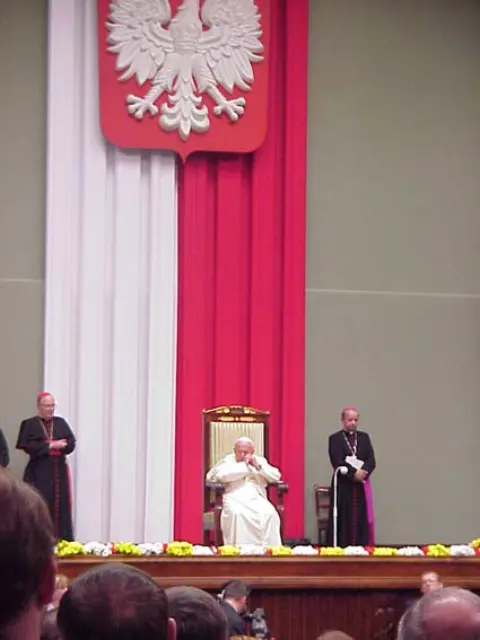
The cause of the Polish martyrs of the Second World War was introduced on behalf of the Polish episcopate, and the Positio covering the group was examined for decades before the Congregation for the Causes of Saints recognised that they had been killed in odium fidei, out of hatred for the faith. John Paul II beatified the one hundred and eight in Warsaw on 13 June 1999, during his pilgrimage to Poland, setting their liturgical memorial on 12 June. The choice of Warsaw, a city rebuilt from the wreckage in which several of them died, gave the beatification the character of a national as well as ecclesial act. The group has since given its name to parishes, including at Powiercie in Koło County and at Malbork. As blesseds they are honoured particularly by Polish communities abroad, for whom their story joins the memory of the war to the memory of the faith that outlasted it.
Legacy
The legacy of the 108 lies less in institutions than in witness. They stand for the many thousands of Polish clergy and religious whom the occupation imprisoned or killed, and their beatification made a representative sample of that sacrifice into a public, named memorial. In Polish parishes their feast of 12 June keeps the war in the liturgy not as politics but as martyrdom. Theologians and historians of the camps cite them when tracing how the sacramental life survived Dachau; popular devotion remembers individual figures — Cebula among the Oblates, Kopliński among Warsaw's poor, the Carmelite Januszewski among those who volunteered for the dying. For the universal Church they confirm a pattern seen across the twentieth century: that the age of ideological persecution produced martyrs not in single deaths but in companies, and that counting them — one hundred and eight out of thousands — is itself an act of remembrance rather than arithmetic.
Timeline
- 1939
German occupation of Poland begins; early victims include Alicja Kotowska, executed with Jewish children at Piaśnica
§ Nuns and religious sisters
- 22 Mar 1940
Priests Bronisław Komorowski and Marian Gorecki die at the Stutthof concentration camp
§ Priests
- 28 May 1940
Priest Władysław Demski dies at the Sachsenhausen concentration camp
§ Priests
- 9 May 1941
Oblate priest Józef Cebula dies at the Mauthausen concentration camp
§ Priests
- 16 Oct 1941
Pallotine priest Józef Jankowski is beaten to death by a kapo at Auschwitz
§ Priests
- 4 Mar 1942
Priests Stanisław Pyrtek, Władysław Maćkowiak, and Mieczysław Bohatkiewicz are shot at Berezwecz
§ Priests
- 3 Apr 1942
Priest Piotr Edward Dankowski dies at the Auschwitz concentration camp
§ Priests
- 3 Jul 1942
Salesian priest Józef Kowalski is beaten to death at Auschwitz
§ Priests
- 24 Jul 1942
Priest Maksymilian Binkiewicz dies of a beating at Dachau
§ Priests
- 20 Aug 1942
Priest Władysław Mączkowski dies at the Dachau concentration camp
§ Priests
- 23 Aug 1942
Priest Franciszek Dachtera dies at the Dachau concentration camp
§ Priests
- 13 Jul 1943
Laywoman Marianna Biernacka is executed in place of her pregnant daughter-in-law
§ Roman Catholic laity
- 1944
Sister Katarzyna Celestyna Faron dies at Auschwitz on Easter Sunday, having offered her life for a bishop's conversion
§ Nuns and religious sisters
- 31 Jul 1944
Layman Franciszek Stryjas dies in Kalisz prison
§ Roman Catholic laity
- 23 Sep 1944
Pallottine priest Józef Stanek is murdered in Warsaw
§ Priests
- 20 Feb 1945
Dominican sister Julia Rodzińska dies of typhoid at Stutthof after volunteering to serve Jewish women prisoners
§ Nuns and religious sisters
- 31 Mar 1945
Laywoman Natalia Tułasiewicz dies at the Ravensbrück concentration camp
§ Roman Catholic laity
- 13 Jun 1999
Pope John Paul II beatifies the group of 108 in Warsaw
§ Introduction
In Their Own Words
We offer our life for God, for the Church and for our Country.
The Record
- Symbols
- Camp stripes beneath the cassock·Martyr's palm·The crown of Poland
- Canonization
- Beatified by Pope John Paul II on 13 June 1999 in Warsaw; the group is venerated as the 108 Blessed Polish Martyrs
Prayer
Bibliography
Show 3 sources
- ↑ Terry Jones. "108 Martyrs of World War Two" . Catholic Forum . Archived from the original on 16 February 2008.
- ↑ "Blessed Jozef Cebula, O.M.I." Oblates . 62 (5). September–October 2005. Archived from the original on 31 March 2012 . Retrieved 5 November 2011 .
- ↑ Terry Jones. "Jozef Kowalski" . Catholic Forum . Archived from the original on 29 February 2008.
Profile text adapted from the Wikipedia article, licensed CC BY-SA 4.0.
Pray with this saint every day
Save The 108 Martyrs of World War II to your favorites, read the full profile, and get feast-day reminders in the Saints app.
Get the Saints AppFree on the App Store for iPhone and iPad