
died after 552·Feast June 22 (June 21 at Saint-Malo)
St. Aaron of Aleth
Hermit and Abbot
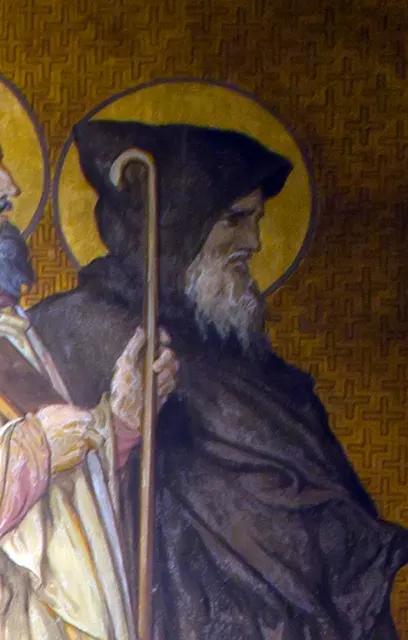
Overview
Aaron, known in Breton as Aihran or Eran, was a hermit, monk and abbot who lived and died on Cézembre, a small tidal island near Aleth, opposite present-day Saint-Malo in Brittany. He most likely crossed from Celtic Britain into Armorica during the age of the Briton migration, though the records of his origin are lost. After living as a solitary near Lamballe and Pleumeur-Gautier he settled on the island, where his reputation for holiness drew a stream of visitors and eventually a community of disciples. Among those who came to him, tradition says, was the young Malo around 544; Aaron received him, guided him and made him a partner in the work. Aaron died soon afterwards, and Malo carried on the spiritual charge of the district that now bears his own name. Aaron's memory survives in the Breton hagiographic tradition and in the town of Saint-Aaron near Lamballe, which keeps his name.
The Complete Life
Early Life
Almost nothing certain is recorded about Aaron's beginnings. The Breton tradition that calls him Aihran or Eran places his birth in the British Isles, with Wales the most often suggested home, and connects his crossing to the great migration of Britons into Armorica in the fifth and sixth centuries. That movement carried monks, clergy and whole communities across the Channel, and it planted the distinctive monastic culture of Brittany among the Celtic-speaking settlers of the north coast. If Aaron belonged to it, he was one of many solitaries who sought out headlands, islands and caves where prayer could be undisturbed. No parentage, teacher or date of birth has come down; what the sources preserve instead is the pattern of his adult life, first near Lamballe inland, then near Pleumeur-Gautier close to the coast, and finally on the sea itself. The silence around his origins is itself telling: holiness, not biography, was what the communities that remembered him judged worth keeping.
§ Introduction
Vocation
Aaron's calling took the shape of the eremitical life. He lived alone for a considerable period, first in the interior country around Lamballe and then toward the shore at Pleumeur-Gautier, before he made his last move to a small island off Aleth. Cézambre, as the place is now called, lies in the bay near the mouth of the Rance, cut off by the tide and offering exactly the harsh separation the desert tradition prized. There he built a cell and gave himself to prayer, fasting and manual work. Yet the eremitical ideal rarely ends in isolation: visitors came by boat, drawn by reports of the holy man of the island, and some stayed. In time the solitary acquired companions and the hermit became an abbot, governing a monastic family on the rock. His vocation thus moved through the classic stages of Celtic monasticism, from wandering pilgrim to anchorite to father of a community, each stage answering a different need of the church taking root on the Breton coast.
§ Introduction
Mission
Aaron's mission was exercised less through preaching than through presence. The island community he governed became a fixed point for the Christianizing of the country around Aleth, a place where the faith could be seen lived out day after day. His influence reached beyond his own monks: sailors, farmers and pilgrims made the crossing to seek counsel, and from that stream came the man who would matter most to the region's future. Around 544, tradition records, Malo arrived at Cézembre, and Aaron recognized in him a successor. The older hermit trained the younger missionary, entrusted responsibility to him, and in dying handed on the spiritual charge of the district. Malo went on to be consecrated the first Bishop of Aleth, and the city that grew from that see took his name. In that sense Aaron's most durable missionary act was a succession: he prepared the pastor under whose name the church of the whole area would be remembered.
§ Introduction
Final Years
The chronology of Aaron's last years depends on the traditional dating of Malo's visit. If the young missionary came to the island in 544, Aaron's death followed soon after, and the notice that he died after 552 fixes the outer limit. He is said to have died on Cézembre, among the community he had gathered, having lived to see solitude bear fruit in fellowship. His burial place preserved his memory locally, and his cult was carried in the lists of the Breton saints, notably in the compilations of Albert Le Grand and in Les Vies des Saints de Bretagne, which kept his feast alongside the other monastic founders of the Armorican church. No dramatic deathbed scene is recorded; the sources content themselves with the image of an old man who had traded Britain for Brittany and ended where he had chosen to live, on an island between the sea and the sky.
§ Introduction
Canonization
Aaron belongs to the vast company of saints of the early medieval West who were never canonized by any formal process. His standing rests on the consent of the local church: he was venerated at Aleth and in the surrounding country from an era long before the papacy reserved canonization to itself, and his name appears in the regional martyrologies and lives of the Breton saints. The liturgy kept his feast on 22 June in the general observance and on 21 June at Saint-Malo itself, a small but telling sign of the special regard in which the mother-community of the region held him. Both the Catholic Church and the Eastern Orthodox Church count him among their saints. No bull, no decree, no investigation documents the cult; only the unbroken habit of a people who crossed the water to his island and kept his day, which in the tradition of the saints is the oldest form of canonization there is.
§ Introduction
Legacy
Aaron's legacy is written into the map of Brittany. The town of Saint-Aaron, now part of Lamballe in the Côtes-d'Armor, carries his name, a survival of the local cult that once centered on his memory. The island of Cézembre, within sight of Saint-Malo, remains associated with the first monastic settlement of that coast, and the story of the hermit who trained Malo has been retold in every generation of Breton hagiography. He stands in the larger story of the Welsh and Cornish saints whose migration refounded the church in Armorica, a reminder that Brittany's Christianity arrived by sea, carried by men and women willing to leave everything for a cell on a rock. For pilgrims and readers today he represents the grace of hidden beginnings: the communities and institutions that shape a region often trace back to someone the wider world never knew, whose only monument was faithfulness in a place no one else wanted.
§ Introduction
Timeline
- 544
Attracts many visitors to his island hermitage near Aleth, among them, by tradition, the young Malo
§ Introduction
- 552
Is still living in this year; sources give his death only as occurring sometime after it
§ Introduction
The Record
- Patron of
- Hermits·The town of Saint-Aaron, Lamballe, France
- Symbols
- Hermit's cell on a tidal island·Abbot's staff
- Canonization
- Pre-congregation; ancient local cult in Brittany
Prayer
Bibliography
Show 6 sources
- ↑ Jones, Terry. "Aaron" . Patron Saints Index . Archived from the original on 20 March 2012 . Retrieved 8 March 2012 .
- 1 2 Rabenstein, Katherine (June 1998). "Aaron of Brittany" . Saint of the Day, June 22 . SaintPatrickDC.org. Archived from the original on 30 January 2010 . Retrieved 8 March 2012 .
- ↑ Butler, Alban . "Saint Aaron" . Lives of the Saints . (online version by Terry Jones). Archived from the original on 20 March 2012 . Retrieved 8 March 2012 .
- ↑ Butler, Alban (1845). The Lives of the Fathers, Martyrs, and Other Principal Saints . Duffy. p. 274.
- ↑ Monks of Ramsgate. "Saint Aaron". Book of Saints , 1921. CatholicSaints.Info. 27 April 2012 This article incorporates text from this source, which is in the public domain .
- ↑ Holweck, F. G. A Biographical Dictionary of the Saints . St. Louis, MO: B. Herder Book Co. (1924)
Profile text adapted from the Wikipedia article, licensed CC BY-SA 4.0.
Pray with this saint every day
Save St. Aaron of Aleth to your favorites, read the full profile, and get feast-day reminders in the Saints app.
Get the Saints AppFree on the App Store for iPhone and iPad