
martyred c. 4th century·Feast July 31 (Epip 24)
St. Abanoub of Nehisa
Child Martyr
Overview
Abanoub was born at Nehisa in the Egyptian Delta, the only son of Christian parents who raised him in the fear of God and died while he was still small. According to the Coptic tradition, preserved by the writer Julius El-Akfahsi, he was twelve years old when the persecution of Diocletian broke upon the Church. Hearing a priest call the faithful to stand firm, the boy partook of communion, gave to the poor all that his father had left him, and set off along the river to confess Christ. At Samanoud he declared his faith before the governor Lucianus and insulted the pagan idols, and the tortures that followed, whippings, being hung upside down from a mast on the way to Athribis, beatings on the mouth, could not move him. Miracles attended him: the archangel Michael healed his wounds, and soldiers who struck him were struck blind until he promised them healing at Athribis, where they confessed Christ and were themselves killed. Sent on to Alexandria, Abanoub was tortured until he died, receiving what the Coptic Church calls the crown of martyrdom. His body was returned to Nehisa and later transferred with honor to Samanoud, where his church remains a place of pilgrimage.
The Complete Life
Early Life
Abanoub was born in the town of Nehisa in the Nile Delta, identified with modern Kafr al-Abhar in the district of Talkha. His parents were Christians who reared their only son in the fear of God, but they died while he was still a young child, leaving him an inheritance of gold, silver and clothing. The Coptic Life, ascribed to Saint Julius El-Akfahsi, places his childhood in the years of the Diocletianic persecution, when confessing Christ in Egypt could cost a person liberty and life. The turning point came in his own parish church: the priest, reading the times, called the congregation to remain faithful under trial, and the boy of twelve stepped forward. He received the holy mysteries with unusual devotion and then prayed a plain, startling prayer, asking God to show him where he could go to confess the faith of Jesus. The answer he gave himself was radical. Returning home, he distributed every valuable his father had left to the poor and needy and walked out of Nehisa along the bank of the river toward Samanoud.
§ History
Confession and Miracles
On the road the archangel Michael appeared to Abanoub and told him plainly that he would suffer at Samanoud, and so it proved. Brought before the governor Lucianus, the boy confessed the Name of Christ and reviled the ruler's idols until Lucianus, furious, ordered him whipped; the soldiers beat him severely, but Michael healed his wounds in the night. The next day the governor took him by boat toward Athribis, and as punishment the child was hung upside down from the mast while the soldiers drank and danced and struck him on the mouth until his nose bled. Then, the account says, the soldiers were suddenly struck blind and their ruler left paralyzed. In their distress they begged Abanoub to intercede for them, promising to become Christians, and his answer was that their healing would come at Athribis, so that the whole city would know there is no other God but Christ. An angel loosed him and wiped the blood from his face; a strong wind carried the boat to port. There the soldiers were healed, threw down their uniforms before the governor, and were put to death for their new faith.
§ History
Martyrdom at Alexandria
The governor of Athribis, enraged by the loss of his men, tortured Abanoub severely and then sent him to Alexandria, the great city where the persecution had judicial weight. There the boy was tortured until, as the Coptic Life recounts, he yielded up his soul and was granted the crown of martyrdom, though he was still a child of twelve. Julius El-Akfahsi, who wrote his biography, was said to have been present at the death; he claimed the body and sent it home under some of his own men to Abanoub's hometown of Nehisa, so that the boy who had given everything away returned home at least in burial. The date of the martyrdom is not fixed in the sources, which set the events broadly in the era of Diocletian at the turn of the fourth century. Coptic memory holds that the body was later translated with honor to the church of the Virgin Mary at Samanoud, and that many churches were built in his name through the Delta and beyond.
§ History
Cult and Veneration
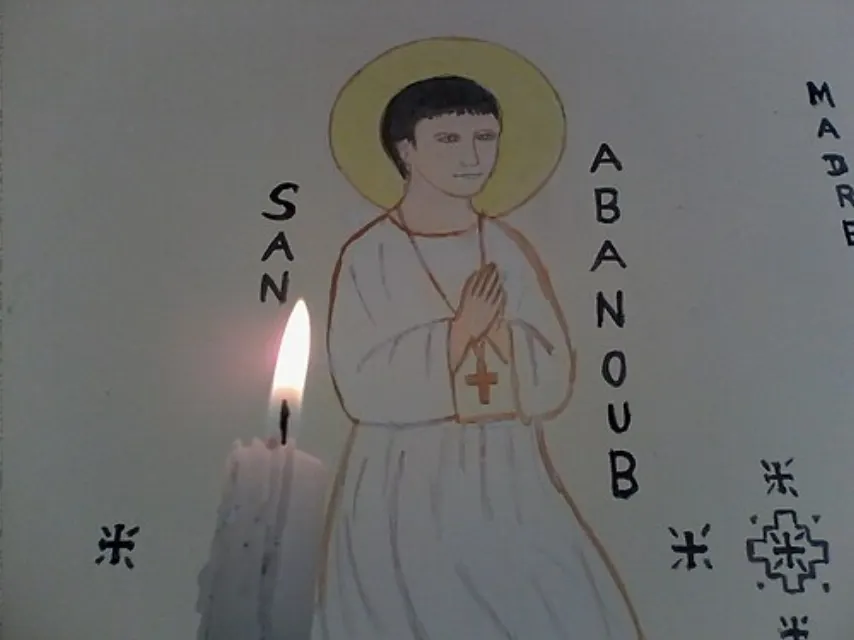
Abanoub belongs to the vast company of Egyptian martyrs honored before the era of formal canonization; his cult is ancient and continuous in the Coptic Orthodox Church, which also receives him in the wider family of Oriental Orthodox, Eastern Orthodox and Catholic traditions. His feast is kept on July 31, which corresponds to the twenty-fourth day of the Coptic month of Epip. His principal shrine is the church of the Virgin Mary and Saint Abanoub at Samanoud in the Gharbia Governorate, where his body is said to rest; other churches bearing his name stand at Sebennytos and across Egypt. Pilgrims, especially families with children, come to the shrine asking the intercession of the Child Martyr. The Life by Julius El-Akfahsi remains the principal written source of his story, and it continues to be read and retold in Coptic communities as an example of courage without age. Hymns and icons show him as a boy in a white robe with hands lifted in prayer, the cross in his hand and the crown of a martyr above him.
§ Introduction
Legacy
Abanoub's significance lies in the image he fixed in Coptic devotion: a twelve-year-old orphan who heard one sermon, gave away his inheritance, and walked into martyrdom with the composure of a veteran. His story joins the tenderness of childhood to the severity of the Diocletianic persecution, and its most memorable scene is not the cruelty of the torturers but the boy's mercy toward them, promising healing to the very soldiers who had beaten him, on condition that the whole city of Athribis see that Christ alone is God. Churches named for him, above all the shrine at Samanoud, keep his cult alive, and his feast each July fills them with families. He is invoked as a patron of children and of the young in Egypt, and in popular devotion his name, related to that of the old Egyptian god Anubis, stands as a sign that a holier claimant took possession of the child's loyalty.
§ Introduction
The Record
- Patron of
- Vertubian orders·Children·Egyptian youth
- Symbols
- Cross·White robe·Hands folded in prayer
- Canonization
- Pre-congregation; ancient cult in the Coptic Orthodox Church
Prayer
Bibliography
Show 8 sources
- ↑ "Saint Abanoub 2003" . Stmary-church.com . Retrieved October 10, 2011 .
- ↑ Timm, Stefan. Das christlich-koptische Agypten in arabischer Zeit . p. 1725.
- 1 2 "St. Abanoub" . www.copticchurch.net . Retrieved March 17, 2018 .
- ↑ "Saint Abanoub the Nehissan" . Canadian Coptic Centre. Archived from the original on August 7, 2013 . Retrieved September 19, 2012 .
- 1 2 "Saint Abanoub" . stabanoub-dallas.org . Retrieved March 17, 2018 .
- ↑ "St. Abanoub | The Saints | The Church" . archive.is . February 17, 2014 . Retrieved March 17, 2018 . {{ cite news }} : CS1 maint: deprecated archival service ( link )
- ↑ "Lives of Saints :: Abib 24" . copticchurch.net . Archived from the original on March 4, 2016 . Retrieved September 10, 2015 .
- ↑ "Saint Abanoub", Saint George Coptic Orthodox Church, Nashville, Tennessee
Profile text adapted from the Wikipedia article, licensed CC BY-SA 4.0.
Pray with this saint every day
Save St. Abanoub of Nehisa to your favorites, read the full profile, and get feast-day reminders in the Saints app.
Get the Saints AppFree on the App Store for iPhone and iPad