
3rd century·Feast June 14 (7 Paoni in the Coptic calendar)
St. Abaskhiron the Soldier
Coptic Soldier and Martyr
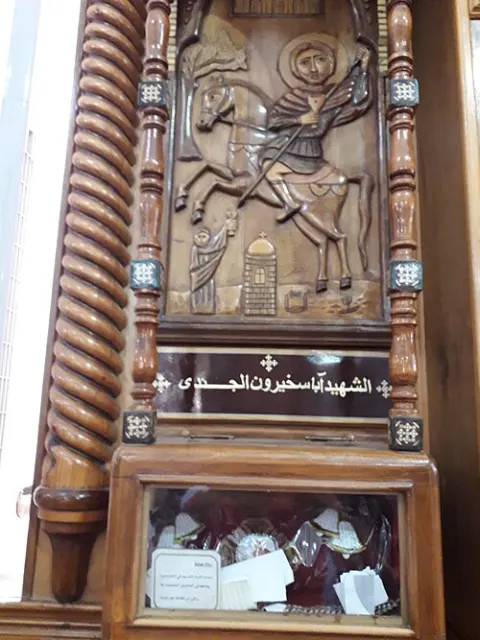
Overview
Abaskhiron, whose name Coptic piety reads as the honorific Abba, father, joined to a word for the strong, was a young soldier from the town of Qallin in the Delta, serving under Arianus, the governor of Ansena, when the edict of Diocletian commanding worship of the idols was published. Standing among the people assembled for the sacrifice, he refused outright. Struck on the mouth by the furious governor, he answered by stripping off his soldier's belt and uniform and throwing them down before the tribunal. He was flung into the suffocating dungeon of the palace at Asyut, where five fellow soldiers, Alfius, Armanius, Arkias, Peter, and Cranius, joined their refusal to his and were crucified or beheaded. Abaskhiron himself passed through a longer trial: torture, a cup of serpent's poison blessed and drunk without harm, blinding, and a furnace, before he too was beheaded and, in the Coptic account, healed and comforted at each stage by angelic visitation. His church at Qallin is remembered for the miracle of its translation to Biho, and his relics rest at the monasteries of Saint Pishoy and Saint Samuel the Confessor.
The Complete Life
Early Life
Abaskhiron came from Qallin, a town of the northern Delta in the region of modern Kafr el-Sheikh, and belonged to the military class on which the Roman administration of Egypt depended. The Coptic tradition that preserves his memory gives him the affectionate title Abba, father, joined to a name it glosses as the strong, an odd honor for a young man but one that reflects the authority his endurance won him. He served among the soldiers of Arianus, the governor of Ansena, the Middle Egyptian city that became one of the bloodiest stages of the Diocletian persecution. Nothing more is recorded of his family or upbringing; what the account preserves is the scene in which his life changed, when the edict commanding all to sacrifice to the idols was read and the people gathered to obey it, and one young soldier standing in the crowd refused. His biography, in the manner of the martyr acts, begins at the moment of his confession, and everything before it is folded into that single act of defiance.
§ Biography
The Confession and the Companions
Confronted before the governor, Abaskhiron spoke his refusal aloud and was struck on the mouth for it. His answer has become the defining gesture of his iconography: he stepped forward, removed the uniform that marked him as the governor's own man, and threw it on the ground. For this double insult to authority and cult he was consigned to the dungeon of the palace at Asyut, a place the Coptic text describes as suffocating and foul, where Christian prisoners had already been brutally used. There his courage proved contagious. Five other soldiers of the same garrison, Alfius, Armanius, Arkias, Peter, and Cranius, bound themselves to share his fate; the governor crucified some of them and beheaded the rest. Abaskhiron's own execution was delayed, the narrative suggests, precisely because his torturers hoped to break the example rather than multiply it, and so his trial lengthened into a series of ordeals designed to force a public recantation.
§ Biography
Ordeals and Consolation
The acts of Abaskhiron belong to the great Coptic literature of the persecutions, in which torture and miraculous deliverance alternate and the martyr's body becomes the visible field of the contest between Christ and the demons. The governor summoned Alexander, described as the greatest sorcerer available, who conjured a serpent in two and mixed its venom into a cup; Abaskhiron signed the cup with the cross, drank in the name of Jesus of Nazareth, and took no harm, while the sorcerer, marvelling at what he had witnessed, confessed the God of Abaskhiron and was himself beheaded. Condemned a second time, Abaskhiron was blinded and thrown into a furnace; the account tells that the Archangel Michael spread his wings over his eyes and healed them. The pattern is theological rather than forensic: each instrument of pain is answered by a greater power, and the reader is taught that the confessors were sustained, not merely endured. He was finally beheaded and, with his companions, crowned as a martyr.
§ Biography
The Miracle of Qallin
The memory of Abaskhiron stayed most powerfully at his own town. The Coptic tradition records a later wonder attached to his church at Qallin: the people there had a custom of celebrating group weddings for their sons and daughters, and during one such festival, while the congregation was gathered inside the church of Saint Abaskhiron, hostile men surrounded the building intending to kill everyone within. The people called on the saint's intercession, and the whole church, with its congregation, its tree, and its well, was carried away and set down intact at Biho in the south of Egypt, where the church stands to this day, so the account concludes. Whatever is made of the tale, it belongs to a recognizable genre of translation miracles by which Coptic piety affirmed that the martyrs remain active guardians of their people; it also hints, gently, at the insecurity under which Christian communities lived in the Egypt of later centuries.
§ Introduction
Veneration
Abaskhiron belongs to the immense company of Egyptian martyrs whose sanctity was proclaimed by the consensus of the churches rather than by any later process; no canonization dossier exists or ever existed for him. His commemoration falls on 14 June, the seventh day of the Coptic month Paoni, in the calendar of the Coptic Orthodox Church, which has kept his name alongside the great confessors of the Diocletian age. His relics are honored at the Monastery of Saint Pishoy in the Wilderness of Scetis and at the Monastery of Saint Samuel the Confessor at Qalamun, and a monastery at Deir Abu Sefein bears his memory in its traditions. In him the Coptic Church reads its own history whole. He is one of the saints through whom the Coptic Church teaches its children the history of the persecution, invoked with his companions as a witness that the faith of Egypt was purchased at a price.
§ References
Legacy
Abaskhiron's significance lies less in the details of his legend, which the historian must handle with care, than in what his cult has carried across eighteen centuries: the memory of a soldier who chose the cross over his profession, of a young man whose steadfastness drew five companions into martyrdom with him, and of a church that has never stopped celebrating them. His story, with its stripped uniform, poisoned cup, and healing angel, gave Coptic iconography several of its familiar motifs, and his feast continues to be kept in the villages of the Delta and the monasteries of Scetis. For a church that in living memory has again produced its martyrs, on the shores of Libya and in the churches of Egypt, the young soldier of Qallin remains a contemporary figure rather than an antiquarian one: proof that the decision he made before the altar of the idols is still being made, and still being kept.
§ References
The Record
- Patron of
- Soldiers·Those facing false accusation
- Symbols
- Soldier's uniform cast aside·Cup of poison·Archangel Michael
- Canonization
- Pre-congregation (ancient Coptic cult)
Prayer
Bibliography
Show 5 sources
- ↑ Atiya, Aziz S. The Coptic Encyclopedia. New York: Macmillan Publishing Co., 1991. ISBN 0-02-897025-X
- ↑ "St. Mary AlSourian Monastery" . www.st-mary-alsourian.com . Retrieved 2018-03-17 .
- ↑ "غفير برية شيهيت" . شيهيت Sheheet.com (in Arabic). 2015-08-08 . Retrieved 2018-03-17 .
- ↑ "Saint AbaSkhyroon" . stmarystminacopticchurch.org . Retrieved 2018-03-17 .
- ↑ "Lives of Saints :: Paona 7" . copticchurch.net . Retrieved 2017-07-16 .
Profile text adapted from the Wikipedia article, licensed CC BY-SA 4.0.
Pray with this saint every day
Save St. Abaskhiron the Soldier to your favorites, read the full profile, and get feast-day reminders in the Saints app.
Get the Saints AppFree on the App Store for iPhone and iPad