
died 1125·Feast October 20
St. Adelina of Mortain
Benedictine Abbess of the Abbaye Blanche
Overview
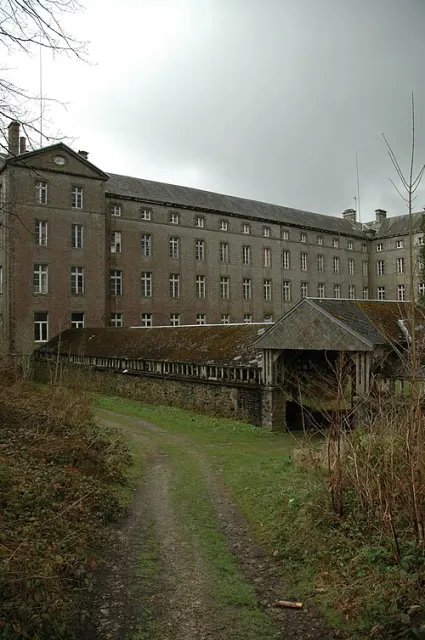
Adelina of Mortain was a Norman noblewoman remembered as the first abbess of the Abbaye Blanche, the 'White Abbey' for women founded at Mortain in 1112 by her brother, Saint Vitalis of Savigny, alongside his better-known abbey of Holy Trinity for men. Vitalis had gathered hermits into the monastic Order of Savigny; the women's house at Mortain was its feminine counterpart, and Adelina governed it as abbess until her death in 1125. The nuns wore habits of undyed wool — the white that gave the house its name — and followed a deliberately strict reading of the Rule of Saint Benedict. In 1147, after Adelina's death, the communities of Savigny, the Abbaye Blanche among them, passed with some thirty houses into the Cistercian order. Her church, built on a Latin-cross plan with a wide transept, survives in part; her feast is kept on 20 October. In an age when women's religious houses usually depended on a male founder's patronage, the Abbaye Blanche is a rare example of a foundation whose first superior was the founder's own sister, sharing his austerity and governing in her own right. Adelina's cult remained local, but her abbey's buildings survive at Mortain to this day.
The Complete Life
A Noblewoman of Normandy
Adelina came from the Norman nobility; she was the sister of Vitalis, the hermit-preacher who became founder of the monastic Order of Savigny and was himself canonized. The sources say little more of her birth and youth: she belongs to that large company of medieval women whose lives were written only at the edges of their brothers' biographies. What can be said is that she shared her generation's monastic renewal from the inside. Early twelfth-century Normandy was thick with new religious foundations, and the families that produced founders usually produced nuns as well; the sister of Vitalis was given the government of the women's branch of his work. She is not to be confused with the other Adelinas of the era, and no writings of hers survive. Her significance rests entirely on what the Abbaye Blanche became under her and after her.
§ Introduction
Abbess of the White Abbey
Shortly after establishing the men's abbey of Holy Trinity at Savigny, Vitalis set up a house for women at Mortain, in the Norman border country, and placed his sister at its head. It was called the Abbaye Blanche — the White Abbey — from the undyed wool of the nuns' habits. The community kept the Rule of Saint Benedict under a very strict reading, with the austerity that marked the young Order of Savigny, whose reputation for rigour was such that it was said to have frightened more postulants than it kept. Adelina governed the house from its foundation in 1112 until her death in 1125 — only thirteen years, but the founding years, in which a community's character is set. The church was built on a Latin-cross plan with a central nave and an unusually wide transept, in the Early Gothic style; the chapter house, cellar and Romanesque cloister still stand in something like their original twelfth-century form.
§ Introduction
Death and the Cistercian Future
Adelina died in 1125, thirteen years after the founding of her abbey, and was buried as a saint of her community. Her personal cult remained local and pre-congregational — no formal process existed, or would exist for centuries, for a Norman abbess — but her feast was kept on 20 October and her memory attached permanently to the house she had ruled. The great institutional event of the abbey's history came after her death: in 1147 the Order of Savigny, over thirty houses including the Abbaye Blanche and the mother house at Savigny itself, was absorbed into the Cistercian order, whose customs the Savigniacs had closely resembled. The White Abbey thus ended the century as a Cistercian nunnery, carrying Adelina's founding work into the largest monastic enterprise of the Middle Ages.
§ Introduction
Legacy
The Abbaye Blanche outlived its foundress by more than seven centuries, surviving as a religious house until the French Revolution, and its buildings — the chapter house, the cellar, the Romanesque cloister and the Latin-cross church — remain among the tangible monuments of the Savigniac experiment, protected today as historic monuments of France. Adelina herself is one of the quiet founding figures of women's monasticism in Normandy: a noblewoman who accepted the government of a strict new community at her brother's side and gave it its first thirteen years. Her feast on 20 October keeps her name in the martyrologies, and the survival of her abbey's architecture keeps her work visible. She stands in the collection as an example of how much of medieval sanctity was institutional: the holiness of founding, governing and enduring rather than of martyrdom or writing.
§ Introduction
Timeline
- 1112
Vitalis founds the Abbaye Blanche at Mortain; Adelina becomes its first abbess
§ Introduction
- 1125
Dies as abbess of the Abbaye Blanche
§ Introduction
- 1147
The Abbaye Blanche, with the Order of Savigny, joins the Cistercian order
§ Introduction
The Record
- Patron of
- Norman monasticism (first abbess of the Abbaye Blanche)
- Canonization
- Pre-congregation
Prayer
Bibliography
Show 2 sources
- ↑ Van Moolenbroek, Jacob Johannes; Mayo, Hope. "Vitalis van Savigny (1122): Bronnen en vroege cultus mit editie van diplomatische teksten - A Review". Speculum . doi : 10.2307/2852620 . JSTOR 2852620 .
- ↑ “Saint Adelina”. Saints.SQPN.com. 11 August 2012. Web.
Profile text adapted from the Wikipedia article, licensed CC BY-SA 4.0.
Pray with this saint every day
Save St. Adelina of Mortain to your favorites, read the full profile, and get feast-day reminders in the Saints app.
Get the Saints AppFree on the App Store for iPhone and iPad