
c. 945-1004·Feast November 13
St. Abbo of Fleury
Benedictine Abbot of Fleury, Scholar and Martyr
Overview
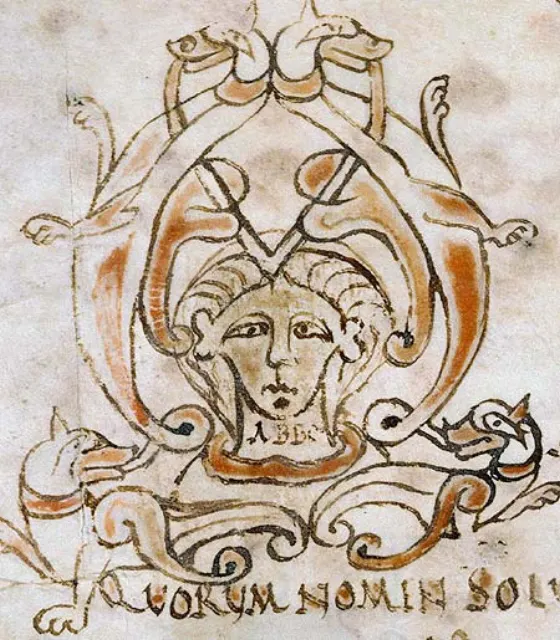
Abbo of Fleury — Abbo Floriacensis in Latin — was a monk, scholar, and abbot of Fleury Abbey at Saint-Benoît-sur-Loire near Orléans, born nearby about 945 and died 13 November 1004. Brought up at Fleury and educated at Paris and Reims in philosophy, mathematics, and astronomy, he was among the most learned men of the tenth-century church. He spent two years, 985 to 987, in England at the newly founded monastery of Ramsey in Huntingdonshire, directing its school and assisting Archbishop Oswald of York in restoring the monastic system. Returning to Fleury in 988 he was chosen abbot after Oilbold's death; a contested election that drew in the king, the bishop of Orléans, and finally Gerbert of Aurillac — the future Pope Sylvester II — was settled in his favor. As abbot he moved in the highest politics: he attended the Synod of Verzy at which Arnulf of Reims was deposed, and in 996 King Robert II sent him to Rome to ward off an interdict over the royal marriage to Bertha of Burgundy. He helped calm the panic over the end of the world in the year 1000. In 1004, having traveled to La Réole in Gascony to tighten its observance, he took a lance-thrust in his side while stepping between quarreling monks, hid the injury, and died in his cell with his disciple Aimoin at his side. His works include a passion of Saint Edmund, a Latin grammar, a simplification of the computus, and a commentary on the Calculus of Victorius of Aquitaine.
The Complete Life
A Boy of Fleury
Abbo was born near Orléans about 945 and given to Fleury as a child — the abbey that claimed the bones of Saint Benedict himself and stood, with them, at the head of the monastic life of northern Gaul. His schooling continued at Paris and Reims, the two great schools of the later Carolingian world, where he devoted himself to philosophy, mathematics, and astronomy: the exact inheritance of the Carolingian renaissance at a moment when its schools were thinning. Abbo is one of the few tenth-century churchmen of whom it can be said that he mastered the inherited sciences — the computus, the arithmetic of Victorius of Aquitaine, the astronomy of the Latin textbooks — and taught them forward. What the sources do not much show is the interior life that drove him; but a monk who spent his last night dictating to a disciple while dying of a lance wound had resources beyond the academic.
Ramsey and the English Revival
In 985 Abbo crossed to England, drawn by the young Benedictine revival under Dunstan, Oswald, and Æthelwold, and spent two years mostly at Ramsey in Huntingdonshire, a new foundation of the fenland revival. There he was abbot and director of the school from 986 to 987, teaching the English monks the mathematics and astronomy they had lacked, writing them a Latin grammar, and assisting Archbishop Oswald of York in restoring the monastic system. It was at Ramsey that he heard from contemporaries of the martyrdom of Edmund of East Anglia and wrote the Passion of Saint Edmund, the source on which all later knowledge of that martyrdom depends. Richard Pfaff's verdict stands: Abbo carried a great deal of worth out of the reformed French monastic inheritance and into England's young monastic culture at the close of the tenth century. The Ramsey years also produced his grammar for the English students and, most lastingly, the Passion of Saint Edmund, on which all later knowledge of that martyrdom depends.
Abbot of Fleury
Abbo returned to Fleury in 988 and was selected as abbot on the death of Abbot Oilbold. A rival monk, who had won over both the king and the bishop of Orléans, challenged the election, and the affair swelled to national scale until Gerbert of Aurillac — the greatest scholar of the age, later Pope Sylvester II — settled it in Abbo's favor. His abbacy was spent in the thick of the church's politics: he sat at the Synod of Verzy near Reims, where Arnulf, archbishop of Reims, faced a treason charge and was removed so that Gerbert could take his place; he waged a six-year quarrel with Arnulf of Orléans over monastic reform; and in 996 King Robert the Pious dispatched him to Rome to head off a threatened papal interdict arising from the king's marriage to Bertha of Burgundy. On that journey he met Pope Gregory V, a fugitive from the antipope John XVI, and the two formed an esteem and affection that the sources note explicitly; the royal plea for a dispensation failed, and Abbo managed to bring about Arnulf's reinstatement in the see of Reims.
The Year 1000
Abbo's most quietly influential act was his conduct in the panic over the year 1000. Fear that the world would end with the millennium's turn was widespread in Europe, fed by apocalyptic readings of Revelation and by the disorders of the age, and Abbo — who possessed every intellectual means of judging better — played a real part in quieting the alarm. His commentary on the Calculus of Victorius of Aquitaine, written around 980 to 985, shows the temper of mind that made this possible: a work nominally devoted to arithmetic that wanders across the question of wisdom, the philosophy of number, the tie between unity and plurality, and the theology of Creation, putting grammar, logic, and cosmology to work in the service of an ordered, intelligible world. Against those who read history as about to close, Abbo set a universe whose numbers opened indefinitely. It is a spirituality of reason at the service of a stable creation, and it did its work.
La Réole
In 1004 Abbo set out to tighten discipline at the monastery of La Réole in Gascony by moving a number of Fleury's monks into that house — the usual monastic cure of seeding obedient men into an unruly community. The trouble grew instead of yielding; the two parties came to blows, and as Abbo tried to part them a lance struck him in the side. He hid the wound, walked to his cell, and died there on 13 November 1004 held by his devoted disciple Aimoin, who left behind an account of his labors and virtues and preserved much of his correspondence. The manner of his death — a peacemaker run through while parting brawling monks — fixed his memory: the miracles worked at his tomb soon led the church of Gaul to venerate him as a saint and martyr, although Rome appears never to have issued a formal canonization.
Scholar Between Two Churches
Abbo's legacy runs in three channels. In learning: his computus work, his grammatical writing, and his commentary on Victorius belong to the small surviving corpus of tenth-century exact science, most of it printed in the Patrologia Latina. In hagiography: the Passion of Saint Edmund is the founding text of the Edmund legend, without which East Anglia's royal martyr would be a name. In monastic history: he is the bridge between reformed Fleury and Ramsey, and through Ramsey to the whole English Benedictine line. Aimoin's contemporary life, with its embedded letters, is a historical source of the first rank for the reign of Robert II and the papacy of the era. The Eastern Orthodox Church numbers Abbo among its saints — one of the last western figures to be claimed naturally by both traditions — and his feast is kept on 13 November. Aimoin's Life, written by the disciple who held him as he died, preserves the correspondence and remains a first-rank source for the reign of Robert II and the papacy of the era.
Timeline
- 945
Born near Orléans and raised from childhood in the Benedictine abbey of Fleury
§ Introduction
- 980
Writes a commentary on the Calculus of Victorius of Aquitaine, working from about this year to 985
§ Works
- 985
Crosses to England for two years, mostly at the new Ramsey monastery, aiding Archbishop Oswald of York
§ Life
- 986
Serves as abbot and director of the school of the newly founded Ramsey monastery, from 986 to 987
§ Life
- 988
Returns to Fleury and is chosen abbot after Abbot Oilbold's death, a disputed election settled by Gerbert of Aurillac
§ Life
- 988
Begins a feud with Arnulf of Orléans over monastic reform that lasts until 994
§ Life
- 996
Sent by King Robert II to Rome over the royal marriage to Bertha of Burgundy; the dispensation is refused
§ Life
- 1000
Helps calm the widespread European fear that the world would end
§ Life
- 13 Nov 1004
Pierced by a lance while parting fighting monks at La Réole in Gascony, he dies in his cell with Aimoin beside him
§ Life
The Record
- Major works
- Passion of Saint Edmund (Passio Sancti Eadmundi)·Quaestiones grammaticales (Latin grammar for his English students)·Three poems to Dunstan·Simplification of the computus (Easter computation)·Epitome de XCI Romanorum Pontificum Vitis·Collectio Canonum·Commentary on the Calculus of Victorius of Aquitaine
- Patron of
- Fleury Abbey (Saint-Benoît-sur-Loire)·Ramsey Abbey, England·Scholars of the computus and Easter dating
- Symbols
- Abbot's crozier·Lance (instrument of his death)·Mathematical and astronomical instruments
- Canonization
- Regarded as a saint and martyr in Gaul from his death; never formally canonized by Rome; recognized as a saint by the Eastern Orthodox Church
Prayer
Profile text adapted from the Wikipedia article, licensed CC BY-SA 4.0.
Pray with this saint every day
Save St. Abbo of Fleury to your favorites, read the full profile, and get feast-day reminders in the Saints app.
Get the Saints AppFree on the App Store for iPhone and iPad