
d. c. 420·Feast May 16
St. Abdas of Susa
Bishop and Martyr
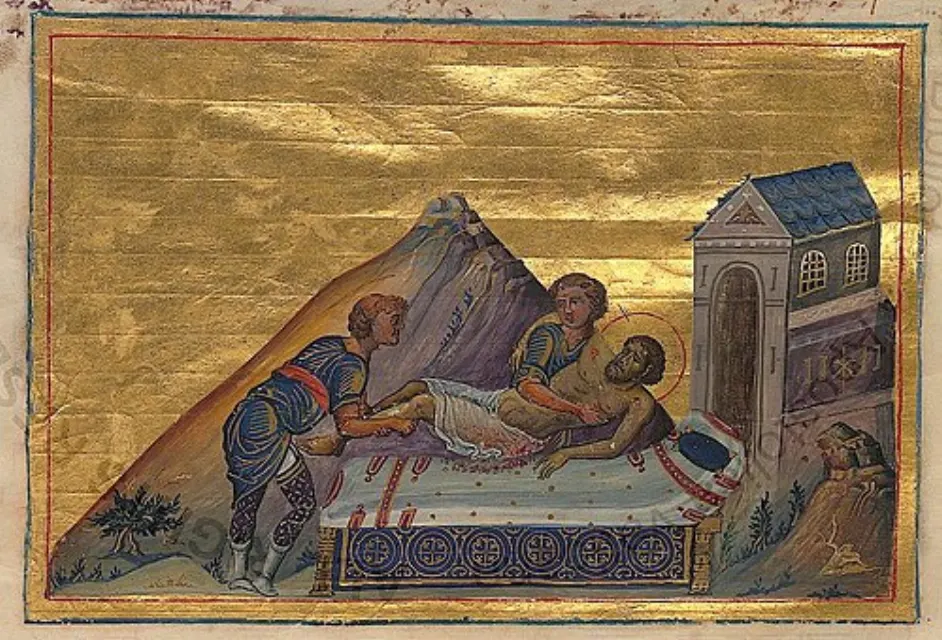
Overview
Abdas, also rendered Abda, Abdias, and Audas, was a bishop of Susa in the Sasanian Empire whom Socrates of Constantinople calls simply 'bishop of Persia.' Raised in Chaldor by a Zoroastrian mother who taught him virtue, he accepted Christian ordination as a priest and founded in the town of his birth both a monastery and a school that in time numbered around sixty teachers. Arrested by the magi for his many conversions, he endured hunger and humiliation in prison without yielding, and was eventually released and raised to the episcopate at Susa. A companion of Maruthas of Martyropolis, he is said to have helped drive a demon from the son of King Yazdegerd I. But around 419-420, at the head of a band of priests and laymen, he razed a Zoroastrian fire temple, and when he refused the king's order to rebuild it, he was executed together with his companions, igniting a general persecution of Persian Christians.
The Complete Life
Early Life
Abdas was born in the fourth century at Chaldor, in the Sasanian Empire, to a mother who followed the Zoroastrian religion yet, in the account that survives, educated him in virtue. He came to Christian faith as an adult and was ordained a priest. In his hometown he founded a monastery and a school, an institution of learning that in time counted around sixty teachers — evidence of a vigorous Christian educational culture inside a Zoroastrian state. His pastoral energy showed itself above all in baptism: he baptized many converts in Chaldan, and the success of his mission drew the hostile attention of the Zoroastrian magi, who arrested him. Prison brought humiliations, hunger, and pain, but he remained a Christian until his release. Christianity had spread through Mesopotamia and Khuzistan partly through deportees settled by earlier Sasanian kings, and priest-teachers like Abdas made it a self-sustaining community with institutions of its own.
§ Introduction
Bishop of Susa
Upon his release Abdas was made bishop of Susa, the ancient city of Khuzistan, and entered a period of unusually good relations between the Persian church and the crown. He was an associate of Maruthas of Martyropolis, the physician-bishop whose diplomacy at the Persian court had secured toleration for Christians, and he is supposed to have assisted Maruthas in driving out a demon that afflicted King Yazdegerd I's son. In that atmosphere of royal favor the church expanded. Yet the same zeal that filled his school and font could run to impetuosity, and it was Abdas's act of public destruction, not his teaching, that ended the truce between the king and the Christians of the empire. His cathedral city, the ancient Susa of Esther and Daniel, kept memories of prophets older than the empire itself, and its Christian community was both ancient and proud of its Persian identity. His school at Chaldor, with its sixty teachers, had made him the most visible churchman of the region.
§ Life
Martyrdom
Around 419-420 Abdas, acting in concert with a group of Christian clergy and laypeople, tore down a Zoroastrian fire temple. He was summoned to the king's court and heard Yazdegerd demand why they despised the kingdom, transgressed his command, and razed what he called the houses of prayer and the very underpinnings of the fire temples handed down from their forefathers. When Abdas hung back, one of the priests in his company replied that the foundation was demolished and the fire extinguished because it was not a house of God, nor was the fire the daughter of God. Historians note such demolitions broadcast the victory of Christianity. Abdas refused to restore the temple and was put to death; those killed alongside him were the priests Hashu and Isaac, Ephrem a secretary, Papa a hypodeacon, the laymen Daduk and Durdan, and Papa, his own brother, and a general persecution followed. Yazdegerd died within months of the execution, and the persecution begun in his final year rolled on under his successor Bahram V with far greater cruelty.
§ Life
Veneration
Abdas belongs to the great pre-congregation roll of Persian martyrs. He is commemorated in Syriac Christianity on 31 March and in the Western martyrologies on 16 May. His story survives chiefly through Socrates of Constantinople's Ecclesiastical History, the Catholic Encyclopedia's articles on Persia, and modern scholarship on Persian Christianity; the episode is studied not only as martyrdom but as a key that unlocked the last great pre-Islamic persecution of Christians in Iran, begun in the final year of Yazdegerd's reign and carried to fury by his successor Bahram V. His companions are remembered with him: the priests Hashu and Isaac, Ephrem the secretary, Papa the hypodeacon, the laymen Daduk and Durdan, and Papa his brother. Syriac calendars group them among the martyrs of 420, and modern historians treat the episode as the hinge between the tolerated church of Maruthas's diplomacy and the confessing church of the decades that followed. His memory endures among them still.
§ Life
Legacy
Abdas's legacy is double-edged and honest history keeps both edges. For the churches that venerate him he is a confessor-bishop who would not undo a act of zeal even to save his life, and his companions form one of the memorable companion-martyrdoms of the Persian church. Historically, his demolition of the fire temple is remembered as the spark of the persecution of 420, in which countless Persian Christians suffered under Bahram V, including the Forty Martyrs of Sebaste's Persian counterparts and figures such as Simeon bar Sabba'e's successors. He stands as a reminder that saints act in history, and that the cost of their acts is often paid by the whole community they love. He is honored today chiefly in Syriac liturgy and in the memory of Iran's Christians, a patron for believers who live as a minority under a state religion, and his case is still weighed by historians as an example of conscience acting with public consequences.
§ Introduction
Timeline
- 419
Levels a Zoroastrian fire temple with a band of priests and laymen, and is summoned to Yazdegerd I's court
§ Life
- 420
Refusing to rebuild the fire temple, he is executed at Susa with seven companions
§ Life
The Record
- Patron of
- Persecuted Christians·The Church in Iran
- Symbols
- Bishop's vestments·Extinguished fire (the destroyed fire temple)
- Canonization
- Pre-congregation martyr of the Persian church
Prayer
Bibliography
Show 4 sources
- 1 2 Socrates Scholasticus, Ecclesiastical history , vii. 8 Archived 2005-01-18 at the Wayback Machine
- 1 2 Oussani, Gabriel. "Persia." The Catholic Encyclopedia Vol. 11. New York: Robert Appleton Company, 1911 This article incorporates text from this source, which is in the public domain .
- 1 2 3 Payne 2015 , p. 47.
- ↑ Odden, Per Einar. "Den hellige Abdas av Susa og ledsagere (d. 420)", Den katolske kirke, December 28, 2015
Profile text adapted from the Wikipedia article, licensed CC BY-SA 4.0.
Pray with this saint every day
Save St. Abdas of Susa to your favorites, read the full profile, and get feast-day reminders in the Saints app.
Get the Saints AppFree on the App Store for iPhone and iPad