
d. c. 167·Feast October 22
St. Abercius of Hieropolis
Bishop, Equal-to-the-Apostles
Overview
Abercius, in Greek Aberkios, was a Christian clergyman of Hierapolis in Phrygia Salutaris under the emperor Marcus Aurelius, generally though not indisputably regarded as bishop of that city and successor of Papias, and possibly identical with the author cited in later sources as Avircius Marcellus. He is said to have evangelized widely across Syria and Mesopotamia, for which the East honors him as Equal-to-the-Apostles, and to have been imprisoned under Marcus Aurelius before dying around 167. His fame rests on the great inscription he apparently erected over his future tomb, a metrical Greek epitaph that recounts a journey to Rome — 'I saw a people bearing the splendid seal,' meaning baptism — and travels beyond the Euphrates where 'everywhere I had associates,' while attesting the Eucharist of bread and wine. Recovered in fragments in the 1880s, the inscription is a primary witness to second-century faith and devotion.
The Complete Life
Early Life and See
Abercius lived in the second century in Phrygia, the province of Asia Minor already sown with Pauline Christianity a hundred years before. He served at Hieropolis in Phrygia Salutaris, and although the sources are not unanimous, he is generally regarded as that city's bishop and the successor of Papias, the hearer of the apostle John whose own writings survive only in fragments. Later sources may identify him with Avircius Marcellus, a writer's name of the same age. The confusion of two similarly named cities — Hierapolis on the Maeander and Hieropolis of the Sandukli valley near Synnada — has tangled his biography for centuries; scholars such as William Ramsay and J. B. Lightfoot concluded his city was the smaller Hieropolis near Synnada. His lifetime bridged the sub-apostolic and the patristic age: when he was young the hearers of the apostles were newly gone, and when he died the apologists were already defending the faith before emperors.
§ Controversy over location of Abercius' bishopric
Missionary Journeys
Tradition sends Abercius out from his see as a wandering evangelist across Syria and Mesopotamia, territories where the Church was young and persecuted, and on that basis the Eastern churches style him Equal-to-the-Apostles. His own epitaph confirms a journey to Rome — where 'a people bearing the splendid seal,' the baptized, met his eyes — and travels beyond the Euphrates where 'everywhere I had associates.' These are the words of a man who moved along the roads of the empire and found Christians wherever he went, an unintentionally precious testimony to how far the faith had spread by the 160s. He is also said to have been imprisoned under Marcus Aurelius, the philosophic emperor whose reign made honesty about the Christians inconvenient. The title Equal-to-the-Apostles, which the East gives him, belongs to missionaries remembered as founders rather than administrators; Abercius is counted with those who carried the Gospel over the frontiers of Rome into the Syriac-speaking East.
§ Introduction
The Inscription
Abercius's spirituality is preserved in stone. The inscription he prepared for his own tomb, in Greek verse, is the earliest substantial Christian epitaph known, and it speaks with striking serenity of faith, baptism as the seal, and the Eucharist: he describes receiving 'a pure fish from the spring' with bread and wine — the ichthys of the early Church — and he bids every passerby understand that he was a Christian and pray for him. The middle verses tell of the journeys; the last lines invite the sharing of the cup. In 1883 William Ramsay recovered the fragments in the masonry of the baths at Hieropolis, and comparison with a pagan epitaph of Alexander showed how deliberately Christian the old bishop's language was. The fish from the spring, served with bread and wine, stands among the earliest Eucharistic testimonies outside the New Testament, and the closing prayer for the passerby shows a Christianity unafraid to speak aloud in the necropolis.
§ Controversy over location of Abercius' bishopric
Final Years and Lost Works
Abercius died around 167, in the reign of Marcus Aurelius, at an advanced age by the reckoning of the epitaph, which he had evidently composed in anticipation of death. Several works were ascribed to him in antiquity: an Epistle to the Emperor Marcus Aurelius, of which Baronius spoke as still extant in his day but produced no text, and a Book of Discipline in Greek addressed to his clergy — both lost. What survives is the inscription, broken into three fragments and carried piecemeal to the Vatican Museums, where the greater part is displayed, one of the treasures of early Christian epigraphy. The fragments were recognized after Ramsay found them reused in the masonry of the public baths, and the central portion reached the Vatican, where it remains one of the earliest and most treasured Christian inscriptions on display. Nothing certain is known of his last days beyond the epitaph itself.
§ Works
Veneration
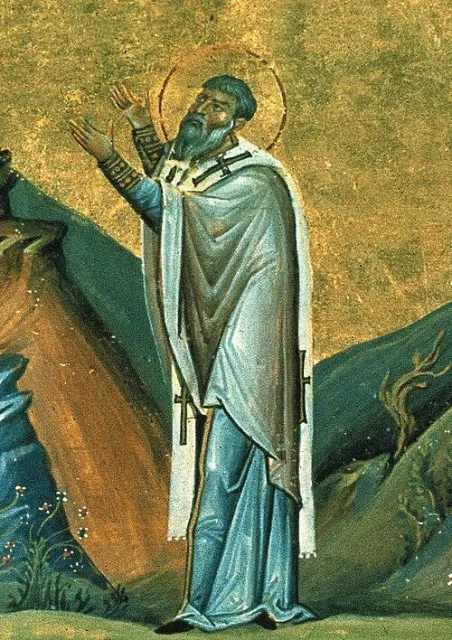
Abercius belongs to the ancient, pre-congregation cult. His feast is kept on 22 October in the Byzantine calendar, which on the Julian calendar falls on 4 November of the civil reckoning, and he appears in both Catholic and Orthodox martyrologies as a bishop-confessor rather than a martyr, notwithstanding his imprisonment. His cult centered on his tomb at Hieropolis, where the inscription he left became itself an object of pilgrimage; the recovery of its fragments in the 1880s by Ramsay, identified by De Rossi and Duchesne, revived scholarly devotion to him as the man whose epitaph is the oldest Christian poem of length we possess. In art he appears as a bishop holding the crosier that tradition says an angel brought him, an emblem recorded in the early modern manuals of sacred iconography, and the Menologion of Basil II preserves a miniature of him among the saints of October. His cult never spread far beyond Phrygia, yet it endured where it began.
§ Introduction
Legacy
The Inscription of Abercius holds a permanent place in the history of early Christianity: it is cited in every account of second-century belief as direct evidence for baptism, the Eucharist with bread and wine, the fish symbolism of Christ, and the sense of a worldwide communion stretching from Rome to beyond the Euphrates. It is also a monument of Christian self-understanding — a bishop planning his own epitaph as a confession and an invitation to prayer. For the churches of Phrygia and for all who study the apostolic age, Abercius is the voice from the tomb, cheerful about death, certain of the fish from the living spring, and eager to be remembered by name. Every history of the Eucharist, of baptismal symbolism, and of early Christian travel cites his verses; for the ordinary reader he proves that second-century Christianity was already worldwide, joyful, and articulate about its sacraments. He remains a favorite of archaeologists and liturgists alike.
§ Introduction
Timeline
- 155
Succeeds Papias as bishop of Hierapolis, serving until his death
§ Introduction
- 167
Dies at about 167, after imprisonment during the reign of emperor Marcus Aurelius
§ Biography
- 216
A stele at Kelendres dated year 300 of the Phrygian era echoes phrases from Abercius' epitaph
§ Controversy over location of Abercius' bishopric
- 1883
William Ramsay discovers two inscription fragments at Hieropolis that complete the middle of the epitaph
§ Controversy over location of Abercius' bishopric
In Their Own Words
I saw a people bearing the splendid seal.
Everywhere I had associates.
The Record
- Major works
- Inscription of Abercius (metrical epitaph)·An Epistle to Marcus Aurelius (lost)·A Book of Discipline for his clergy (lost)
- Patron of
- Phrygian Christianity·Pilgrims of the ancient Church
- Symbols
- Crosier brought to him by an angel
- Canonization
- Pre-congregation (ancient cult of Phrygia)
Prayer
Bibliography
Show 8 sources
- ↑ Drake, Maurice and Drake, Wilfred. Saints and their Emblems , London, T. Werner Laurie Ltd., 1916
- ↑ Blank 2023 , pp. 59–70.
- ↑ Blank 2023 , pp. 54–59.
- ↑ Bowker, John, ed. (1997). "Abercius, St." . The Oxford Dictionary of World Religions . Oxford : Oxford University Press . p. 5. ISBN 0-19-213965-7 . OCLC 896422819 . {{ cite encyclopedia }} : CS1 maint: ref duplicates default ( link )
- ↑ Christie, Albany James (1867). "Abercius" . In Smith, William (ed.). Dictionary of Greek and Roman Biography and Mythology . Vol. 1. p. 2. Archived from the original on 2005-07-28 . Retrieved 2007-08-20 .
- ↑ Ramsay, W. M. (1882). "The Tale of Saint Abercius" . The Journal of Hellenic Studies . 3 : 339– 353. doi : 10.2307/623544 . JSTOR 623544 .
- ↑ Lightfoot, J. B. (1889). The Apostolic Fathers: Part II. S. Ignativs. S. Polycarp . Vol. 1 (2nd ed.). Macmillan and Co. p. 495.
- ↑ Leclercq, Henri (1907). "Inscription of Abercius" . Catholic Encyclopedia . Vol. 1.
Profile text adapted from the Wikipedia article, licensed CC BY-SA 4.0.
Pray with this saint every day
Save St. Abercius of Hieropolis to your favorites, read the full profile, and get feast-day reminders in the Saints app.
Get the Saints AppFree on the App Store for iPhone and iPad