
c. 1st century BC - c. AD 50·Feast Fourth Friday after Easter (Assyrian Church of the East)
St. Abgar V the Black
King of Osroene, First Christian King
Overview
Abgar V, called Ukkāmā, the Black, was king of the small realm of Osroene with its capital at Edessa, modern Şanlıurfa, across the turn of the era. Tacitus, a near-contemporary, styles him king of the Arabs, and the dynasty that produced him is now generally agreed to have been Arabic. He is remembered among Christians for the legend enshrined as early as Eusebius: that Abgar, suffering an incurable disease, wrote to Jesus at Jerusalem inviting him to Edessa, and received a letter in which Jesus blessed his faith without seeing and promised to send a disciple after his ascension. The Doctrine of Addai tells how Thaddeus, or Addai, one of the seventy, came, healed the king and baptized the city. When Egeria visited Edessa in the fourth century, the letter was still kept there, and people treasured copies of it as talismans. Historians doubt the correspondence, but Edessa's early and deep Christianity is fact, and Abgar became the type of the first Christian king.
The Complete Life
Early Life and Reign
Abgar V ruled Osroene, a buffer kingdom wedged between Rome and Parthia on the upper Euphrates, from his capital at Edessa. His epithet Ukkāmā, the Black, appears in the Syriac sources, though whether it referred to complexion or to something else is debated. Tacitus, writing within living memory, calls him king of the Arabs, and modern scholarship agrees that the Abgarid dynasty was Arabic in origin even as it ruled a largely Syriac-speaking city that cultivated Greek learning as well. His dates are reconstructed from coinage and from the notices of Josephus and Tacitus: a long reign interrupted by deposition, restoration and the politics of the Roman-Parthian confrontation, in which Edessa's kings survived by maneuver. The Armenian historian Movses Khorenatsi later claimed him as an Armenian and married him to Queen Helena of Adiabene, but Josephus, the contemporary witness, gives Helena to Monobaz I; the Armenian material is legendary. The historical Abgar was a shrewd minor monarch of a crossroads kingdom.
§ Background
The Letter and the Legend
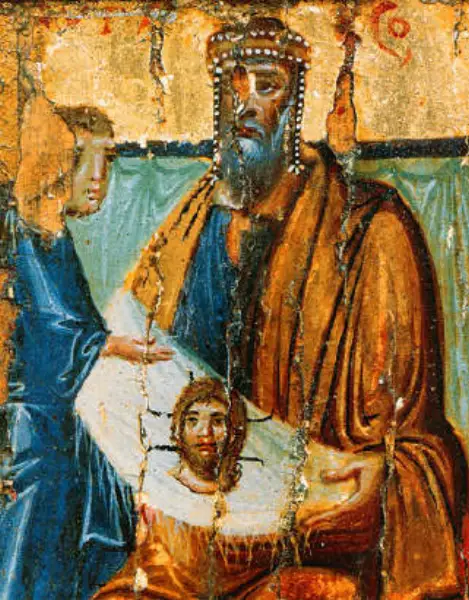
What made Abgar a figure of universal Christian memory is the correspondence. Eusebius, writing in the early fourth century, reports that he found in the Edessene archives a Syriac document containing a letter from Abgar to Jesus and the reply said to have been dictated by the Lord. In it the king, ill and having heard of the cures at Jerusalem, invites Jesus to Edessa, offering a small but noble city great enough for them both; Jesus blesses him for believing without seeing and promises that a disciple will be sent. The Doctrine of Addai, a Syriac work of the late fourth century or later, completes the story: after Pentecost the apostle Thomas sends Addai, one of the Seventy, who heals the king, preaches, and founds the church of Edessa. Later versions add the Mandylion, a portrait of Christ sent to the court, which reached Constantinople in 944. Egeria saw the letter at Edessa and copied it. Scholars judge the correspondence apocryphal, a product of Edessene piety, but the legend encodes a truth: Edessa was Christian very early.
§ Letter of Abgar to Jesus
Mission
Abgar's mission in the legend is that of the royal patron who opens a city to the Gospel. The Doctrine of Addai presents the healed king as a protector of the preachers, and the church that resulted became within two centuries one of the great centers of Syriac Christianity, the place where the Diatessaron was composed, where the poetry of Ephrem would later flower, and where the Syriac language itself was shaped into a theological instrument. Whether or not Abgar personally baptized, the tradition that a king received the faith made Edessa's Christianity respectable, public and old, three things a young church prized. The letter of Jesus, copied on parchment, carved in stone and metal, was carried through the medieval world as an amulet, an application of the legend that its authors might not have foreseen but that testifies to its hold on imagination. In taking the correspondence into his Church History, Eusebius gave the story its passport into Greek and Latin Christendom.
§ References
Spirituality
The spirituality that gathers around Abgar is the spirituality of the letter itself. Jesus' answer, as Eusebius transmits it, blesses the one who believes without seeing, a phrase drawn from the resurrection narrative and applied to a Gentile king before the missions to the Gentiles had properly begun. The tradition thus makes Abgar the first fruit of those who come to faith by report rather than by sight, the patron of every Christian who has believed on testimony. The exchange also honors the small: Jesus declines to come to a great city's court, but the promise that a disciple will be sent teaches that no place is too minor for the Gospel, a word that Edessa, a border town between empires, took to heart and embodied. The legend's restraint about the miraculous, in that healing is deferred to the church's mission rather than performed at a distance, has often been noted; even as an amulet the letter pointed beyond itself to the messenger who would follow it.
§ Introduction
Final Years
Abgar died around the year 50, after a reign that had spanned the whole public life of Jesus and the first two decades of the church. The Syriac tradition makes his last years those of a baptized king, and the Doctrine of Addai surrounds his court with converts. Historically, the Christianization of Edessa's royal house cannot be confirmed, and the dynasty, whatever its members' beliefs, continued to strike coins and navigate between empires until Osroene was absorbed into the Roman system under Abgar's successors. What is certain is that when historians and pilgrims of the fourth century reached Edessa they found a church that claimed the king as its own and possessed the letter to prove it. The translation of the Mandylion to Constantinople on 15 August 944, together with the letter, gave the story a second life in the Byzantine capital and thence in the art and liturgy of both East and West.
§ Letter of Abgar to Jesus
Canonization
No process ever declared Abgar a saint; he belongs to that archaic stratum of sanctity that the churches of Syria, Armenia, Mesopotamia and Byzantium inherited as given. The Syriac churches honor him as the first Christian king, and the Assyrian Church of the East keeps his commemoration on the fourth Friday after Easter, a date that ties his memory to the season of the resurrection appearances that his legend elaborates. The Armenian apostolic tradition, through Khorenatsi, wove him into its own national story, and the Greek and Latin churches knew him through Eusebius and the translating centuries. Devotion focused less on his person than on the relics of the legend, the letter and the image, which were venerated as bridges between the earthly ministry of Christ and the church of the nations. He thus received a cult without a canonization, his sanctity consisting in the role the tradition assigned him as the first ruler to seek the Lord.
§ Introduction
Legacy
Abgar's legacy is Edessa's. The city that legend made the first Christian kingdom became in fact a cradle of Syriac Christianity, the language and literature of which shaped the churches of Persia, India and beyond; the Peshitta, Ephrem's hymns and the earliest Syriac monasticism all belong to that stream. The letter of Abgar and Christ circulated for a thousand years, and its use as a talisman, whatever theologians thought of it, shows how deeply it entered popular devotion. The Mandylion became one of the most discussed images in Christian history, entangled with the story of the Shroud and with the whole theology of the icon. In the modern ecumenical conversation Abgar stands as a reminder that Christianity was royal, public and Syriac-speaking within the apostolic generation by tradition, and the churches of the East claim him as their own charter. For rulers he remains the type of the sovereign who writes to ask rather than to command.
§ Letter of Abgar to Jesus
Timeline
- 50
Dies at Edessa about this year; tradition remembers him as one of the first Christian kings
§ Introduction
- 384
During her Edessa pilgrimage, Egeria reads the letter of Jesus kept there and finds it fuller than copies at home
§ Letter of Abgar to Jesus
- 15 Aug 944
Constantinople's Blachernae church receives the letter of Jesus and the Mandylion; both are then moved to the Pharos church
§ Letter of Abgar to Jesus
In Their Own Words
I have heard the reports of you and of your cures as performed by you without medicines or herbs... either you are God, and, having come down from heaven, you do these things, or else you, who does these things, are the son of God.
The Record
- Major works
- Letter of Abgar to Jesus (apocryphal correspondence)
- Patron of
- Edessa and the Syriac churches·Christian rulers
- Symbols
- Letter and seal·Mandylion, the image of Christ sent to Edessa
- Canonization
- Pre-congregation; honored in the Syriac, Armenian and wider Christian tradition
Prayer
Bibliography
Show 1 sources
- ↑ Arabic : أَبْجَر ٱلْخَامِس أُوكَامَا , romanized : ʾAbǧar al-Ḫāmis ʾŪkāmā , [ citation needed ] Syriac : ܐܒܓܪ ܚܡܝܫܝܐ ܐܘܟܡܐ , romanized : ʾAḇgar Ḥmīšāyā ʾUkkāmā , [ citation needed ] Armenian : Աբգար Ե Եդեսացի , romanized : Abgar Hingerord
Profile text adapted from the Wikipedia article, licensed CC BY-SA 4.0.
Pray with this saint every day
Save St. Abgar V the Black to your favorites, read the full profile, and get feast-day reminders in the Saints app.
Get the Saints AppFree on the App Store for iPhone and iPad