
6th century·Feast December 12 (Gregorian); November 29 (Julian)
St. Abibos of Nekresi
Bishop of Nekresi, Martyr
Overview
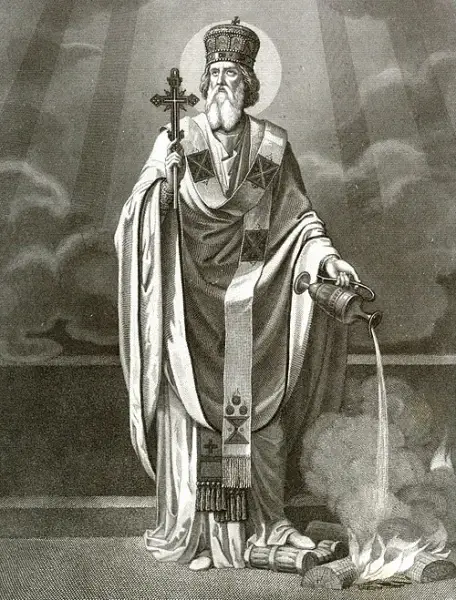
Abibos of Nekresi — in Georgian, Abibos Nek'reseli — is counted among Georgia's thirteen Assyrian apostles, the Syrian brotherhood of monks who came in the sixth century under Saint Ioane of Zedazeni, who led the rebuilding of the Georgian church. He became bishop of Nekresi and began his ministry among the hill villages of Kakheti, the eastern region of Georgia. The chronicle Life of Kartli credits him with spreading Christianity not only among Georgians but among the mountain tribes — the Didoians, ancestors of the modern Dagestanis — beyond the effective reach of church or crown. Eastern Georgia in his day lay under Persian rule, where Zoroastrianism was the faith of those in power. Tradition holds that he poured water over a sacred Zoroastrian flame. He was arrested by the fire-worshippers, beaten and bound, and brought before the Persian marzban; even in custody he received a strengthening letter and eulogia from Simeon the Stylite of the Wonderful Mountain. At Rekhi he died by stoning; his corpse was cast outside for the wild animals, yet the local clergy — forbidden as this was — recovered it and gave it honorable burial.
The Complete Life
The Thirteen Assyrian Apostles
Abibos came to Georgia among the thirteen Assyrian apostles — Syrian monks who arrived in the sixth century under Ioane of Zedazeni and are remembered as the second evangelization of the Georgian church, the founders of its organized monasticism. Their Syriac provenance tied the church of the Caucasus to the wider ascetic world of the Near East, and their settlements — a ring of monasteries across eastern Georgia — became the institutional skeleton of the church. Abibos's own place in the band was Kakheti, the east: as bishop of Nekresi he served the hill villages of a region where the old faiths still held the high country.
§ Introduction
Mission in Kakheti
The chronicle Life of Kartli records that Abibos spread Christianity not only among the Georgians but among the mountain tribes — the Didoians, the ancient predecessors of the modern Dagestanis. This was mission beyond the frontier of the kingdom itself, among peoples whom the Persian-backed order neither governed nor evangelized. It is a rare explicit notice of Christian mission into the Dagestani highlands in antiquity, and it gives Abibos a significance beyond the Georgian church.
§ Introduction
The Fire of Nekresi
Persian power governed Eastern Georgia at the time, and the official cult was Zoroastrianism. The story goes that he extinguished one of the holy fires of the Zoroastrians with water — a direct blow at the rival faith, and the act that set his death in motion. The Zoroastrian priests seized him, tied and beat him, and carried him before the marzban, the Persian governor. Hagiography records a gesture of solidarity from the wider ascetic world: from the Wonderful Mountain, Simeon the Stylite forwarded a letter, a eulogia (most likely a morsel of prosphoron), and a staff meant to fortify his spirit. At Rekhi the Zoroastrian Persians killed him with stones; his corpse was hauled beyond the walls and left for wild animals.
§ Introduction
Cult and Relics
Though it was strictly forbidden, the Rekhi clergy rescued the martyr's remains and laid them to rest with great honor at Samtavisi Monastery, halfway between Mtskheta and Gori. Later, under Prince Stepanoz of Kartli, the relics were translated to Samtavro Monastery at Mtskheta and buried beneath the altar, where his major shrine remains. His feast was kept on 12 November until 1700, when it was moved to 12 December in the Gregorian and 29 November in the Julian calendar — a rare documented shift in a saint's day.
§ Introduction
Legacy
Abibos is one of the clearest cases of martyrdom by Zoroastrian hands in the Georgian tradition, and his image — quenching the sacred fire, painted by Mikhail Sabinin in 1882 — has become an icon of the Georgian church's Persian-era struggle. For the church of Kakheti and for the memory of mission to the Dagestani peoples, he is a founding figure, and his shrine at Samtavro still draws pilgrims.
§ Introduction
The Record
- Patron of
- Kakheti·Nekresi
- Symbols
- Episcopal vestments·Extinguished sacred fire·Stones (instrument of martyrdom)
- Canonization
- Pre-congregation; one of the thirteen Assyrian apostles of Georgia
Prayer
Bibliography
Show 3 sources
- ↑ "Holy Martyr Abibos of Nekresi (6th Century)" . Pravoslavie.ru .
- 1 2 Loosley Leeming, Emma (2018). Architecture and Asceticism: Cultural Interaction between Syria and Georgia in Late Antiquity . Texts and Studies in Eastern Christianity. Vol. 13. Brill. p. 44. ISBN 978-90-04-37531-4 .
- ↑ "About Sights – Nekresi Monastery" . Retrieved 2018-02-21 .
Profile text adapted from the Wikipedia article, licensed CC BY-SA 4.0.
Pray with this saint every day
Save St. Abibos of Nekresi to your favorites, read the full profile, and get feast-day reminders in the Saints app.
Get the Saints AppFree on the App Store for iPhone and iPad