
c. 307–322·Feast November 15 (Orthodox and Catholic); September 2 (Oriental Orthodox)
St. Abibus of Edessa
Deacon, Confessor and Martyr under Licinius
Overview
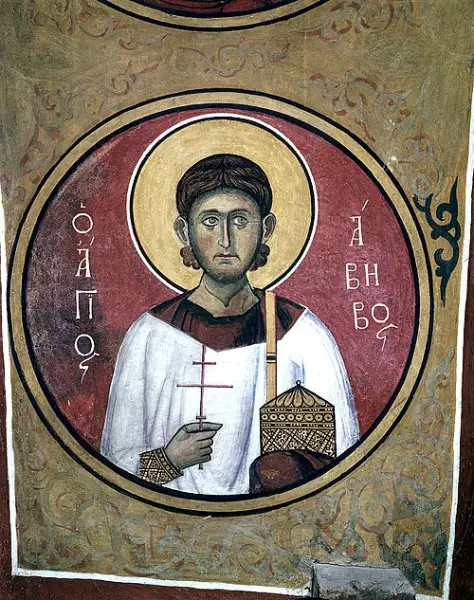
Abibus of Edessa — Syriac Ḥabbīḇ Ōrhāyā, also Abibus the New, Habib the Deacon — was a fourth-century Syrian Christian deacon, confessor and martyr, executed at Edessa by immolation under the emperor Licinius, according to the Martyrdom of Habib the Deacon. Born at Edessa in the Roman province of Osroene around 307 to Christian parents, he worked as a tradesman in his early years and was ordained a deacon at fourteen, the age of legal adulthood in classical antiquity. When the emperor decreed his arrest for preaching and spreading Christianity, Abibus refused to hide, saying that if he stayed out of sight he would be compelling others to take the martyr's crown without any free choice of their own — a man meets death wherever he turns — and so he went straight to those who were to execute him: 'I am Habib, the man you seek.' During days of torture he was scourged and combed by five men; when the governor threatened him he replied that, just as a well-watered tree gives its fruit, torment only made his spirit firmer, and that Christians feel no hatred for the body but rejoice in what is spiritual. He is depicted holding a censer while on fire, and is invoked for contracts, marriages, firemen, and Syria and its people.
The Complete Life
A Tradesman's Son of Edessa
Abibus was born at Edessa — modern Urfa, in southeastern Turkey — in about 307, into a Christian family of the city that was, by the early fourth century, one of the great centres of Syriac Christianity: the city of Abgar, of the Diatessaron, of Bardaisan and later of Ephrem. In his younger years he made his living as a tradesman — the martyrs of the acts are typically artisans and petty merchants, the social world of the urban church — and he was ordained a deacon at fourteen, which the age's law counted as legal adulthood. The title 'the New' by which he is sometimes distinguished belongs to the calendar's need to separate him from earlier Abibuses of the Syriac martyrologies; this Abibus is the deacon of the Licinian persecution, the last of the Roman persecutions before Constantine's peace transformed the Church's situation entirely.
§ Introduction
The Self-Surrender
The emperor — Licinius, in the East, in his final confrontation with Constantine — made a decree for Abibus's arrest for his preaching and spreading of Christianity. The decree is the hinge of the story, because Abibus had the option the other persecuted Christians mostly lacked: he could have hidden. He refused, and the acta give his reasoning in his own voice: that by staying hidden he would be imposing the martyr's crown on others who had not chosen it; that a faith professed only because it was compelled wins nobody's respect; and that wherever a man turns, death awaits him, as it awaits every child of Adam. Determined that nobody, Christian or pagan, should be made to suffer because of the warrant out for him, he went forward and gave himself up to his executioners, declaring, 'I am Habib, the man you seek.' The self-surrender to spare the innocent is one of the most attractive of the martyrs' gestures, and it fixed his character in the Syriac memory.
§ Introduction
Torture and Fire
His trial lasted several days. Five men took turns scourging and combing him, with the iron combs that flay the flesh — the standard apparatus of the acta — and when the governor threatened more gruesome tortures, the dialogue that has come down was spoken: 'Just as a well-watered tree gives its fruit, so my spirit grows only firmer under torment'; and to the governor's frustrated question whether his faith taught him to hate his own body, 'We are no enemies of this material body; our joy is in the spiritual reality.' He was condemned and executed by immolation — burned — the death his iconography remembers: he is depicted holding a censer while on fire, the church's instrument of prayer in his hands as the flames take him, the martyrdom itself become an offering of incense. The date was 322, under Licinius; within a year the persecutor was defeated and the empire Christian.
§ Introduction
Cult and Calendar
The Catholic, Eastern Orthodox and Oriental Orthodox Churches all reckon Abibus among their saints, a rare triple communion for a Syriac martyr — evidence of how early and how widely his cult spread from Edessa. The Eastern Orthodox and Roman Catholic Churches keep his feast on 15 November; the Oriental Orthodox keep it on 2 September, the divergence of dates marking the two liturgical families that inherited him. His patronages are unusually concrete and civic: contracts and marriages — the oaths and bonds of ordinary life that a man who kept faith under torture may be trusted to guard — firemen, for the manner of his death; and Syria and the Syrian people, for whom he has become in modern times a patron and a sorrow, the martyr of the city that has seen so much fire. In art, the censer in the flames remains his sign: prayer at the point of destruction.
§ Introduction
Timeline
- 307
Born at Edessa in the Roman province of Osroene, to Christian parents
§ Early life
- 322
Complying with the emperor's arrest decree, he gives himself up and is sentenced to death by burning under Licinius
§ Execution, burial and hagiographical tradition
- 15 Nov 322
Local Christians, Jews and pagans bury his relics with the martyrs Gurias and Samonas at Beith Elaha Cucla
§ Execution, burial and hagiographical tradition
In Their Own Words
If I remain in secret, others will be forced to receive the crown of martyrdom against their will and what respect will one have in our faith if one does not accept it willingly? Death is before man wherever he goes, such is the fate of all children of adam.
As a tree that is watered bears fruit, so is my spirit strengthened by torment.
I am Habib of Edessa, the one whom you are inquiring for.
The Record
- Patron of
- Contracts·Marriages·Firefighters·Syria and the Syrian people
- Symbols
- Holding a censer while on fire
- Canonization
- Pre-congregation
Prayer
Bibliography
Show 9 sources
- ↑ "Lives of the Saints" . www.holy-transfiguration.org . Retrieved 2023-09-14 .
- 1 2 "Holy Martyrs and Confessors Gurias, Samonas, and Habibus, of Edessa" . www.oca.org . Retrieved 2023-09-14 .
- ↑ Bishop Grigorios of Mesaoria. "Memory of Holy Martyrs and Confessors Gurias, Samonas, and Abibus of Edessa", Orthodox Times , November 15, 2019
- ↑ Holy Martyrs and Confessors Gurias, Samonas and Abibus, of Edessa Retrieved on 20 Feb 2018
- 1 2 Holy Martyrs GURIA, SHAMUNA, and HABIB of Edessa (November 15) , retrieved 2023-09-14
- ↑ Monks of Ramsgate. "Abibus". Book of Saints , 1921. CatholicSaints.Info. 2 September 2016 This article incorporates text from this source, which is in the public domain .
- ↑ Antiochene (2013-03-29). "Habib-i Neccar and Sham'un" . Antiochene . Retrieved 2023-09-15 .
- ↑ Gorgias Encyclopedic Dictionary of the Syriac Heritage website
- ↑ The Cult of Saints in Late Antiquity website
Profile text adapted from the Wikipedia article, licensed CC BY-SA 4.0.
Pray with this saint every day
Save St. Abibus of Edessa to your favorites, read the full profile, and get feast-day reminders in the Saints app.
Get the Saints AppFree on the App Store for iPhone and iPad