
1878-1945·Feast April 30
St. Abimalek Timotheus
Metropolitan of Malabar and All India
Overview
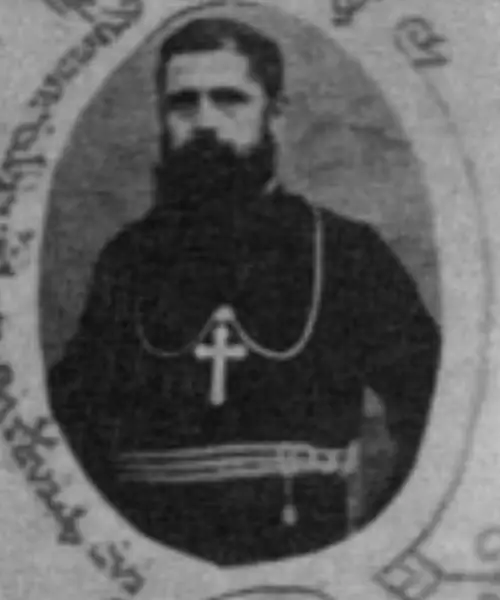
Mar Abimalek Timotheus, a bishop of the Church of the East, governed its Indian flock as Metropolitan of Malabar and All India, holding that office from 1907 to 1945. Born in 1878 at Mar Bisho, a village among the Hakkari mountains then under Ottoman rule, he was formed in the monastic and patriarchal world of that remote church, being ordained deacon and then priest by Catholicos-Patriarch Shimun XIX Benyamin in 1903. When the Chaldean Syrian Church of Trichur in India petitioned the patriarch for a bishop of their own, Shimun XIX chose Timotheus, who was consecrated on 15 December 1907 in the patriarchal cathedral at Qochanis and sent across the sea. For nearly four decades he governed the Indian church through famine, war and the catastrophe that overtook his own people in Hakkari after 1915. He died at Trichur on 30 April 1945. The Holy Synod announced his canonization in 2018, and he was formally proclaimed a saint by Catholicos-Patriarch Gewargis III on 29 September 2019.
The Complete Life
Early Life
Timotheus was born in 1878 at Mar Bisho, a village of the Hakkari mountains in what was then the Ottoman Empire, the inaccessible homeland of the independent Assyrian people among whom the patriarchs of the Church of the East had their seat. His world was one of stone villages, ancient liturgy in Syriac, and a church that had survived the loss of its medieval heartland by retreating into the mountains. Formation for ministry in such a church meant apprenticeship to the patriarchal household itself: study of the scriptures and the fathers in the classical tongue, the daily round of the divine office, and the practical learning of a community that governed itself with little help from the state. His gifts were noticed early, and his ordinations came from the highest hands. He was made deacon on 7 July 1903 and priest on 21 September of the same year, in both cases by Catholicos-Patriarch Shimun XIX Benyamin, the martyred patriarch under whom the Assyrian nation would pass through its greatest trial.
§ Introduction
Vocation
His vocation took definite shape through a petition from India. The Chaldean Syrian Church at Trichur, a community of the St. Thomas Christians of Kerala that had placed itself under the patriarch of the Church of the East, had no bishop of its own and asked Shimun XIX to appoint one. The patriarch's choice fell on the young priest Timotheus, whom he consecrated bishop on 15 December 1907 in the Patriarchal Cathedral of Mar Shalita at Qochanis, with Mar Yalda Yahballaha as co-consecrator. The title given him, Metropolitan of Malabar and All India, carried responsibility for a church an ocean away from the mountains that had formed him. The consecration itself, in the winter of the Hakkari, joined two worlds that would define his life: the Syriac Christianity of the East, ancient and embattled, and the vivid, numerous Christianity of the Malabar coast, which claimed origins with the apostle Thomas. Timotheus accepted the charge and left for India, never again to see his homeland whole.
§ Introduction
Mission
The mission that awaited him in Malabar was not the founding of a church but the pastoring of one already old. The Chaldean Syrian community of Trichur, today's Thrissur, needed steady administration, sacramental life in the Syriac tradition, clergy, schools and a voice amid the complicated ecclesiastical politics of Kerala, where Rome, the West Syrians and the Church of the East all had congregations descended from the same Thomas Christian roots. Timotheus gave the community nearly four decades of exactly that steadiness. He ordained clergy, maintained the liturgy, corresponded with the patriarchs, and led the church through the years of two world wars, during which the connection with Hakkari was repeatedly broken and the Assyrian homeland itself was destroyed in the upheavals that followed 1915. That his community emerged from those decades intact and self-confident, with its identity as the Indian province of the Church of the East preserved, is the measure of his work.
§ Introduction
Final Years
Timotheus died on 30 April 1945 at Trichur, having governed the Indian church for thirty-eight years. His death closed one of the longest episcopates in the modern history of the Church of the East, and it came only months before the end of the Second World War, in a world in which his own nation had lost its mountain homeland and been scattered into Iraq, Syria, Iran and the diaspora. The community he left behind mourned him as a father, and his memory remained alive among the Chaldean Syrian faithful, who kept his grave and told of his patience and his care. Sainthood, in his church, was not an everyday occurrence: the Church of the East had for centuries recognized the saints of antiquity without adding new names. His long and faithful service made him the natural exception when the church decided to act again.
§ Introduction
Canonization
In May 2018 the Assyrian Church of the East's Holy Synod made known that Timotheus would be raised to the altar, a step made possible by a canonization procedure newly adopted — the first such procedure in the modern history of that ancient church. The formal proclamation took place on 29 September 2019, when Catholicos-Patriarch Gewargis III declared him a saint. The choice was significant in several ways: he was a modern bishop, not an ancient father; he belonged to the missionary and pastoral history of the church rather than to the age of martyrs; and his field was India, evidence of the world-wide character of a church often identified only with its Mesopotamian past. His canonization thus marked both a continuity, the church's confidence that holiness is found among its recent pastors, and a new chapter, the revival of a formal process of recognition that had long lain dormant.
§ Introduction
Legacy
Timotheus' legacy lives chiefly in the Chaldean Syrian Church of India, the community he served for almost forty years and which continues in Thrissur and the surrounding country, keeping the East Syriac liturgy that he maintained. For the Assyrian Church of the East worldwide he stands as proof that the ancient church of the East can produce and recognize modern saints, and his canonization in 2019 has become a point of reference for its self-understanding as a global rather than merely historical community. He also belongs to the larger story of the St. Thomas Christians of Kerala, whose divisions and renewals over the last two centuries have drawn in bishops from Portugal, Rome, Antioch and Qochanis alike; his long tenure represents one of that tradition's stable chapters. For interchurch relations he offers a model of a missionary bishop who became an indigenous pastor, dying among the people he was sent to serve.
§ Introduction
Timeline
- 28 Aug 1878
Born at Mar Bisho in the Ottoman Empire
§ Introduction
- 7 Jul 1903
Ordained deacon by Mar Shimun XIX
§ Introduction
- 21 Sep 1903
Ordained priest by Mar Shimun XIX
§ Introduction
- 1907
Appointed Metropolitan of Malabar and All India, an office he held until his death
§ Introduction
- 15 Dec 1907
Consecrated bishop at the Patriarchal Cathedral of Mar Shalita in Qochanis
§ Introduction
- 30 Apr 1945
Dies at Trichur, Cochin, in British India
§ Introduction
- May 2018
The Holy Synod of the Assyrian Church of the East announces his coming canonization
§ Introduction
- 29 Sep 2019
Formally proclaimed a saint by Catholicos-Patriarch Gewargis III at Thrissur
§ Introduction
The Record
- Patron of
- The Chaldean Syrian Church of India·Church of the East faithful in Kerala
- Symbols
- Metropolitan's cross·Assyrian liturgical vestments
- Canonization
- Canonized by the Assyrian Church of the East; proclaimed by Catholicos-Patriarch Gewargis III on 29 September 2019
Prayer
Bibliography
Show 5 sources
- 1 2 Assyrian Church of the East (2018). "The Third Holy Synod of the Assyrian Church of the East Convened under His Holiness Mar Gewargis III, Catholicos-Patriarch" (PDF) . Retrieved 30 January 2020 .
- ↑ Mooken, Aprem (1975). Mar Abimalek Timotheus: A Biography . Trichur: Mar Narsai Press. pp. 6, 13.
- 1 2 Coakley, James F. (2018). "Timotheus, Abimalek" . Gorgias Encyclopedic Dictionary of the Syriac Heritage: Electronic Edition . Beth Mardutho . Retrieved 30 January 2020 .
- ↑ "Sainthood for Mar Abimalek Timotheus" . The Times of India . 28 September 2019 . Retrieved 30 January 2020 .
- ↑ Assyrian Church of the East (17 November 2019). "Fourth Bi-lateral Dialogue Meeting of the Assyrian Church of the East and the Russian Orthodox Church" . Retrieved 30 January 2020 .
Profile text adapted from the Wikipedia article, licensed CC BY-SA 4.0.
Pray with this saint every day
Save St. Abimalek Timotheus to your favorites, read the full profile, and get feast-day reminders in the Saints app.
Get the Saints AppFree on the App Store for iPhone and iPad