
c. 756-786·Feast January 8 (January 21 Old Style)
St. Abo of Tiflis
Martyr of Tbilisi
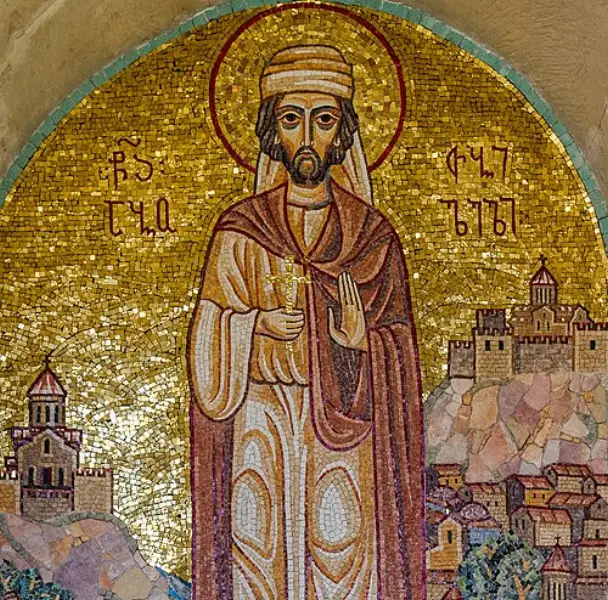
Overview
Abo of Tiflis was a Christian martyr of Arab origin, born around 756 in Baghdad and raised a Muslim in the young Abbasid capital. Trained as a perfumer, a craft demanding practical knowledge of chemistry, he entered the service of the Georgian prince Nerses of Kartli, who had been held in confinement in Baghdad after being slandered before the caliph and was then freed by a new caliph. Abo followed Nerses to Tbilisi, the Arab-ruled capital of eastern Georgia, and there began the long soul-searching that ended in his conversion to Christianity — a conviction reached only after heated arguments even with Christian priests and bishops. At first he kept his faith quiet, abandoning Muslim prayer for Christian prayer while still under Arab rule. When Nerses sought shelter among the Khazars north of the Caspian, Abo went with him and was baptized; in free Abkhazia he then gave himself to prayer and ascetic discipline. Returning to Tbilisi with Nerses in 782, Abo spent about three years openly confessing Christ in the streets of the Arab emirate, strengthening Christians and calling his fellow Arabs to the Gospel. Denounced in 786, he confessed his faith at trial and was executed on 6 January 786. His contemporary Ioane Sabanisdze wrote his life in The Martyrdom of Saint Abo.
The Complete Life
Early Life in Baghdad
Abo was born around 756 in Baghdad, the new capital of the Abbasid caliphate, and grew up as a Muslim Arab of the city. He earned his living as a perfumer, standing out for the fine perfumes and ointments he compounded — a craft demanding practical chemistry and ranking him among the skilled artisans of that cosmopolitan capital. His path was redirected by politics: the Georgian prince Nerses, ruler of Kartli in the Caucasus, was slandered before the caliph and spent three years in confinement in Baghdad; when a new caliph freed him, Abo entered his service and went north with him to the Georgian world.
§ Life
Conversion
In Tbilisi, the Arab-ruled capital of eastern Georgia, Abo encountered Christianity and began the inquiry of his life. His conversion was neither sudden nor sentimental: it followed a committed process of soul-searching, one that brought heated disputes with Christian priests and even bishops over the fine points of religion — and, as the tradition tells it, those disputes only hardened his certainty that Christianity held the truth. With Arab power governing eastern Georgia, he did not at once declare himself: he gave up the Muslim practice of five daily prayers and took up Christian prayer instead, a convert in everything but baptism. When Prince Nerses had to take refuge in Khazaria — a land beyond the Caspian, out of reach of Muslim authority — Abo went along and received baptism there; moving on with Nerses to Abkhazia, also free of Arab dominion, he lived a zealous life of prayer and ascetic struggle, preparing for a mission he already foresaw.
§ Life
Mission in Tbilisi
In 782 Nerses and his party returned to Tbilisi, and Abo, warned that it was not safe for him there, went anyway. For about three years he openly confessed his Christian faith in the streets of the city, doing two things at once: steadying by his example those Christians tempted to flee Arab dominion, and laboring to bring his fellow Arabs to Christ. Neither threats nor warnings could cool his zeal. The mission he carried out was that of the lay witness — a perfumer with no office in the church whose public confession made the Gospel visible in the capital of the emirate.
§ Life
Trial and Martyrdom
In 786 Abo was denounced to the Arab officials of Tbilisi as a Christian — as an apostate from Islam, which was the more serious charge. Arrested, he faced a judge who tried to talk him back into the religion of his forefathers. He stood firm in his confession at the trial, was held in prison, and on 6 January 786 was put to death. His death made him at once the patron martyr of the city; a church of St. Abo stands in Tbilisi today, and his memory is bound to the Christian identity of the Georgian capital under centuries of Muslim rule.
§ Life
Cult and Commemoration
Abo is a pre-congregation saint, venerated in the Eastern Orthodox Church and recognized in the Catholic Church as well. His feast is kept on 8 January, corresponding to 21 January on the Old Style Julian calendar. His cult is strongest in Georgia, where his major shrine is the church dedicated to him in Tbilisi. His life was written within living memory of his death by Ioane Sabanisdze, the Georgian religious writer who was his contemporary, in the hagiography known as The Martyrdom of Saint Abo — one of the earliest works of Georgian literature to treat a recent event and a foundation of Georgian hagiography.
§ Introduction
Legacy
Abo's significance lies first in what he was: an Arab Muslim of Baghdad, converted by argument and example, who chose to return to a city where his baptism was a capital crime. He is the patron of Tbilisi and a classic patron of converts, showing that the movement between the two great faiths, so fraught in every century, has also produced saints. The Martyrdom of Saint Abo remains a central text of early Georgian literature and a principal source for the history of Arab-rule Tbilisi. In modern Georgia, a church built in his honor in the capital's old city keeps his witness before a new generation.
§ Life
Timeline
- 756
Born in Baghdad in the Abbasid Caliphate and raised as a Muslim, training as a perfumer
§ Introduction
- 782
Returns to Tbilisi with Nerses despite warnings that it is unsafe for him as a Christian convert
§ Life
- 6 Jan 786
Denounced and arrested as a Christian, confesses his faith at trial, and is executed in Tbilisi
§ Life
The Record
- Patron of
- Tbilisi·Converts
- Symbols
- Cross·Martyr's palm
- Canonization
- Pre-congregation; venerated in the Eastern Orthodox and Catholic Churches
Prayer
Bibliography
Show 12 sources
- ↑ Thomson, Robert W. (1996). Rewriting Caucasian History: The Medieval Armenian Adaptation of the Georgian Chronicles . Oxford University Press. pp. 234– 236.
- ↑ Hewsen, Robert H. (2001). Armenia: A Historical Atlas . University of Chicago Press. p. 109.
- ↑ Rapp Jr., Stephen H. (2017). The Sasanian World through Georgian Eyes: Caucasia and the Iranian Commonwealth in Late Antique Georgian Literature . Routledge. p. 187.
- ↑ Bosworth, C. E. (1986). The History of al-Ṭabarī, Vol. 30: The ʿAbbāsid Caliphate in Equilibrium . SUNY Press. pp. 45– 46.
- 1 2 3 4 5 6 Lang, David Marshall (1956). Lives and Legends of the Georgian Saints . Allen & Unwin. pp. 55– 60.
- ↑ van Esbroeck, Michel (1982). La littérature hagiographique géorgienne . Peeters. pp. 120– 125.
- ↑ Toumanoff, Cyril (1963). Studies in Christian Caucasian History . Georgetown University Press. p. 402.
- ↑ Golden, Peter B. (2007). Khazars: Studies in History and Culture . Ashgate. pp. 89– 90.
- ↑ Martin-Hisard, Bernard (1996). Christian Caucasian History . Variorum. pp. 210– 212.
- ↑ Rapp Jr., Stephen H. (2014). The Blackwell Companion to Eastern Christianity . Wiley-Blackwell. pp. 137– 138.
- ↑ "Martyr Abo the Perfumer, of Tbilisi, Georgia" . Orthodox Church in America .
- ↑ van Esbroeck, Michel (1982). La littérature hagiographique géorgienne . Peeters. p. 123.
Profile text adapted from the Wikipedia article, licensed CC BY-SA 4.0.
Pray with this saint every day
Save St. Abo of Tiflis to your favorites, read the full profile, and get feast-day reminders in the Saints app.
Get the Saints AppFree on the App Store for iPhone and iPad