
c. 343-360·Feast December 12
St. Abra of Poitiers
Virgin, Daughter of St. Hilary of Poitiers
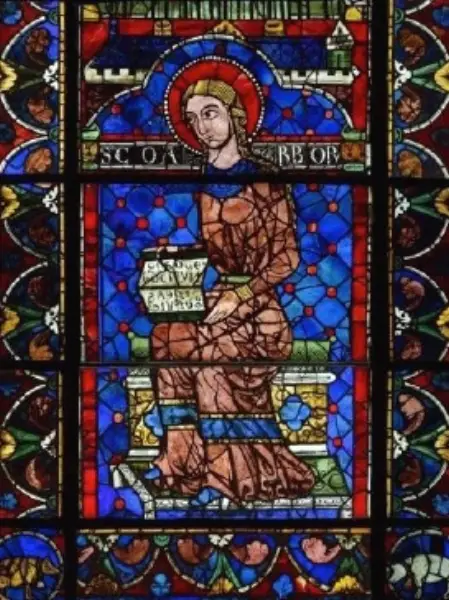
Overview
Abra, also spelled Afra or Apra, is a saint of fourth-century Gaul remembered as the daughter of Hilary of Poitiers, the great defender of the Trinity against Arianism. According to the medieval accounts that carry her memory, she was born while Hilary was still a married layman, before his unexpected elevation to the episcopate, and she grew up in a household newly and seriously Christian. Following her father's counsel she is said to have consecrated herself to God as a virgin, declining the marriage arranged for her, and to have given herself to prayer and to the service of the poor around Poitiers. She is reported to have died around 360, in her seventeenth or eighteenth year, shortly after her father's return from exile, with Hilary himself said to have witnessed her death. Her existence, however, is historically uncertain: the sources that name her date from centuries after Hilary's time, and a letter attributed to him concerning her is judged a medieval forgery. The cult at Poitiers kept her feast on 12 December.
The Complete Life
A Bishop's Household
Everything reported of Abra hangs on her father. Hilary of Poitiers was a Gallo-Roman aristocrat, married, with a daughter — so much at least is consistent across the sources — when the clergy and people of Poitiers raised him to the episcopate around 350, a common and canonically awkward occurrence in the fourth-century West. The medieval narratives give the girl the name Abra, or Afra, or Apra, and report that she was born around 343, before her father's orders. She would have been small when Hilary began the fight against Arianism that would cost him four years of exile in Asia Minor under Constantius II. The household in which she grew up was therefore one of intellectual conversion, sudden prominence, and danger — a father present, then absent, then returned.
Consecrated Virginity
The tradition reports that Abra, on her father's advice, renounced marriage and consecrated herself to God as a nun — language that anticipates the institutional consecrated virginity of a later age, applied to a fourth-century girl of aristocratic family. Such a decision, in her world, was not private: the marriage of a senatorial daughter was an alliance, and refusing it was a public act. The accounts add that she used what means she had in charity toward the poor of the region around Poitiers, and that her Christian example helped spread the faith there. The picture is of the briefest of vocations — a few years of resolved virginity and almsgiving, ended before it could bear visible fruit.
Death and the Question of History
Abra is said to have died around 360, aged seventeen or eighteen, shortly after Hilary's return from exile, and the medieval accounts place her father at her deathbed. Here the sources must be handled honestly. Nothing about Abra appears in Hilary's own considerable writings or in the records of his contemporaries; her story is carried by hagiography composed centuries later, and a letter in which Hilary is made to write to her about her mother is universally judged a medieval forgery. Modern scholars are divided: some allow that Hilary's married state implies a real daughter behind the legend, others doubt she existed at all. What is certain is that Poitiers kept a feast of Abra on 12 December through the Middle Ages, and that medieval writers, Montaigne among their later readers, found in her early death a subject for reflection.
Cult
Abra's sanctity rests on local cult rather than formal process: pre-congregation in the strict sense, and never confirmed by Rome. Her feast on 12 December is recorded for Poitiers; she appears in the older biographical dictionaries of the saints, and medieval authors compared her to Sarah, the scriptural wife whose name means princess. The uncertainty of her history has kept her cult small and local — a saint carried by a city's memory of its greatest bishop and of the household that shared his exile-era trials.
Legacy
Abra's legacy is narrow but real. She witnesses to the early appearance of consecrated virginity in Gallic aristocratic society, a generation before the great monastic foundations of the West. She is part of the domestic face of Hilary's story — the bishop as husband and father in an age when the discipline was still settling — and a reminder that the families of the Fathers were themselves part of the church's formation. Montaigne, reading the medieval accounts of her death, used them to think about the deaths of the young in his own day, which is a small immortality for a girl about whom nothing certain can be said. Her profile is retained with the honest caveat that history may have given her only a name and a feast.
Timeline
- 12 Dec 339
Born at Poitiers to Hilary, then a married layman
§ Introduction
- 360
Hilary returns from exile in the East
§ Hagiography
- 360
Dies shortly after her father's return, supposedly in her seventeenth or eighteenth year
§ Hagiography
The Record
- Patron of
- Young women discerning virginity or consecrated life
- Symbols
- Lily (virginity)·Palm
- Canonization
- Pre-congregation; local cult at Poitiers; historicity uncertain
Prayer
Profile text adapted from the Wikipedia article, licensed CC BY-SA 4.0.
Pray with this saint every day
Save St. Abra of Poitiers to your favorites, read the full profile, and get feast-day reminders in the Saints app.
Get the Saints AppFree on the App Store for iPhone and iPad