
c. 293 – c. 366·Feast October 29 (Catholic and Eastern Orthodox); October 24 (Syriac Orthodox); December 14 (Syriac Catholic); July 29 (Coptic)
St. Abraham Kidunaia
Syriac Hermit and Priest
Overview
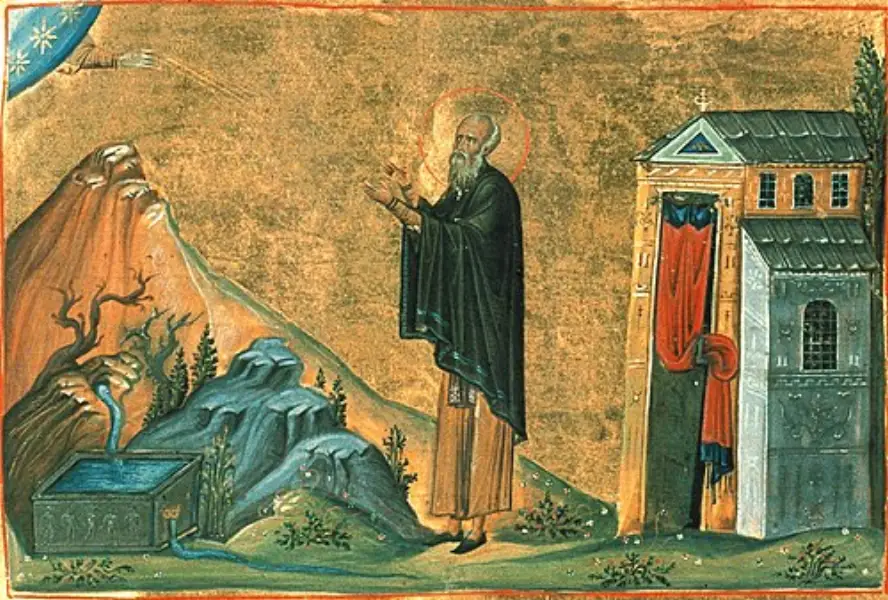
Abraham Kidunaia was a Syriac hermit and priest of the fourth century whose life was written by his friend Saint Ephrem the Syrian, an unusually good pedigree for a desert saint. Born around the 290s to a wealthy family near Edessa and given a careful education, he submitted to his parents' wish that he marry, but at the door of the ceremony he told his bride of his desire to give his life to God; she accepted, and he withdrew to a cell near the city, walling up the door and leaving only a window through which food could be passed. When his parents died and left him wealthy he gave the inheritance to the poor. Ordained priest by the bishop of Edessa, he was sent to the stubbornly pagan village of Beth-Kidunaa, where he smashed the idols, was driven out, returned, was driven out again, and persisted for three years until the place was converted. He then withdrew to his cell for some fifty years of prayer, famed for gentleness, and died around 366 at about seventy. A famous episode concerns his niece Mary, whom he rescued from a life of prostitution in the Troad.
The Complete Life
Early Life
Abraham was born near Edessa, the great Syriac-speaking city beyond the Euphrates, sometime around the 290s, into a family wealthy enough to give him an excellent education in an age when that meant Greek and Syriac letters, scripture, and perhaps rhetoric. His parents, pious and practical, arranged a marriage for him, as parents of property did; Abraham, whose heart had already turned toward the ascetic life then spreading through Syria in the generation after Anthony, did not rebel. He went through the preparations, allowed the day to arrive, and then, on the very threshold of the ceremony, told his bride that he wished to dedicate himself wholly to God. The sources record her acceptance without drama; the Syriac world of the fourth century knew what the renunciation of marriage meant and could honor it. Abraham then settled in a cell outside the city and did what few hermits have done so literally: he walled up the door, leaving only a small window, so that the world would have to come to him one plate of bread at a time. Ten years later both his parents died, leaving him a rich man; he had the whole inheritance distributed among the poor.
§ Introduction
The Runaway Groom
The episode at the wedding has given Abraham Kidunaia his minor modern nickname, and it deserves attention because of what it reveals about Syrian asceticism. This was not a rejection of the bride as a person, and the tradition takes care to note her consent and dignity; it was a claim that a life could be offered entirely to God, body and estate and future. The walled cell made the claim permanent and visible. From the window Abraham became known in the district as a holy man; the sick, the troubled, and the simply curious came to the wall, and counsel passed through the opening. Ephrem the Syrian, the greatest poet of the Syriac church, knew him personally and wrote his Vita, which is why the outline of this life survives where so many desert lives are lost. In due course the bishop of Edessa judged that so renowned a recluse ought to be a priest, and Abraham, obedient, received ordination, and with it an assignment that would draw him out of his enclosure entirely.
§ Introduction
Beth-Kidunaa
The bishop's assignment was a mission parish of the least promising kind: Beth-Kidunaa, a village attached to its idols. Abraham went, and his first pastoral act was to destroy the pagan altars and images. The villagers, unsurprisingly, drove him out. He returned; they drove him out again; he returned again. The Vita compresses the episode into a rhythm of expulsion and persistence that reads almost as comedy, but the point is serious: Abraham had no leverage, no garrison, no patron; he had only patience, and he outlasted the village's anger. Within three years the place was Christian, at least in the reckoning of the hagiographer, and Abraham, fearing, the text says, that success might attach him to the possessions and affection he had won, asked leave to withdraw. He returned to his cell near Edessa, and there he remained for the better part of fifty years, in prayer and penance, receiving through the window those who still came, and gaining the reputation the tradition summarizes in a single trait: he never corrected anyone harshly; every rebuke he gave was wrapped in charity and gentleness.
§ Biography
Mary the Niece
The most human chapter of the Vita belongs not to Abraham but to his niece Mary. Left an orphan, the girl had been given into his keeping; he made her a cell beside his own and brought her up in letters and devotion until her twentieth year. Then a false monk seduced her, and the ashamed girl fled, ending in the Troad on the northwest coast of Asia Minor as a prostitute. For two years Abraham lamented her disappearance without knowing where she had gone. When word finally reached him, he did not send a letter or a rebuke: he put on traveler's clothes, let his hair and beard grow unkempt, went to the town where she was, lodged near her, and won his way in as a customer. Then, in a scene the Syriac churches have never forgotten, he revealed himself, not in anger but in grief and love, and led her home. The story became one of the classic tales of the rescue of a fallen woman, told of several fathers, but belonging most tenderly to the gentle recluse of Edessa.
§ Introduction
Final Years and Death
Abraham's last decades were the long evening of the walled cell. The Vita counts his years there, after his return from Beth-Kidunaa, at about fifty, which would make him near ninety at his death if all the figures are pressed literally; the sources more cautiously say he died around 366 at about seventy, and the discrepancies are the normal arithmetic of hagiography. Edessa remembered him as a priest who had buried himself alive for love of God and been twice drawn out, once for a stubborn village and once for a ruined niece, and whose counsel through the window had settled quarrels and guided monastics. He was buried near his cell, and his cult spread quickly through the Syriac churches and their neighbors. His commemoration multiplied across the calendars of the Christian East: 29 October in the Byzantine and Catholic traditions, 24 October for the Syriac Orthodox, 14 December for the Syriac Catholics, and 29 July among the Copts, a fourfold feast rare even among desert saints.
§ Introduction
Legacy
Abraham Kidunaia stands at the head of that distinctively Syriac form of sanctity in which extreme physical enclosure is joined to extreme pastoral tenderness. The wall with its window became an image that later Syriac and Byzantine hagiography reused; the runaway groom gave preachers a stock figure for the vocation that overrides family plans; and the rescue of Mary entered the common inheritance of Christian literature on repentance, echoed in the parables of the seeking father. Modern readers find in him, too, an unexpected model for mission: his three years at Beth-Kidunaa are a study in non-coercive persistence, a missionary who destroyed idols but stayed to be expelled, and stayed again, until the village kept him. In the calendars of the churches that remember him, from Rome to Kerala, he remains what Ephrem first drew: a man gentler than his austerities, whose strength was hidden behind a wall and spent entirely on others.
§ Introduction
Timeline
- 290
Born to a wealthy family near Edessa, between about 290 and 296
§ Biography
- 366
Dies aged about seventy after a long life as hermit and priest
§ Introduction
The Record
- Patron of
- Hermits and anchorites·Those fleeing arranged marriages·Difficult parishes
- Symbols
- Walled cell with a window·Broken idols·Monastic habit
- Canonization
- Pre-congregation (ancient cult)
Prayer
Bibliography
Show 6 sources
- 1 2 Butler, Alban. "St. Abraham, Hermit", The Lives of the Saints , Vol.III, 1866
- ↑ Johnson, Elizabeth. "St. Abraham Kidunaia: the runaway groom", Faith magazine, Diocese of Lansing, Michigan, March 2010
- 1 2 "Abraham Kidunaia", Oxford Dictionary of Saints
- ↑ "St. Abraham Kidunaia", Catholic Courier , Diocese of Rochester, March 9, 2008 Archived December 7, 2014, at the Wayback Machine
- 1 2 Staley, Tony. "Left the altar for the desert", The Compass , Diocese of Green Bay, Wisconsin, March 14, 2003
- ↑ Martyrologium Romanum (Libreria Editrice Vaticana 88-209-7210-7). The date was formerly March 16.
Profile text adapted from the Wikipedia article, licensed CC BY-SA 4.0.
Pray with this saint every day
Save St. Abraham Kidunaia to your favorites, read the full profile, and get feast-day reminders in the Saints app.
Get the Saints AppFree on the App Store for iPhone and iPad