
died c. 345·Feast February 4–5 (Syriac Churches); January 31 (Catholic)
St. Abraham of Arbela
Bishop and Martyr under Shapur II
Overview
Abraham of Arbela — Abramius, as he is also called — was the bishop of Arbela in Sassanid Persia who died a martyr around 345, in the great anti-Christian persecution ordered by Shapur II. When Bishop Ioannis of Arbela was imprisoned for the faith, the local Christian community appointed Abraham as his deputy, and he inherited the same fate. The church historian Sozomen, writing about a century later, devoted a passage of his Ecclesiastical History to the Persian persecutions and included Abraham among the bishops, priests, deacons and consecrated virgins whose blood was shed in almost countless multitude. Abraham was tortured and finally beheaded at Telman because he refused to worship the sun, the official cult which Shapur used as a test of loyalty. He is commemorated on 4 and 5 February in the Syriac churches, and on 31 January in the Catholic Church. With Papa bar Gaggai of Seleucia-Ctesiphon and Simeon bar Sabba'e before him, Abraham belongs to the first rank of the bishops who refused to buy peace with the sun. The Church of the East, which still keeps his feast, looks back to men like him as its foundation.
The Complete Life
A Church under Two Empires
Arbela — modern Erbil, in what is now Iraqi Kurdistan — was the seat of one of the oldest bishoprics of the Church of the East, in a province that changed hands between Rome and Persia more than once. Christians of the Persian empire lived under a permanent suspicion of sympathy with Rome, the enemy power, and whenever the two empires went to war that suspicion turned lethal. Under Shapur II, after Constantine's conversion had made Christianity in Persian eyes a Roman religion, the suspicion became policy: the martyrdoms of the 340s, recorded in Syriac martyrologies and summarized by the Greek church historians, rank among the fiercest persecutions the ancient Church endured. Nothing is recorded of Abraham's birth or family; what matters in the record is his office. He was a bishop of that embattled see, a successor of the long line of bishops of Adiabene whose acts the Syriac tradition preserved.
§ Introduction
Deputy Bishop in Time of Persecution
The immediate occasion of Abraham's martyrdom was an arrest. Ioannis (John), the bishop of Arbela, was imprisoned for the faith, and while he lay in prison the local religious community appointed Abraham as his deputy to carry on the government of the church. The arrangement shows both the crisis and the church's resilience: a community whose bishop was in chains simply chose another to stand in his place, knowing what standing in his place would mean. Sozomen, in the second book of his Ecclesiastical History, describes the persecutions and tortures under Shapur and says that in those days a multitude past counting — bishops, priests, deacons and the rest of the clergy, together with religious and consecrated virgins — won the martyr's crown; among the names he managed to preserve was that of Bishop Abraham of Arbela. Abraham too was seized, and tortured to induce him to worship the sun.
§ Introduction
Martyrdom at Telman
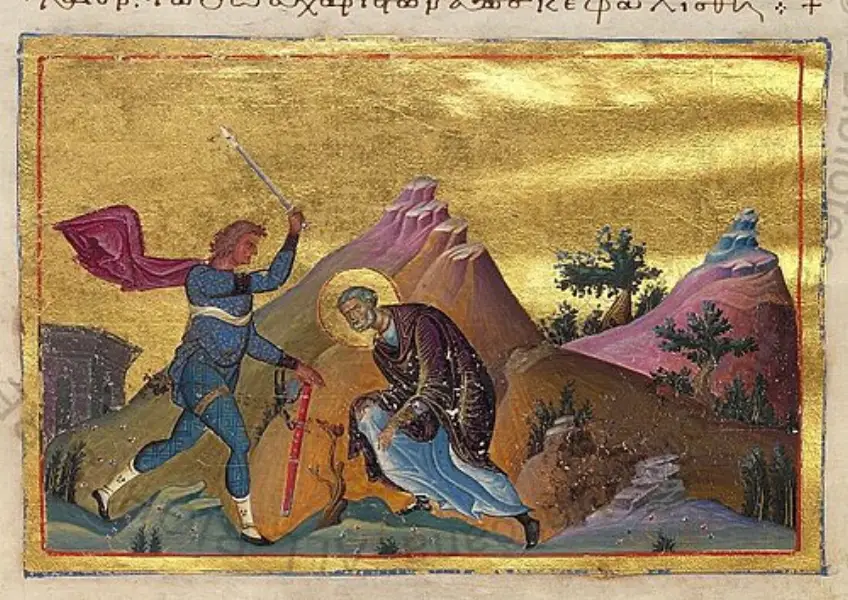
The test applied to Abraham was the one applied across Shapur's persecution: worship the sun — the object of Zoroastrian devotion which the crown made a token of political loyalty — and live. Abraham refused. He was tortured and then beheaded at Telman, a site otherwise obscure in the record. The date given is about 345, in the middle years of the persecution. His emblem in later Christian art is a sword beside him, the instrument of his beheading. The manner of the death — sword rather than crucifixion or fire — identifies him in the iconographic tradition, which relied on such emblems to distinguish the many Persian martyrs who otherwise shared a single story: bishop, confessor, refusal, death.
§ Introduction
Cult and Calendar
Abraham belongs to the pre-congregational martyrs: no process canonized him because none was needed — the churches of the East simply kept his feast, and keep it still. His commemoration is doubled in the Syriac calendars on 4 and 5 February, and the Catholic Church honours him on 31 January. He is also called Abramius in some sources, a Greek form of the same name, and must be distinguished from the several other Abrahams of the Syriac martyrologies — the period produced many. He stands in this collection as a bishop of the Church of the East, martyred not by a pagan Roman magistrate but by a Christian-era Persian king, a reminder that the great persecutions were not a Roman monopoly and that the Church of Iraq was born in that blood.
§ Introduction
The Record
- Patron of
- Persian Christians; the Church under persecution
- Symbols
- Sword beside him (emblem in art)
- Canonization
- Pre-congregation (ancient martyr cult)
Prayer
Bibliography
Show 5 sources
- ↑ Husenbeth, Frederick Charles. Emblems of Saints: By which They are Distinguished in Works of Art , Longman, Green, Longman, and Roberts, 1860, p. 1
- ↑ † ca 345 Abraham van Arbela Retrieved on 27 Feb 2018
- ↑ Abraham, bishop of Arbela - ܐܒܪܗܡ(d. 345), saint Retrieved on 27 Feb 2018
- ↑ St. Abraham Retrieved on 27 Feb 2018
- ↑ Roman Martyrology
Profile text adapted from the Wikipedia article, licensed CC BY-SA 4.0.
Pray with this saint every day
Save St. Abraham of Arbela to your favorites, read the full profile, and get feast-day reminders in the Saints app.
Get the Saints AppFree on the App Store for iPhone and iPad