
d. 1 April 1229·Feast April 1
St. Abraham of Bulgaria
Martyr (Avraamy Bolgarsky)
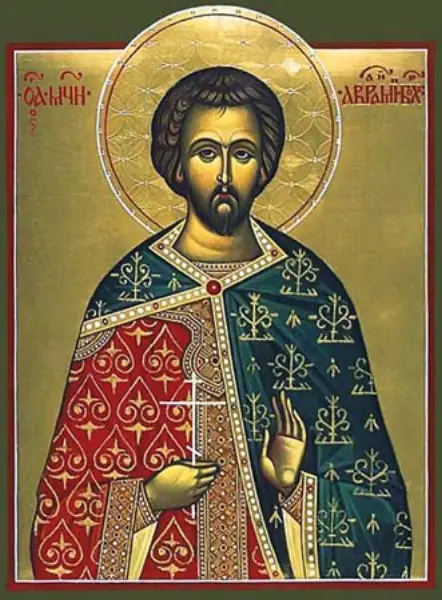
Overview
Abraham of Bulgaria, in Russian Avraamy Bolgarsky, was born among the Muslim Volga Bulgars of the twelfth or thirteenth century, in what is now Tatarstan. He grew into an Islamic merchant known for kindness to the destitute, and in adult life he converted to Christianity. His compatriots pressed him persistently to renounce Christ; he remained unshakable, and on 1 April 1229, at the bank of the Volga near Bolghar, the capital of Volga Bulgaria, he was put to death for his conversion — cut apart by the sword and then decapitated. Russian merchants buried him in the Christian cemetery at Bolghar, and Georgy Vsevolodovich, Grand Prince of Vladimir, ordered his body translated to Vladimir. The chronicles record that soon afterward the city of Bulgar burned, read by contemporaries as punishment 'for the blood of the martyr of Christ,' and a healing spring appeared at the place of execution.
The Complete Life
Early Life
Abraham was born in Volga Bulgaria, the prosperous trading state of the Muslim Volga Bulgars that stood on the middle Volga in what is now Tatarstan. Very little is known of his life: the basic information comes from chronicles and written histories of the seventeenth century, and the oldest source reporting him is the fourteenth-century Laurentian Codex. The chronicler noted that he was 'of another language' — a Bulgar, not a Russian — and the tradition remembers that even before his conversion he was good and kindly toward the destitute, a merchant whose alms were known. What survived of him lived on in the Volga country itself: records of the Kazan diocese show his cult still active in parish devotion in the late nineteenth and early twentieth centuries — an unusual afterlife for a saint whose written life is barely a page.
§ Life
Conversion
At some point in his adult life this Muslim merchant became a Christian. The circumstances of his conversion are not recorded — whether through Russian trading contacts on the Volga, through a Christian wife, or through his own searching — but its consequences were. Islam was the established religion of his state, and apostasy from it was a public matter. His compatriots tried persistently to persuade him to renounce Christ, by argument and by pressure, and the sources agree that he answered them with unshakable steadiness. His vocation, in the plain sense, was to hold the faith he had received at the cost of everything else. The sources pass over the conversion itself in near-silence; what every account, from the Orthodox Church in America's life of him onward, keeps is the resolve that would not give Christ back. That resolve, not biographical detail, is what the Church received as sanctity.
§ Life
Martyrdom
On 1 April 1229, at the bank of the Volga near Bolghar, the capital, Abraham was executed by his compatriots for his conversion — the accounts describe him cut apart by the sword and then decapitated. Russian merchants trading at Bolghar buried his body in the Christian cemetery there, and when word of the martyrdom reached Georgy Vsevolodovich, Grand Prince of Vladimir, he ordered the relics translated to his own city. The Laurentian Chronicle registers the translation under 9 March 1230. Soon afterward, chronicle testimony says, Bulgar was burnt, read by that generation as a punishment 'for the blood of the martyr of Christ.' Nothing in the healing spring, the burned city, or the chronicle's dated entry would exist without the traders who buried him first and carried the story up the Volga — where the grand prince's men received the relics in March 1230 — a chain of testimony the later sources never had to invent.
§ Life
The Healing Spring
A healing spring was said to have appeared on the spot where Abraham was executed, and pilgrims of both faiths came to it. A local legend records that the first person healed at the source was a Muslim man — a detail worth pausing on, since it makes the martyr's grace overflow precisely to the community that had killed him. Whatever the historical kernel, the story shaped how the Volga country remembered him: not as a trophy of interreligious conflict but as a source of mercy, whose prayers healed without asking the sufferer's confession. The spring anchored the cult on the ground where he died, and devotional accounts of the Kazan diocese were still writing it up in the decades before the Revolution — the longest-lived element of his cult on the middle Volga for century after century, reprinted by later devotional collectors.
§ Life
Veneration
Abraham was received as a martyr by the Russian Church without formal process; his cult is documented from the moment of the 1230 translation and strengthened by the chronicle entry. He is venerated in the Eastern Orthodox Church, and Roman Catholic martyrologies also carry his name, an unusual double listing for a Volga saint. His principal feast is 1 April, the day of his death, and 9 March keeps the translation of his relics to Vladimir on the Klyazma, where they are venerated still. The double listing is itself the evidence: a martyr too early for any formal process, kept alive on the Russian side by the chronicle tradition and on the Western side by martyrologists such as the Holweck Biographical Dictionary of the Saints that reprints his life for Western readers — both calendars naming him a martyr rather than a confessor alone.
§ Introduction
Legacy
Abraham of Bulgaria stands almost alone in the calendar as a baptized Muslim merchant martyred by his own trading city, and that rarity has kept his memory alive in the church of Tatarstan and among students of medieval Volga life. He is a witness that the Gospel reached the middle Volga centuries before the Russian conquest of Kazan, carried not by armies but by commerce and conscience. For converts everywhere — and especially those whose families regard their baptism as betrayal — he remains a patron of costly, unrepeatable fidelity. His memory stayed where he died: the church of Tatarstan keeps him, and it was Kazan diocese historians, not the capitals, who carried his story into modern print. The feast dates of 1 April and 9 March are the fixed points every later account builds on.
§ Life
Timeline
- 1 Apr 1229
Cut down by the sword and beheaded at the Volga bank for refusing to renounce Christ, then buried at Bolghar
§ Life
- 9 Mar 1230
Grand Prince Georgy Vsevolodovich has the relics translated to Vladimir; the chronicle records the event
§ Life
The Record
- Patron of
- Converts from Islam·Merchants·The Volga region
- Symbols
- Palm of martyrdom·Sword (instrument of his death)
- Canonization
- Pre-congregation martyr's cult; venerated in the Russian Orthodox Church and also listed in Roman Catholic martyrologies
Prayer
Bibliography
Show 7 sources
- ↑ "Saint Abraham le Bulgare" .
- ↑ "Den hellige Abraham Bulgareren ( -1229)" . April 2009.
- ↑ "Martyr Abraham of Bulgaria", Orthodox Church in America
- 1 2 "Martyr Abraham of Bulgaria" . www.oca.org . Retrieved 2024-08-18 .
- ↑ АВРААМИЙ [ АВРАМИЙ ] БОЛГАРСКИЙ (in Russian) Retrieved on 28 Feb 2018
- ↑ Святой источник (Saint spring) Archived 2018-01-09 at the Wayback Machine Retrieved on 28 Feb 2018
- ↑ Алексеев И. Почитание святого мученика Авраамия (Аврамия) Болгарского в Казанской епархии во второй половине XIX — начале XX вв.
Profile text adapted from the Wikipedia article, licensed CC BY-SA 4.0.
Pray with this saint every day
Save St. Abraham of Bulgaria to your favorites, read the full profile, and get feast-day reminders in the Saints app.
Get the Saints AppFree on the App Store for iPhone and iPad