
d. 20 July 1375·Feast July 20
St. Abraham of Galich
Abbot and Monastic Founder (Avraamy Galichsky, Chukhlomsky, Gorodetsky)
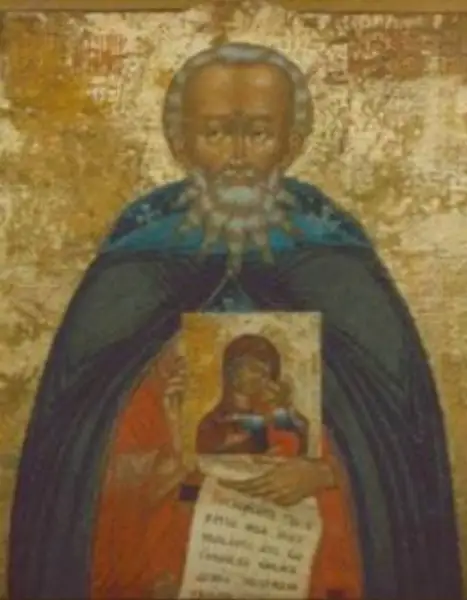
Overview
Abraham of Galich — in Russian Avraamy Galichsky, also called Chukhlomsky or Gorodetsky — was an abbot of the Russian Orthodox Church who died on 20 July 1375. His birthplace and secular name are unknown. He began his monastic life at the Pechersky Ascension Monastery in Nizhny Novgorod, then moved to the Trinity Lavra of Sergius of Radonezh, becoming one of that great father's disciples. With Sergius's blessing he went north into the Galich princedom and founded the first monastery of the region, the Avraamiyev Novozaozersky monastery in honor of the Dormition of the Mother of God, on the northeastern shore of Lake Galich. Settling in the domain of Prince Dimitry of Galich in the early 1360s, he went on to found three further houses, among them the Gorodets Monastery of the Protection of the Holy Virgin on the northern shore of Lake Chukhloma. He died in a chapel near his monastery, having withdrawn there shortly before the end.
The Complete Life
Early Life
The birthplace and secular name of Abraham are unknown; he enters history as a monk. He first worked at the Pechersky Ascension Monastery in Nizhny Novgorod, on the Volga, a house old enough to carry the memory of the Kiev caves in its name. From there he moved to the Troitse-Sergiyeva Lavra, the monastery of Sergius of Radonezh near Moscow, where he became one of Sergius's disciples in the generation when Russian monasticism was spreading from the center of the country to its forest frontiers. The habit of obedience learned under Sergius framed everything he did afterward. The Russia of his youth was recovering from the Mongol invasions of the previous century, and monasteries were among the few institutions that kept writing, building, and prayer alive in the devastated countryside. Nizhny Novgorod and Trinity, the two houses that formed him, stood at opposite ends of the monastic spectrum of his day: a river city monastery and a forest lavra, and he carried the second ideal into the wilderness.
§ Life and devotion
Vocation
After some time at the Lavra, with Sergius's blessing, Abraham went out to the Galich princedom, the wooded and lake-studded land northeast of Moscow. According to his legend he settled in the domain of Prince Dimitry of Galich, who held the town in the years 1360-1363, and there raised the Galich region's first monastery — Avraamiyev Novozaozersky, dedicated to the Dormition of the Most Holy Theotokos — on Galich Lake's northeastern shore. It was the beginning of a colonizing monasticism: prayer houses that also cleared land, welcomed settlers, and gave the remote north its spiritual centers. That blessing was the currency of fourteenth-century Russian monasticism: a disciple went no farther than his elder allowed, and the houses he planted were counted as Sergius's work extended into the north. The northeast shore he chose was wild country, and the name Novozaozersky, 'beyond the lakes,' preserves the sense of a house on the far edge of the settled world.
§ Life and devotion
Mission
The founding of one monastery did not end the work. Three further houses followed around Lake Chukhloma; among them was the Gorodets Monastery, dedicated to the Protection of the Holy Virgin, standing on the lake's northern shore. Four foundations in one region made him, after Sergius himself, the most consequential monastic planter of the Russian northeast, knitting together a landscape of hermitages, chapels, and villages that looked to the monasteries for worship, learning, and order. The mission was less preaching than presence: communities of prayer set down where no such communities had been. Each house was dedicated to a feast of the Mother of God, and each served the scattered population of fishers and foresters who otherwise lived and died without a priest. Tradition also remembers him as a disciple whose counsel was sought, and the four communities became a school of prayer for the region's own monks and priests.
§ Life and devotion
Final Years
Shortly before his death Abraham withdrew to a chapel near his monastery, the traditional retirement of the Russian abbot who hands the house to successors and goes to meet God alone. According to his legend he died there on 20 July 1375, though the scholars D. F. Prilutsky and Y. E. Golubinsky argued for a somewhat later date, since Prince Yuri Dimitrievich, named as his contemporary, received the Galich lands only in 1389. A stone cathedral honoring the Intercession of the Theotokos rose over his relics in 1608-1631; once that monastery had fallen into ruin, another cathedral, dedicated to the Tenderness icon of the Mother of God, replaced it in 1857-1867. The date on his liturgical memory, 20 July, has nonetheless been kept steadily by the churches he founded. The pilgrims who came to his relics in later centuries found in his withdrawal a pattern: the founder does not cling to his foundation but hands it on.
§ Death
Canonization
Twice Abraham was raised to local veneration, first in 1553 and then in 1621 — the latter perhaps a diocesan celebration — both times centered at Kostroma. His hagiography was compiled in 1548-1553 by Protasy, an abbot of the Gorodets Monastery, working from the old monastic records of the saint. In 1981, at the initiative of Archbishop Cassian (Yaroslavsky) of Kostroma and Galich, the Cathedral of the Kostroma Saints was established, and Abraham's name was entered among the region's saints, giving his cult a modern liturgical home. The double canonization, a century and more after his death, reflects the deliberate gathering of local saints' cults under Metropolitan Macarius in the sixteenth century. Local canonization in the Russian Church meant an authorized office and service to the saint, and his inclusion ensured that his feast would be sung, not merely remembered. His office and service texts, sung on 20 July, carry the memory of the Galich forests into the liturgical year of the modern Russian Church.
§ Canonization and veneration
Legacy
The monasteries of the Galich and Chukhloma lakes preserved Abraham's memory through the centuries of the Muscovite church, and the Gorodets house kept his relics beneath successive cathedrals into modern times. As a disciple of Sergius of Radonezh he belongs to the movement that some historians credit with shaping Russian identity itself — the forest monasteries that carried Orthodox life into the north. Locally he remains the abbot-founder of a whole lake country, and his 20 July feast keeps the Kostroma countryside mindful of its monastic beginnings. He is counted among the sobor of Kostroma saints whose common feast gathers the region's holiness into a single act of remembrance. His name also lives in the landscape: the lake and town of Chukhloma still carry the memory of the abbot who settled their shores. Pilgrims still come to the lakes he settled, and his story is told wherever the northern monasteries trace their founding generation.
§ Introduction
Timeline
- 1360
With Sergius of Radonezh's blessing, settles in Prince Dmitry's Galich lands and founds the Dormition monastery Avraamiyev Novozaozersky
§ Life and devotion
- 20 Jul 1375
Dies, according to his legend on this date, in a chapel near his monastery; some scholars place his death slightly later
§ Death
- 1548
His hagiography is compiled by Protasy, abbot of Gorodets Monastery, from old monastic records, completed by 1553
§ Canonization and veneration
- 1553
Canonized to local veneration by the Russian Orthodox Church; a second canonization follows in 1621
§ Canonization and veneration
- 1608
A stone cathedral honoring the Intercession is built over his relics, completed in 1631
§ Death
- 1857
After the monastery's ruin, a new cathedral honoring the Mother of God Tenderness icon is raised over his relics, completed 1867
§ Death
- 1981
His name is entered in the Cathedral of the Kostroma Saints, founded by Archbishop Cassian of Kostroma and Galich
§ Death
The Record
- Patron of
- Monastic founders·The Kostroma region
- Symbols
- Abbot's staff·Northern Russian lakes and forests
- Canonization
- Canonized to local veneration in 1553 and again in 1621 at Kostroma
Prayer
Bibliography
Show 7 sources
- ↑ Miller, David B. (2010). Saint Sergius of Radonezh, His Trinity Monastery, and the Formation of the Russian Identity . Northern Illinois University Press. p. 78. ISBN 978-0-87580-432-3 .
- 1 2 "Repose of Venerable Abramius of Galich or Chukhloma Lake, disciple of Venerable Sergius of Radonezh", Orthodox Church in America
- ↑ Church, Orthodox Eastern (1945). A Manual of Eastern Orthodox Prayers . St Vladimir's Seminary Press. p. 109. ISBN 978-0-88141-012-9 . {{ cite book }} : ISBN / Date incompatibility ( help )
- 1 2 АВРААМИЙ ГАЛИЧСКИЙ, in Orthodox encyclopedia Retrieved on 6 Mar 2018
- ↑ Icon of the Mother of God “Chukhloma” from Galich Retrieved on 6 Mar 2018
- ↑ Авраамий Галичский Archived 2013-09-25 at the Wayback Machine Retrieved on 6 Mar 2018
- ↑ ПРЕПОДОБНЫЙ АВРААМИЙ ГОРОДЕЦКИЙ, ГАЛИЧСКИЙ И ЧУХЛОМСКИЙ (St. Abraham Gorodetsky, Galitzki and Chuhlomsky) Retrieved on 6 Mar 2018
Profile text adapted from the Wikipedia article, licensed CC BY-SA 4.0.
Pray with this saint every day
Save St. Abraham of Galich to your favorites, read the full profile, and get feast-day reminders in the Saints app.
Get the Saints AppFree on the App Store for iPhone and iPad