
died 1077 (traditionally 1010)·Feast October 29 (November 11 New Style)
St. Abraham of Rostov
Archimandrite and Apostle of Rostov
Overview
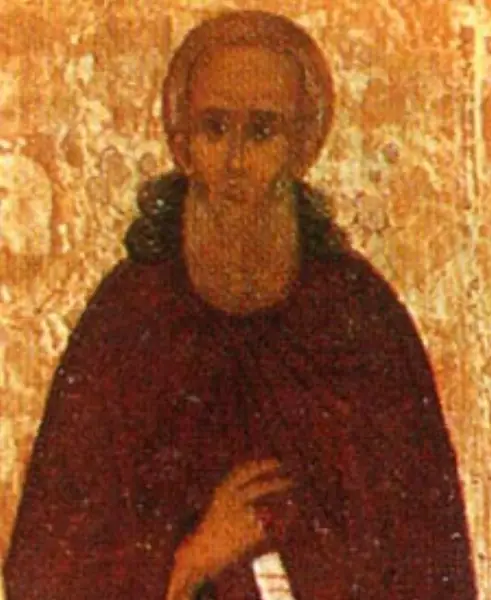
Abraham of Rostov, born Abercius in the tenth century at Chuhloma in the Kostroma region near Galich, was a Russian monk, missionary, and archimandrite who became the apostle of the Rostov region. Very ill as a child, he was cured of illness through prayer, according to tradition, and converted to Christianity in his youth. He embraced the monastic life at Valaam, the renowned monastery on Lake Ladoga, and took the new name Abramius — Abraham — making his home at Rostov beside Lake Nero. Close to his hut rose a pagan temple in which the local tribes paid worship to a stone idol of Veles, an object of superstitious dread throughout the district. Legend tells that he was granted a miraculous vision of John the Evangelist, who handed him a cross-topped staff to be used against the idol. Where the temple had stood, Abraham founded a monastery honoring the Theophany and raised a church dedicated to Saint John the Theologian, and as he preached the Gospel through the district many pagans received baptism at his word. At the petition of the Rostov princes he was ordained archimandrite of the Theophany monastery. In 1077, an old man, he died, and his disciples laid him to rest in the Theophany church.
The Complete Life
Early Life
Abraham was born Abercius in the tenth century at Chuhloma, in the Kostroma region near Galich in the Russian north. He was very ill as a child, and according to tradition was cured of his illness through prayer — the experience that turned him toward God. He converted to Christianity in his youth, in a land where the official conversion of Kievan Rus under Vladimir was recent and the countryside still largely pagan. His spiritual home became Valaam, the monastery on Lake Ladoga founded from the Byzantine tradition, where he received the monastic tonsure and the name Abramius, Abraham.
§ Life
Settlement at Rostov
Leaving Valaam, Abraham took up residence at Rostov, which stands on Lake Nero's shore and ranks among the oldest towns of the Russian northeast. His mission confronted a rooted paganism: a temple stood not far from his dwelling, and there the local tribes paid worship to the stone idol of Veles, a deity of cattle and wealth whose presence filled the whole neighborhood with superstitious fright. The legend tells of a miraculous vision in which John the Evangelist handed him a staff whose crown was a cross, commanding him to destroy the idol. The story is the hagiographical signature of his work: the fear of the old cult broken by a visible sign of the greater power of Christ.
§ Life
The Theophany Monastery
In commemoration of the destruction of the idol, Abraham erected a monastery at the site of the temple in honor of the Theophany, and built a church dedicated to Saint John the Theologian, the apostle who had empowered him in the vision. Around this foundation his mission was organized: he preached the Gospel through the district, and many pagans were convinced by his preaching and baptized. The Rostov princes petitioned for his ordination as archimandrite of the Theophany monastery; as its head he governed the region's chief religious house and turned it into the center from which the Rostov land was Christianized.
§ Life
Death and Relics
Abraham, having grown old, died and was laid to rest by his disciples within the Theophany church. The discovery of his relics took place under Grand Prince Vsevolod Georgievich, whose rule ran from 1176 to 1212 — an event commemorated in one of his feasts. His memory was kept in the Rostov church, and a divine service in his honor, compiled in imitation of the service to Sergius of Radonezh, is first mentioned in a manuscript collection of the fifteenth century. The dating of his life is debated: the legend gives 1010 as his death, while historians from Karamzin to Klyuchevsky have placed his activity in Rostov at various points across the eleventh and early twelfth centuries, with 1077 the commonly received year.
§ Death and veneration
Canonization
The church historian Golubinsky holds that Abraham's general church canonization was already complete when the Makaryev Sobors of 1547-1549 met — the great councils summoned under Metropolitan Macarius which regularized the veneration of the Russian saints. He keeps October 29 (November 11 New Style) — observed together with the finding of his relics and in the Synaxis of the Kostroma Saints — as well as May 23 in the Synaxis of the Rostov-Yaroslavl Saints and May 21 in the Synaxis of the Karelian Saints; these dates follow the Julian calendar.
§ Death and veneration
Legacy
Abraham's legacy is the Theophany Monastery of Rostov, which carried his mission for centuries. In 1551 Ivan the Terrible, campaigning against the Khanate of Kazan, went on pilgrimage to the Abraham Monastery before the battle and carried the saint's staff with him; victorious, he gave the staff back and in 1553-1555 commissioned the building of the stone Cathedral of the Theophany — an earthly reward for a saint who had preached where the cross had never been named. Some modern historians, notably Golubinsky, were skeptical of his very existence, suggesting confusion with Abraham of Galich, but the tradition of the Rostov church has kept his memory as the apostle of its land.
§ Death and veneration
Timeline
- 1077
Dies in old age and is laid to rest in the Theophany church by his disciples
§ Death and veneration
- 1549
His general church canonization is already accomplished by the time of the Makaryev Sobors
§ Death and veneration
- 1551
Ivan the Terrible makes a pilgrimage to the Abraham Monastery ahead of his campaign against Kazan
§ Death and veneration
- 1553
After taking Kazan the tsar returns the saint's staff and orders building of the stone Cathedral of the Theophany
§ Death and veneration
The Record
- Patron of
- Rostov region
- Symbols
- Staff crowned with a cross·Monk's habit
- Canonization
- Canonized by the Makaryev Sobors, by 1549
Prayer
Bibliography
Show 10 sources
- 1 2 3 Зонтиков, H.A. (2014). Чухлома: спорные вопросы ранней истории города(Chuhloma:outstanding issues in early history of the town), almanac, issue 7 . Kostroma: Костромская земля(Kostroma Land). p. 130. Archived from the original on 2015
- ↑ "St. Abraham of Rostov", Catholic Review , October 29, 2006
- 1 2 "Venerable Abramius the Archimandrite of Rostov", Orthodox Church in America Retrieved on 13 Mar 2018
- ↑ Butler, Alban. "Butler's Lives of the Saints, Vol. 10", (Paul Burns, ed.), the Liturgical press, Collegeville, Minnesota 1995, p.201 Retrieved on 14 Mar 2018
- ↑ МИФ О РОЖДЕНИИ В ЧУХЛОМЕ ПРЕПОДОБНОГО АВРААМИЯ РОСТОВСКОГО (Myth about the birth in Chuhloma of venerable Abraham of Rostov) Retrieved on 13 Mar 2018
- 1 2 ЖИТИЕ ПРЕПОДОБНОГО АВРАМИЯ, АРХИМАНДРИТА РОСТОВСКОГО (Legend of venerable Abraham, archimandrite of Rostov) Retrieved on 14 Mar 2018
- ↑ Голубинский. История канонизации.(Golubisky. History of canonization) С. 82-83
- 1 2 11 ноября. Память преподобного Авраамия Ростовского(11 November. Feast day of venerable Abraham of Rostov) Retrieved on 14 Mar 2018
- ↑ ЖИТИЕ АВРААМИЯ РОСТОВСКОГО (The legend of Abraham of Rostov) in ancient Slavic Retrieved on 14 Mar 2018
- 1 2 Житие Авраамия Ростовского (The legend of Abraham of Rostov) Retrieved on 14 Mar 2018
Profile text adapted from the Wikipedia article, licensed CC BY-SA 4.0.
Pray with this saint every day
Save St. Abraham of Rostov to your favorites, read the full profile, and get feast-day reminders in the Saints app.
Get the Saints AppFree on the App Store for iPhone and iPad