
c. 1172-c. 1222·Feast August 21
St. Abraham of Smolensk
Hieromonk and Wonderworker of Smolensk
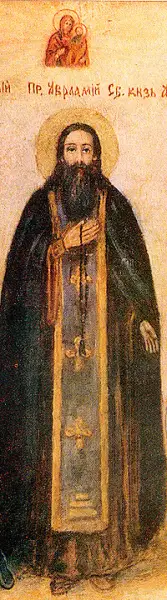
Overview
Abraham of Smolensk, in Russian Avraamii Smolensky, was a monk and priest of pre-Mongol Rus who became the most striking preacher of his city. Born around 1150 or 1172 to noble parents and orphaned young, he gave away his inheritance for the austere religious life. He lived at the Bogoroditskaya convent in Smolensk, where he was regarded as a wonderworker, and combined strict asceticism with extensive biblical study and fearless preaching on the Last Judgement. His success among the sick and troubled aroused the jealousy of fellow clergy, who brought moral and theological charges against him; the bishop silenced his preaching, and even his withdrawal did not end suspicion. Eventually the case was reopened and Abraham acquitted, and he was made abbot of a small, poor convent of the Mother of God, where he spent his remaining years and died around 1222. A life written by his disciple Ephraem survives. Canonized in 1549, he is venerated as a saint of the Russian Orthodox Church.
The Complete Life
Early Life
Abraham was born at Smolensk around 1150 or 1172 — the sources differ — into the local nobility. Orphaned while still a child, he faced the choice familiar to young Russian aristocrats without protectors: make his way at court or renounce the world entirely. He chose renunciation, giving away the fortune he had inherited and entering upon a deliberately hard life of fasting, vigil and prayer. Medieval Smolensk was a wealthy mercantile city on the Dnieper with churches, schools and a cathedral clergy, but Abraham attached himself to the ascetic current of the age, the same movement that was filling the forests of the north with hermits. The discipline he took on in youth never left him; contemporaries described him as stern toward himself first of all, a man who kept the thought of the Last Judgement before his own eyes before preaching it to anyone else.
Preacher and Wonderworker
Abraham resided at the Bogoroditskaya convent of the Mother of God in Smolensk, where he was ordained priest and became famous as a wonderworker. His real work, however, was the word. He studied Scripture intensively and preached constantly, holding up the Coming Judgement as the lens through which wealth, quarrels and injustice in the booming city had to be read. The common people loved him: the sick, the troubled and the poor found in him tenderness, counsel and practical help, and his reputation for miracles spread through the town. It was precisely this popularity that made trouble, for the city's other priests saw their congregations and their standing drained away by a monk of severe habits. Early thirteenth-century Smolensk, with its princely rivalries and reforming bishop, was fertile ground for clerical friction, and Abraham became its most visible target.
Accusation and Trial
The climax of Abraham's life was ecclesiastical persecution. Moral and theological charges were brought against him by envious clergy, and the bishop of Smolensk acted on them: Abraham was forbidden to preach, and a cloud lay over his name for some years. He accepted the silence without revolt, but suspicion did not die — some clerics continued to view him askance even in retirement. Later the bishop reopened the case and fully acquitted him, going further and appointing him superior of a smaller, impoverished convent honoring the Mother of God in that area. Humbled and vindicated at a stroke, he governed a poor house, continued to receive the troubled who sought him out, and lived his last years in the quiet he had earlier been denied. His disciple Ephraem wrote an account of his life, which is how the outline of these events survives.
Final Years and Death
Abraham died at Smolensk around 1222, in his fifties or seventies depending on the birth date preferred. His last years as abbot were spent rebuilding the material and spiritual life of a poor convent, a fitting end for a man who had begun by giving away wealth. Within a generation the Mongol invasion swept over Rus, destroying the world of pre-Mongol Smolensk piety in which he had lived; that anything like his life was preserved, through Ephraem's biography, is close to miraculous. The people's memory of the wonderworking monk outlasted the institutions that had once suspected him, and his grave became a place of prayer. He stands in Russian hagiography as the model of the vindicated confessor-abbot: accused, silenced, restored, and finally honoured by the very church that had mishandled him.
Canonization
Abraham was formally canonized by the Russian Orthodox Church at the Makaryev Councils of 1549, the great series of councils convened under Metropolitan Macarius of Moscow that regularized the cult of numerous Russian saints. Local veneration at Smolensk had evidently continued from the thirteenth century, and Macarius' men collected the life by Ephraem and the liturgical service already in use. His feast was set for 21 August. He is titled venerable and wonderworker, archimandrite of Smolensk in Orthodox calendars. In the Smolensk cathedral and diocese his memory remains particularly alive, and the Orthodox Church in America's calendar carries his commemoration for English-speaking faithful. The 1549 canonization is the documentary anchor for everything reported here concerning his official status. He is also honoured in the calendars of other Orthodox jurisdictions that follow the Russian tradition, and services in his name are sung each August in the diocese that keeps his memory. Pilgrims still visit the sites associated with him in the old city on the Dnieper, and his icon, showing a monk with a scroll of the Judgement sermons, is found in Russian churches.
Legacy
Abraham of Smolensk matters for three reasons. First, he is a rare pre-Mongol Russian saint whose inner life is visible: a preacher of judgement who was also tender with sufferers, a stern ascetic whom ordinary people trusted. Second, his story preserves an almost complete case of medieval ecclesiastical scapegoating and rehabilitation, showing how jealousy, accusation, silencing, acquittal and promotion followed one another in a Russian diocese around 1200. Third, his canonization in 1549 shows how Macarius' council gathered up local memories before they vanished. Modern writers on Smolensk and on Russian preaching cite him as the outstanding pulpit figure of pre-Mongol Rus.
Timeline
- 1150
Born at Smolensk to noble parents, according to the earlier of two traditional dates (1150 or 1172)
§ Life
- 1222
Dies at the small convent of the Mother of God in Smolensk, where he spent his last years as abbot
§ Life
- 1549
Canonized as a saint of the Russian Orthodox Church at the Makaryev Sobors
§ Sainthood
The Record
- Major works
- A life was written by his disciple Ephraem (surviving)
- Patron of
- Smolensk
- Symbols
- Monastic habit·Prayer rope·Cross
- Canonization
- Canonized 1549 at the Makaryev Councils by Metropolitan Macarius of Moscow
Prayer
Profile text adapted from the Wikipedia article, licensed CC BY-SA 4.0.
Pray with this saint every day
Save St. Abraham of Smolensk to your favorites, read the full profile, and get feast-day reminders in the Saints app.
Get the Saints AppFree on the App Store for iPhone and iPad