
fl. 12th-14th centuries·Feast August 21
St. Abraham the Laborious
Venerable Monk of the Kiev Caves
Overview
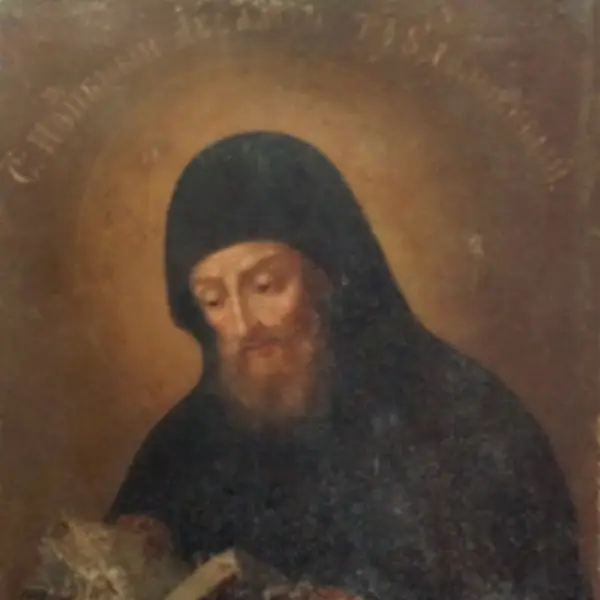
Abraham the Laborious — in Church Slavonic tradition Avramii Trudolyubivy, 'Abraham the lover of toil' — is one of the venerable fathers remembered among the monks of the Kiev Pechersk Lavra, the great cave monastery that is the mother house of Russian and Ukrainian monasticism. His dates cannot be fixed: the sources place him anywhere between the twelfth and fourteenth centuries, which is itself a sign of how the memory of the caves preserved names more exactly than lives. The epithet is nearly all the tradition preserves: the sources know him only as a lover of labor among the monks of the lavra. He was buried in the Near Caves of the lavra, where the relics of the reposed fathers rest, and he is honored annually on 21 August and again on 11 October, the synaxis of all the venerable ones of the Near Caves. The Orthodox Church in America keeps his notice, and the older Western dictionaries carry him briefly.
The Complete Life
Vocation
Abraham belonged to the Kiev Pechersk Lavra, the monastery founded in the mid-eleventh century around the caves of Anthony of the Caves and Theodosius, which formed the religious heart of Kievan Rus'. To be a monk there was to accept the discipline of the caves: narrow passages, services by candlelight, bread earned by the sweat of the community. Which igumen he lived under, and in which generation, the tradition no longer says; he is dated only within the broad span between the twelfth and fourteenth centuries.
§ Introduction
The Lover of Toil
His title, 'the Laborious' or 'lover of labor,' is a spiritual verdict rather than a biographical detail. In the vocabulary of the Kiev Caves paterikon, unceasing manual work is one of the three foundations of the monastic life beside obedience and prayer. A monk remembered as 'the Laborious' was remembered as one who embodied that foundation perfectly: never idle, never serving his own comfort, treating each task in the garden, kitchen, or workshop as an act of worship. The epithet is the hagiographic shorthand for a whole hidden life.
§ Introduction
Final Years
Abraham was buried in the Near Caves (the Caves of Anthony), where the lavra gathered the bodies of its reposed fathers and where Orthodox pilgrims still venerate them. The date of his death is not separately recorded; the placement of his relics with the fathers of the Near Caves is the tradition's strongest single fact about him.
§ Introduction
Veneration
Abraham shares in the general glorification of the Kiev Caves fathers, venerated before any modern formal process and commemorated in the calendars of the Orthodox Church. The Orthodox Church in America's notice ('Venerable Abramius the lover-of-labor of the Kiev Near Caves') and Holweck's Biographical Dictionary of the Saints carry his memory to the West. His principal feast is 21 August, with the common commemoration of 11 October.
§ Introduction
Legacy
Abraham stands for the countless ordinary monks of the lavra whose holiness consisted in faithful work. The Kiev Caves paterikon became a founding text of Russian and Ukrainian spirituality, and its nameless and half-named laborers like Abraham gave that tradition its ideal of sanctity through toil — an ideal that traveled with Orthodoxy wherever it went.
§ Introduction
The Record
- Patron of
- Workers·Monastics
- Symbols
- Monk's habit·Kiev Caves
- Canonization
- Venerated in the Orthodox Church; among the saints of the Kiev Caves Lavra
Prayer
Bibliography
Show 1 sources
Profile text adapted from the Wikipedia article, licensed CC BY-SA 4.0.
Pray with this saint every day
Save St. Abraham the Laborious to your favorites, read the full profile, and get feast-day reminders in the Saints app.
Get the Saints AppFree on the App Store for iPhone and iPad