
c. 660-740/742·Feast October 20
St. Acca of Hexham
Bishop of Hexham, Abbot
Overview
Acca, born in Northumbria around 660, was an early medieval prelate who served as bishop of Hexham from 709 to 732. He began in the household of Bosa, future bishop of York, then attached himself to Wilfrid, perhaps as early as 678, accompanying the great bishop on his journeys — including a stay at Utrecht with Willibrord and two trips to Rome. On returning from the second in 692, Wilfrid made him abbot of St Andrew's monastery at Hexham, and in 709 Acca succeeded him as abbot and bishop. He governed with energy, raised and embellished churches, and combined skill as a musician with real theological learning — Bede names him a cantor of long practice, steeped in scripture and ecclesiastical usage. He brought the cantor Maban north to teach Roman psalmody, encouraged students, prompted the Life of Wilfrid, and fed Bede's histories with materials. In 732 he left his see, to Whithorn, St Andrews, or Irish exile by varying accounts, and died around 740.
The Complete Life
Early Life
Acca was born in Northumbria around 660, into the golden age of the northern church. His first service was in the household of Bosa, who would become bishop of York, but the decisive attachment came when he joined Wilfrid, the brilliant and combative bishop of York and Hexham, possibly as early as 678. His travels with Wilfrid took him overseas; afterwards he would recount to Bede, his friend, how the two had lodged at Utrecht with Willibrord — once Wilfrid's pupil, now busy evangelizing the heathen on the continent. Acca's formation was therefore both domestic and international: an English churchman formed on Roman roads, in Frankish mission stations, and in the two great sees of the north. The Northumbria of his youth had already produced Aidan, Cuthbert, and Hilda, and it would produce Bede; Acca belongs in that constellation not as a writer but as the churchman who made writing possible. Bosa, his first master, had been Abbot of Whitby before ruling York twice, and Acca's move from his household to Wilfrid's following was a choice of the stricter, more Roman party in the English church. It set the direction of his whole life.
§ External links
Vocation
Wilfrid's career was a storm of appeals and exiles, and Acca stood beside him through it. When the pair came back from Rome a second time in 692, Wilfrid recovered his see at Hexham and installed Acca as abbot of the monastery of St Andrew there — a house raised by Wilfrid with the help of masons, glaziers, and singers brought from Rome. During Wilfrid's later years Acca was his loyal companion and effective deputy, and when Wilfrid died in 709 Acca succeeded him as abbot and bishop of Hexham. The succession was the reward of thirty years of fidelity to a difficult master, and it gave the northern church one of its most cultivated pastors. To serve Wilfrid for three decades, through appeals, imprisonments, and two Roman journeys, required a loyalty that looked less like ambition than like love. It also meant that when Acca became bishop, he inherited not only a diocese but a program: Roman liturgy, stone churches, decorated altars, and trained singers.
§ Life
Mission and Ministry
As bishop, Acca tackled his duties with energy in ruling the diocese and conducting the church's services. He continued Wilfrid's programme of building and adorning churches, and he treated the liturgy as an instrument of evangelization: from Kent he recruited to the North a celebrated singing-master, Maban, schooled in the Roman psalmody that had come down from Gregory the Great by way of Augustine of Canterbury, so that Hexham's chant matched what was heard in Rome. He encouraged students by every means in his power, kept a theological library that Bede praised as large and most noble, and used that learning in the service of writers — persuading Stephen of Ripon to write the Life of Saint Wilfrid and lending Bede materials for the Historia ecclesiastica. A churchman who could attract a Kentish-trained cantor to the banks of the Tyne was, in his own way, as much a missionary as those who crossed the sea.
§ Life
Spirituality and Learning
Acca's inner life is visible mainly in his friendships and his books. His bond with Bede, the greatest scholar of the age, was one of mutual gift: Several of Bede's weightiest works were dedicated to Acca — above all those concerned with Scripture — while Acca repaid him with what he had seen and kept. His patronage of the Life of Wilfrid shows a man concerned that holiness be remembered accurately, with the witnesses named. The combination he embodied — chant, doctrine, building, and patronage of scholarship — was the program of the Gregorian mission in miniature, and Hexham under him became one of the centers where that program actually worked. In an age when books were copied by hand at vast cost, his library was a tool of the whole church, and the young scholars he encouraged were his true monument. Bede's dedications to him include commentaries on Scripture, which suggests that Acca read them closely and answered, a correspondence across the Tyne valley between two men who believed that doctrine and devotion were one thing.
§ Life
Final Years
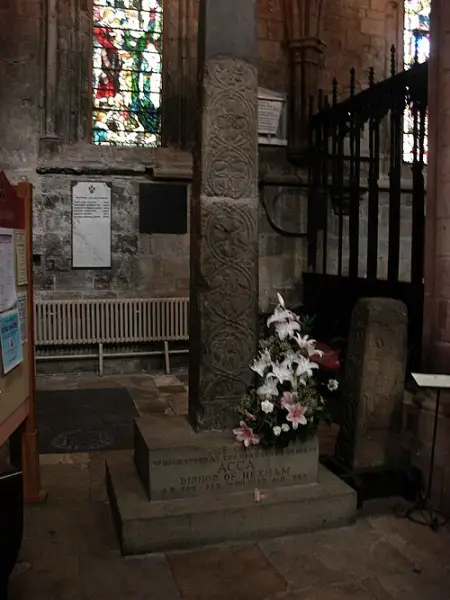
Acca's episcopate ended in 732, when — for causes that remain obscure — he either stepped aside or was expelled from his see. Tradition divides on what followed: Hexham memory makes him bishop of Whithorn in Galloway; other stories give him a new see planted at St Andrews, stocked with relics gathered on his Roman travels — among them those of St Andrew; a third tradition holds that, after quarrelling with the Northumbrian king, he spent years banished on some distant Irish shore before coming back to Hexham. He died in 740 or 742 and was buried close to the abbey's east wall, where a pair of finely carved crosses — one of which survives, though only in fragments — stood at the head and the foot of his grave. Such uncertainty is itself proof of the standing he enjoyed: three different regions wanted to claim the last years of the exiled bishop. Whatever the truth, the Northumbrian chronicles treat his departure as an interruption rather than a disgrace, and his burial at Hexham in a place of honor shows that his own community never accepted any version that dishonored him.
§ Life
Veneration
Reverence for Acca as a saint began the moment he died, with no formal process — no inquiry was needed, for the churchmen of Northumbria had simply recognized his holiness. At least three translations of his body are recorded: one in the early 1000s at the hands of Alfred of Westow, Durham's sacrist; another in 1154, when the church was restored; with further elevations tracking the fortunes of Hexham Abbey. His feast on 20 October is kept in the Catholic Church and in Anglican calendars, and the surviving fragment of his grave cross at Hexham Abbey remains the physical anchor of his cult in Northumberland. Aycliffe's parish church of St Andrew is also said to have been dedicated to him in the Middle Ages. The medieval calendars of the north of England carried his feast steadily, and his name appears in the litanies of Durham, whose monks claimed his relics among their treasures.His cult, in short, outlived every political change that swept the north.
§ Life
Legacy
Acca's legacy lives in three streams. Historically, he is one of Bede's named informants and dedicatees, which means that much of what the world knows about early English Christianity passed through or near his hands. Musically, his importation of Roman psalmody represents the triumph of the continental chant tradition in the Anglo-Saxon north. And locally, Hexham Abbey — Wilfrid's crypt beneath, Acca's cross beside it — keeps him present. He is a reminder that behind every great scholar and every great founder there is usually a bishop who believed in them, paid for their books, and asked the right questions. Pilgrims and visitors at Hexham still stand beside the Acca cross, one of the few objects that can be tied to a named Northumbrian bishop. He shows, too, how much of the Church's memory depends on hospitality: had Acca not housed scholars and lent books, several lives and letters of the age would simply not exist.
§ External links
Timeline
- 660
Acca is born in Northumbria, around this year.
§ Introduction
- 678
Leaves the household of Bosa, future bishop of York, and attaches himself to Wilfrid, possibly as early as this year.
§ Life
- 692
Returning from a second journey to Rome with Wilfrid, he is made abbot of St Andrew's monastery at Hexham.
§ Life
- 709
Acca succeeds Wilfrid as abbot and bishop of Hexham.
§ Life
- 732
For reasons unknown he withdraws, or is driven from, his diocese; traditions link him with Whithorn, St Andrews, or exile in Ireland.
§ Life
- 740
Acca dies, in 740 or 742, and is buried near the east wall of Hexham abbey, revered as a saint at once.
§ Life
- 1000
In the early eleventh century his body is translated by Alfred of Westow, sacrist of Durham.
§ Life
- 1154
At the restoration of the church his relics are translated again, joined with those of all the Hexham saints in a single shrine.
§ Life
- 1240
His body is translated for a third time.
§ Life
In Their Own Words
A most experienced cantor, most learned in sacred writings... and thoroughly familiar with the rules of ecclesiastical custom.
The Record
- Major works
- Encouraged the Life of Saint Wilfrid by Stephen of Ripon·Supplied materials for Bede's Ecclesiastical History
- Patron of
- Church musicians and cantors·The Diocese of Hexham and Newcastle
- Symbols
- Bishop's vestments·Fragmentary carved crosses at his grave at Hexham Abbey
- Canonization
- Pre-congregation; revered as a saint immediately after his death
Prayer
Bibliography
Show 7 sources
- 1 2 3 "Northern Saints", 'This is Durham', Durham County Council
- ↑ Walsh, Michael J,. A New Dictionary of Saints , Liturgical Press, 2007, ISBN 9780814631867 , p. 6
- ↑ Ó Carragáin, Éamonn. Ritual and the Rood , University of Toronto Press, 2005, ISBN 9780802090089 , p. 265
- 1 2 Thurston, Herbert. "St. Acca." The Catholic Encyclopedia. Vol. 1. New York: Robert Appleton Company, 1907. 12 May 2013
- 1 2 3 Oxford Dictionary of Saints
- ↑ " "St. Andrew's Day", Scotland , November 2010" . Archived from the original on 5 September 2017 . Retrieved 12 May 2013 .
- ↑ "St Andrew's Church" .
Profile text adapted from the Wikipedia article, licensed CC BY-SA 4.0.
Pray with this saint every day
Save St. Acca of Hexham to your favorites, read the full profile, and get feast-day reminders in the Saints app.
Get the Saints AppFree on the App Store for iPhone and iPad