
died 376·Feast April 22 (Catholic); November 3 (Greek and Russian Orthodox); September 2 (Syriac Orthodox)
St. Acepsimas of Hnaita
Bishop and Martyr of Persia
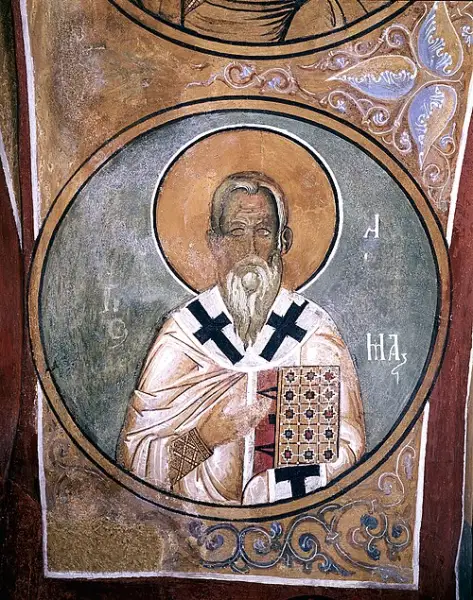
Overview
Acepsimas of Hnaita was a bishop, martyr, and saint of the Persian church under Shapur II, dying on 10 October 376 after three years of imprisonment. Acepsimas served as bishop at Hnaita, making his residence at Paka in the western part of Persia. Together with several companions — among them the priest Joseph of Bet-Katoba, aged seventy, and the deacon Aitillaha of Bet-Nuhadra, aged sixty-six — he was seized for declining to practice the Zoroastrian religion. Brought in chains to Arbela, modern Erbil, he faced the governor, who marveled that this man rejected the divinity of the sun worshipped throughout the East; Acepsimas replied in astonishment that anyone could value a creature above the Creator. On the governor's orders he was stretched on the ground, his feet bound, and flogged until blood covered his entire body, after which he was cast into prison. He endured three years of prison before being racked and whipped to death on 10 October 376. Joseph was tortured and stoned to death by apostate Christians at Tabaha in 377; Aitillaha was stoned at Destegerd that November. These were the final martyrs claimed by the persecution Shapur II waged, and an account of their acts has come down to us that is generally regarded as genuine.
The Complete Life
Background
Acepsimas led the church of Hnaita as its bishop, dwelling at Paka in western Persia, deep inside the Sasanian empire. His church was the Church of the East, Syriac-speaking and organized under its own catholicos at Seleucia-Ctesiphon, living under a Zoroastrian dynasty that in the fourth century came to regard its Christian population — whose loyalties lay with the rival Christian Roman empire — as a fifth column. From about 339 Shapur II unleashed the longest and most systematic persecution the Persian church ever suffered, and its acts were written down by the survivors in one of the great bodies of martyr literature the Syriac tradition produced.
§ Introduction
Episcopate in the Persecution
As bishop, Acepsimas governed a Christian community whose worship had been criminalized. He and several companions — the priest Joseph of Bet-Katoba, seventy years old, and the deacon Aitillaha of Bet-Nuhadra, sixty-six, among them — were seized for declining to practice the Zoroastrian religion. Seizing the aged leadership of a church was the persecution's signature: the state struck at the heads of the community to scatter the body. The three were taken in chains to Arbela — the modern Erbil — the seat of the governor of the province, for trial.
§ Life
Trial, Prison, and Death
Before the governor at Arbela, the judge marveled at the way Acepsimas refused worship to the sun, adored by all the East; the martyr replied, voicing his amazement that anyone could rank a creature above the Creator. The exchange was the whole quarrel in two sentences. At the governor's command, Acepsimas was stretched on the ground, his feet tied, and savagely flogged until blood covered his entire body; afterward he was cast into prison. He endured three years of prison, and was finally racked and whipped to death on 10 October 376. His companions followed: Joseph was taken to Hdajab, tortured, and stoned to death by apostate Christians at Tabaha on the Friday after Pentecost 377; Aitillaha met the same fate at Destegerd on 3 November 377. With them the persecution that Shapur II waged claimed its final victims.
§ Life
Veneration
Acepsimas and his companions are saints of the pre-congregation era, honored across the divided traditions of the East: the Roman Catholic Church keeps their feast on April 22, the Greek and Russian Orthodox Churches celebrate November 3 with the day's full office, and the Syriac Orthodox Church observes September 2. Aitillaha in addition has a feast in his honor alone in the Greek Church on September 1. Also honored as part of this company are the bishop Abdjesus and a deacon called Abdjesu. An account of their acts, preserved in the Syriac martyr literature, is generally judged genuine — that is, drawn from contemporary records rather than later legend — which gives these martyrs an unusually firm documentary standing.
§ Veneration
Legacy
Acepsimas closes the roll of the Shapur persecutions, the four-decade passion of the Persian church that gave Syriac Christianity its greatest age of martyrs. His answer at Arbela — that men should not prefer a creature to the Creator — fixed the theological issue of the persecution in a sentence the tradition never forgot. The commemoration of Acepsimas, Joseph, and Aitillaha across the Catholic, Eastern Orthodox, and Syriac Orthodox calendars is a rare instance of one martyrdom binding nearly all the apostolic churches, and their acts remain a principal source for the history of Christians under Sasanian rule.
§ Introduction
Timeline
- 10 Oct 376
Dies racked and whipped in prison after enduring three years of captivity
§ Life
- 377
Joseph is stoned to death by apostate Christians at Tabaha on the Friday after Pentecost
§ Life
- 3 Nov 377
Aitillaha is stoned to death at Destegerd, the last martyrs of Shapur II's persecution
§ Life
The Record
- Patron of
- The church in Iran and Iraq
- Symbols
- Bishop's vestments·Martyr's palm
- Canonization
- Pre-congregation; venerated in the Syriac Orthodox, Eastern Orthodox, and Roman Catholic Churches
Prayer
Bibliography
Show 4 sources
- ↑ Jeanne-Nicole Mellon Saint-Laurentet al., “ʿAqebshma — ܥܩܒܫܡܐ ” last modified August 17, 2016, http://syriaca.org/person/1135.
- ↑ Father Alban Butler (1866). "Saints Acepsimas, Bishop; Joseph, Priest; and Aithilahas, Deacon, Martyrs". Lives of the Fathers, Martyrs, and Principal Saints .
- ↑ Delaney, John J. (March 15, 2005). Dictionary of Saints . Publisher: Image; 2nd ed. edition. ISBN 978-0385515207 .
- ↑ Saint Aceptismas of Hnaita Retrieved on 28 Mar 2018
Profile text adapted from the Wikipedia article, licensed CC BY-SA 4.0.
Pray with this saint every day
Save St. Acepsimas of Hnaita to your favorites, read the full profile, and get feast-day reminders in the Saints app.
Get the Saints AppFree on the App Store for iPhone and iPad