
died 330·Feast May 15
St. Achillius of Larissa
Bishop of Larissa, Father of Nicaea
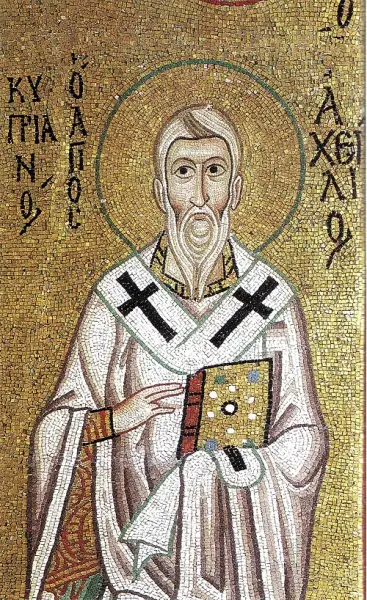
Overview
Achillius, whose name is also rendered Achilles, Ailus, or Achilius, was metropolitan bishop of Larissa in Thessaly in the first third of the fourth century and one of the 318 fathers who attended the First Council of Nicaea. He is remembered chiefly for two things: his vehement defense of orthodoxy against the Arians at the council, and the miracle the tradition attaches to his testimony there. Taking up a stone before the Arian party, he is said to have challenged them: if Christ is a creature, as you say, let no oil flow from this stone; but if the Father and the Son are equals, as we hold, then let oil pour forth — whereupon oil ran from the rock to the amazement of all. Returning from Nicaea to his see, he earned a second reputation, cast down pagan temples, built churches, and cast out demons, in the words of his encomia. He died at Larissa in 330. His cult spans the Greek and Slav worlds: when Samuel, emperor of Bulgaria, conquered Thessaly around the end of the tenth century, he translated Achillius's relics to an island in Lake Prespa that has borne the saint's name ever since, and a district of Larissa is still called after him.
The Complete Life
Early Life
Achillius was a Greek of Thessaly, and the little that is recorded of his origins places his birth in the third century in the region of Larissa, the ancient city on the Peneus river that had been the seat of Greek assembly in classical times and was, by late antiquity, a metropolitan see of considerable rank. His formation belongs to the last generation of the pre-Constantinian church: he would have been a young churchman during the persecutions, and the tradition that makes him a wonderworker and a firm confessor suggests a temperament formed in hard years. By the time of the council he was metropolitan of Larissa, the senior bishop of Thessaly, and the Greek church numbers him among the 318 fathers who gathered at Nicaea, a figure he shares with the other great defenders of the faith, Athanasius's contemporaries and fellow confessors. His name's many spellings in the sources, Achilles, Ailus, Ahillas, Achilius, show how widely his cult traveled and how early it diversified across languages.
§ Introduction
Nicaea and the Miracle of the Stone
The Arian controversy, which asked whether the Son of God is truly God or the highest of creatures, was the business of the council of 325, and Achillius is remembered as one of its vehement defenders of orthodoxy. The tradition has preserved the episode in dramatic form. The Arians argued their case in the assembly; Achillius took up a stone and put the question to a test: if the Christ you speak of is a creature, then bid oil run out of this stone; but if the Son is as great as the Father, as we confess, then let the oil come. The Arians were silent before the demand, and when the bishop renewed his confession, oil ran out of the rock before all who were present. The story belongs to the genre of the wonder at the council, and historians read it as liturgical drama rather than stenography; but it encodes the memory the Greek church kept of Achillius, that at Nicaea he stood with the homoousion, the full divinity of the Son, and that his see honored him for it above all his other claims.
§ Life
Shepherd of Thessaly
Returning from Nicaea with the Creed signed, Achillius gave his last years to the conversion of his own province. The encomia summarize the work with a threefold formula that Byzantine hagiography reserves for its greatest missionary bishops: many pagan temples he pulled down, many churches he raised, and many demons he drove out. Thessaly, with its ancient oracles and its rural cults, offered full employment for all three. The destruction of temples in the generation after Constantine was, whatever modern judgments of it may be, the public end of the old sacrificial order, and bishops like Achillius were its instruments; the building of churches in their place, often from the stones of the shrines, made the change visible in every town. The 1910 Catholic Encyclopedia, in its article on the see of Larissa, pauses to mention him as a bishop of the fourth century celebrated for his miracles, whose feast is on 15 May, an incidental witness that his memory crossed the later division between the churches. He died at Larissa in 330, five years after the council, and was buried in his cathedral city.
§ Introduction
Translation to Prespa
Achillius's cult received its decisive extension at the end of the tenth century. When Samuel, the emperor of Bulgaria whose empire then stretched over much of the Balkans, conquered Thessaly, he carried off the relics of the saint to Prespa, his lake capital in the mountains of Macedonia, and enshrined them on an island in the Small Prespa lake that has been called the Island of St. Achillius ever since. A basilica of consequence was raised over the tomb, and its remains, studied by the Greek archaeological service, still stand among the most important monuments of that vanished Bulgarian empire. The translation is a classic case of relic-taking as policy: Samuel, ruling a young Christian state, gathered to himself the fathers of the faith of the lands he held. In the interval the cult had already spread through the Greek and Slav worlds, and the island shrine made it a place of pilgrimage for both; the calendar of the Orthodox church keeps him on 15 May, and the Roman Martyrology long carried his name as well.
§ Introduction
Legacy
Achillius remains one of the saints through whom the Orthodox churches of Greece, Bulgaria, Serbia, and North Macedonia share a common memory older than their divisions. The island of St. Achillius in Prespa, with its ruined basilica, is a protected monument and a place of pilgrimage in the Balkans; a church in Serbia bears his name; a district of the modern city of Larissa is called Saint Achellios, and the basilica of St. Achillios there keeps the local cult at home. His iconography, in mosaic and fresco from Hosios Loukas onward, shows him as a hierarch, sometimes with the stone of Nicaea. For the church's preachers he has remained the bishop of the Creed: the tradition of the oil from the rock is retold, in Greek and Slavonic alike, as a parable that the confession of Christ's full divinity is not a scholastic nicety but the Church's life, and that God confirmed it, at Nicaea, through a Thessalian bishop of unshakable tongue.
§ Introduction
In Their Own Words
If Christ is a creature of God, as you say, tell oil to flow from this stone.
And if the Son of God is equal to the Father , as we believe, then let oil flow from this stone.
The Record
- Patron of
- Larissa, Greece·Orthodoxy against heresy
- Symbols
- Bishop's vestments·Stone flowing with oil·Church model
- Canonization
- Pre-congregation (ancient cult; relics enshrined at Prespa)
Prayer
Bibliography
Show 6 sources
- 1 2 Catholic Online. "St. Achillas" . Saints & Angels . Archived from the original on 4 February 2007 . Retrieved 2007-01-18 .
- 1 2 Velimirovich, Nikolai. "St Achillius, Bishop of Larissa" . The Prologue From Ochrid . Archived from the original on 2007-10-19 . Retrieved 2007-01-18 .
- 1 2 "Larissa" . Catholic Encyclopedia . Vol. 9. Robert Appleton Company. 1910. Archived from the original on 5 February 2007 . Retrieved 2007-01-18 .
- ↑ (in Greek) Ὁ Ἅγιος Ἀχίλλιος Ἐπίσκοπος Λαρίσης . ΜΕΓΑΣ ΣΥΝΑΞΑΡΙΣΤΗΣ.
- ↑ "God is Wonderful in His Saints". "Our Father among the Saints Achillius, Bishop of Larissa" . Orthodox Saints commemorated in May . Archived from the original on 13 February 2007 . Retrieved 2007-01-18 .
- ↑ See Macedonia Historical Maps Archived 2007-05-25 at the Wayback Machine , which cites "St Achillius" as a "small island with Byzantine churches" in Prespa .
Profile text adapted from the Wikipedia article, licensed CC BY-SA 4.0.
Pray with this saint every day
Save St. Achillius of Larissa to your favorites, read the full profile, and get feast-day reminders in the Saints app.
Get the Saints AppFree on the App Store for iPhone and iPad