
d. 304·Feast November 17
St. Acisclus
Martyr of Córdoba
Overview
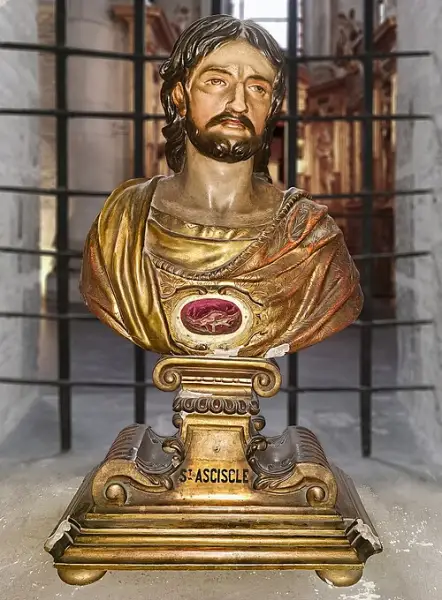
Acisclus — Spanish Acisclo, French Aciscle, also Ascylus or Ocysellus — was a martyr of Córdoba who died in 304, in the persecution of Diocletian, together with his sister Victoria. Their story is unusually well anchored for martyrs of its class: Eulogius of Córdoba, the ninth-century defender of the Mozarabic church, mentions Acisclus's life. The two were arrested and tortured; the tradition holds that Victoria was killed by arrows and Acisclus beheaded, and the red slit on the neck of his surviving bust marks the beheading that the Roman governor ordered. A tenth-century passio elaborates the wonders: the prefect Dion, an iniquitous persecutor, cast the pair into a fiery furnace and heard them singing from within it; he had them bound to stones and thrown into the Guadalquivir, and they floated; he suspended them over a fire, which broke loose and killed hundreds of pagans; and only then, their point proved, did the two accept death. Their house became a church. There is scholarly doubt whether Victoria ever existed at all.
The Complete Life
Early Life
Acisclus was born at Córdoba in the third century, and his whole story is a family one: he suffered with his sister Victoria. The iconography, which regularly shows the two as a young man and a young woman crowned with roses, together with the governor's recorded taunt about the beauty of their youth and the peril it carried, helps explain why art so often depicts him as juvenile. On the question of Victoria's historicity the record is frank: her very existence has been doubted, though both martyrs were honoured in the Mozarabic liturgy, the distinctive rite of the Spanish church under Visigoths and Arabs alike.
§ Introduction
Martyrdom
The persecution of Diocletian reached Córdoba in 304. The core tradition is simple: the two were arrested, tortured, and killed — Victoria by arrows, Acisclus beheaded at the order of the Roman governor. The tenth-century passio supplies the legendary apparatus: the prefect Dion, the fiery furnace that failed, the songs of joy heard from inside it, the binding to stones and the casting into the Guadalquivir, the flotation, and the final fire that turned on the pagans and killed hundreds. The narrative logic is that of the classic martyr romance: the confessors demonstrate God's protection, and only then submit.
§ Introduction
Cult
The cult of Acisclus and Victoria spread throughout Hispania and southern France, with particular strength in Provence. Their home at Córdoba was turned into a church, and by the ninth century it had acquired links with several of the Martyrs of Córdoba — Perfectus among them, who served there as a priest before his own execution in 850. A minor church on the slopes of Montserrat was dedicated to Acisclus, and a cave chapel at Arroyuelos in Valderredible carries both names. A reliquary of Acisclus is preserved in the crypt of the basilica of Saint-Sernin at Toulouse — the reach of a Spanish martyr into Languedoc.
§ Introduction
Legacy
Acisclus and Victoria remain the patron saints of Córdoba, one of the few Roman-era martyr couples still holding a major city's patronage. Eulogius's notice gives them a documentary footing most of their class lack, and their romantic legend gave medieval art one of its loveliest motifs — the rose-crowned boy and girl who sang in the fire.
§ Introduction
The Record
- Patron of
- Córdoba, Spain
- Symbols
- Crowned with roses, with his sister Victoria·Bust with the wound of decapitation
- Canonization
- Pre-congregation; named by Eulogius of Córdoba; honoured in the Mozarabic liturgy
Prayer
Bibliography
Show 2 sources
Profile text adapted from the Wikipedia article, licensed CC BY-SA 4.0.
Pray with this saint every day
Save St. Acisclus to your favorites, read the full profile, and get feast-day reminders in the Saints app.
Get the Saints AppFree on the App Store for iPhone and iPad