
c. 1010–1090·Feast October 6
St. Adalbero of Würzburg
Bishop of Würzburg, Founder of Monasteries
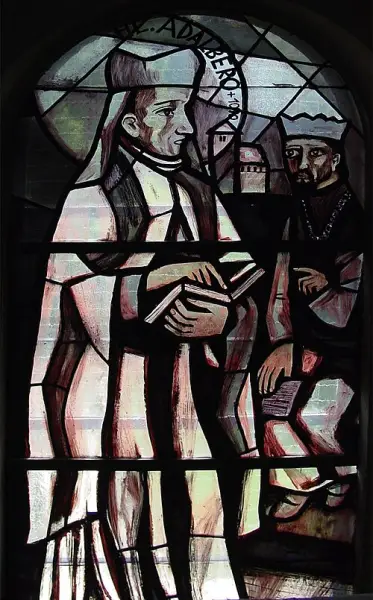
Overview
Adalbero of Würzburg, born around 1010 at Lambach, was the youngest son of Count Arnold II of Wels-Lambach and nephew of Bishop Bruno of Würzburg, whom King Henry III named him to succeed in 1045. Educated at the cathedral school of Würzburg and in Paris, he had already, as a young canon, probably composed the earliest surviving rules for rithmomachia — the philosophers' mathematical game — under the name 'Asilo'. As bishop for four decades he completed the new Würzburg cathedral, built the Neumünster church, and tied himself closely to the reforming circles of Cluny, Gorze and Hirsau, importing the monk Egbert of Gorze whose Münsterschwarzach reforms spread across southern Germany. Godfather to Henry IV, he became a court adviser and mediator, brokering the Peace of Speyer of 1075. When the Investiture Controversy broke out he sided with Gregory VII against his godson, joined the election of the anti-king Rudolf of Rheinfelden in 1077, and was driven from his see, deposed at the Synod of Mainz in 1085, and exiled to Lambach. There he founded and co-founded further monasteries, dying on 6 October 1090 in the abbey church he had built.
The Complete Life
A Count's Son at the Cathedral School
Adalbero was born around 1010 at Lambach on the Traun in what is now Upper Austria, the youngest son of Count Arnold II of Wels-Lambach, of the Formbach family, and his wife Countess Reginlindis. His uncle Bruno, his father's kin in the church, held the bishopric of Würzburg, and the boy's path was set along the usual aristocratic ladder: study at the cathedral school of Würzburg, further study at Paris, then a canonry at Würzburg. The Paris years planted the learning for which he was later known. Evidence from this early period suggests that, writing under the pseudonym 'Asilo', he produced the oldest rules for rithmomachia that survive today — the mathematical battle-game so beloved of medieval scholars. The attribution is a reminder of how wide a cultivated eleventh-century bishop's mind could be: the future reformer of monasteries was also, perhaps, a designer of games of arithmetic. The combination of aristocratic birth, wide study and reforming connections was to define his whole career.
§ Life
Bishop and Reformer
In 1045 King Henry III named Adalbero to succeed his uncle Bruno as Bishop of Würzburg, and he held the see for the next forty-five years. His episcopate was a builder's episcopate: he continued Bruno's new cathedral, adding the east crypt and east choir, raised the Neumünster church between 1058 and 1063, restored the family abbey of Lambach from 1056, and in 1057 re-settled the abbey of St Peter, Paul and Stephen at Würzburg with Benedictines from Münsterschwarzach. That last act joined him to the great reform network of the age — he was in close contact with Cluny, Gorze and Hirsau — and he brought the monk Egbert from Gorze, whose renewal of Münsterschwarzach spread its influence from Harsefeld near Stade in the north to Melk on the Danube. In 1066 he performed the marriage of Henry IV and Bertha of Savoy, and after Henry III's death he became a fixture at the imperial court, prized as adviser and mediator.
§ Life
The Investiture Controversy and Exile
The last act of Adalbero's life was his costliest. When the Investiture Controversy broke out after 1075 — Gregory VII's contest with Henry IV over who should appoint bishops — Adalbero took the pope's side against his own godson. The Synod of Worms declared Gregory deposed; Gregory excommunicated Henry; and after Canossa the war of parties resumed. In March 1077 Adalbero joined other princes in electing Duke Rudolf of Rheinfelden as anti-king. Henry IV besieged Würzburg, whose citizens were turned against their bishop, and Adalbero had to leave the city; Henry then installed a series of anti-bishops. Restored briefly in 1086, he was ejected again, refused all mediation — saying he would die rather than yield — and was formally deposed at the Synod of Mainz in 1085 and driven into exile. He retired to Lambach, renounced his episcopal dignity in 1088, dedicated the monastery of Komburg near Schwäbisch Hall, and co-founded Zwiefalten Abbey in Swabia in 1089. He died at Lambach on 6 October 1090 and was buried in the abbey church he had built.
§ Life
Canonization
Veneration began almost immediately after his death in his Austrian homeland, and his cult at Münsterschwarzach is documented since the seventeenth century; he belonged, that is, to the family of local saints whose fame rested on monastic memory rather than Roman process. In 1883 Pope Leo XIII confirmed Adalbero as a saint of the worldwide Church, in the great wave of confirmations of German and Austrian cults of that pontificate. His relics are honoured today in a glass shrine made by Josef Amberg in the Neumünster at Würzburg, installed in 1948, which contains a thighbone of the saint; the neo-Romanesque St Adalbero's church in Würzburg also bears his name. His iconographic emblem is a church held in his hand — apt for a man who spent a long life and a great fortune raising churches, crypts, choirs and whole monasteries across two lands. His cult thus ran from monastic memory to worldwide recognition in under eight centuries.
§ Veneration
Legacy
Adalbero's legacy is written in stone and in institutions. Würzburg cathedral's east end, the Neumünster, the abbeys of Lambach, Komburg and Zwiefalten, and the Münsterschwarzach reform that ran from the North Sea to the Danube all bear his mark; Zwiefalten and Lambach survive as living monasteries to this day. Politically he stands as one of the clearest cases of a German bishop who paid the full price of the Gregorian reform: deposed, exiled and ending his life in the modest monastery of his own father, rather than submit on investiture. The rithmomachia rules attributed to his youth give him a small, curious place in the history of mathematics as well. Canonized formally only in 1883, he links the eleventh-century reforming episcopate to the modern Church's rediscovery of its medieval witnesses. He is one of the few bishops of the Salian era whose buildings, foundations and canonization can all still be traced.
§ Life
Timeline
- 1010
Born at Lambach an der Traun, youngest son of Count Arnold II of Wels-Lambach
§ Life
- 1045
King Henry III nominates him to succeed his uncle Bruno as Bishop of Würzburg
§ Life
- 1056
Begins restoring Lambach Abbey, which his father had founded in the family castle
§ Life
- 1057
Re-settles the Würzburg abbey of St Peter, Paul and Stephen with Benedictines from Münsterschwarzach
§ Life
- 1058
Establishes the Neumünsterkirche in Würzburg, constructed between this year and 1063
§ Life
- 1066
Officiates at the wedding of King Henry IV and Bertha of Savoy in Würzburg
§ Life
- 1075
With other princes, brokers the Peace of Speyer between Henry IV and the papal party
§ Life
- Mar 1077
Joins other princes in raising Rudolf of Rheinfelden as anti-king in March; Henry besieges Würzburg and drives him out
§ Life
- 1085
Formally deposed at the Synod of Mainz and forced into exile at Lambach
§ Life
- 1086
Rudolf of Rheinfelden restores him to Würzburg, though he is soon ejected again
§ Life
- 1088
Renounces his episcopal dignity and dedicates the monastery of Komburg near Schwäbisch Hall
§ Life
- 1089
Acts as co-founder of Zwiefalten Abbey in Swabia
§ Life
- 6 Oct 1090
Dies at Lambach and is buried in the abbey church he had founded
§ Introduction
- 1883
Pope Leo XIII confirms him a saint for the universal church
§ Veneration
- 1948
Glass shrine holding a thighbone relic of Adalbero is installed in the Neumünsterkirche at Würzburg
§ Veneration
The Record
- Major works
- Earliest surviving rules for rithmomachia, composed under the name 'Asilo' (attribution)
- Patron of
- Diocese of Würzburg; Lambach
- Symbols
- Church in his hand (iconography)
- Canonization
- Canonized in 1883 by Pope Leo XIII
Prayer
Bibliography
Show 7 sources
- 1 2 3 "Hl. Adalbero von Würzburg", Heilige und Selige, Diöceze Würtzburg
- 1 2 Lins, Joseph. "Diocese of Würzburg." The Catholic Encyclopedia Vol. 15. New York: Robert Appleton Company, 1912. 10 June 2018
- 1 2 3 4 "Adalbero", The Cyclopedia of Biblical, Theological, and Ecclesiastical Literature . (James Strong and John McClintock, eds.); Harper and Brothers; NY; 1880 This article incorporates text from this source, which is in the public dom
- ↑ Ann E. Moyer, The Philosopher's Game: Rithmomachia in Medieval and Renaissance Europe (University of Michigan Press, 2001), p. 20.
- 1 2 "Adalbero von Würzburg", Ökumenisches Heiligenlexikon
- 1 2 3 Bertocchi, Pietro. "Beato Adalberone di Wurzburg", July 22, 2011
- ↑ Schoenfeld, Edward. "Pleichfeld, Battle of", The Oxford Encyclopedia of Medieval Warfare and Military Technology , Volume 1, (Clifford J. Rogers, ed.) Oxford University Press, 2010, p. 130 ISBN 9780195334036
Profile text adapted from the Wikipedia article, licensed CC BY-SA 4.0.
Pray with this saint every day
Save St. Adalbero of Würzburg to your favorites, read the full profile, and get feast-day reminders in the Saints app.
Get the Saints AppFree on the App Store for iPhone and iPad