
d. c. 710 (some sources c. 740)·Feast June 25
St. Adalbert of Egmond
Missionary of Frisia (also called Æthelberht of Egmond)
Overview
Adalbert of Egmond, also called Æthelberht, was a Northumbrian Anglo-Saxon missionary and one of Willibrord's companions in preaching the Gospel in Holland and Frisia. Said to be a member of the Northumbrian royal family, he studied, by some accounts, at Rath Melsigi in Ireland with Egbert, the cradle of so many English missionaries. Around 690 he went to assist Willibrord in the Frisian mission field; Alcuin's late eighth-century Life of Willibrord records that they landed near Domburg on the Walcheren coast. Adalbert became particularly associated with Egmond, north of Haarlem, was made archdeacon of the newly founded see of Utrecht, and died there — around 710, though one older source gives about 740 — and was buried at Egmond, where miracles were reported at his tomb and a church rose over it. He is remembered in legend as the protector who shielded Egmond from pirates by raising a fog along the coast.
The Complete Life
Early Life
Adalbert — the name also appears as Æthelberht — was born in Northumbria, and tradition makes him a member of the Northumbrian royal family. His formation was that of the English missionary generation: according to some sources he studied at Rath Melsigi in Ireland under Egbert, the monk whose cell sent Wilfrid's successors, Willibrord, and the brothers who evangelized the continent. That Irish training mattered, for it joined Roman obedience to an ascetic, wandering zeal. Around 690 he crossed to the continent to help Willibrord — himself an alumnus of Rath Melsigi — carry the gospel into Frisia, the coastal strip between the Zuiderzee and the open North Sea, where resistance to the Christian preaching had long been fierce. Frisia had seen missionaries before, among them Wilfrid himself and the murdered Swithberht, but the stable mission that would last came only with Willibrord and the men he gathered, Adalbert among the ablest of them.
§ Biography
Mission in Frisia
Alcuin's late eighth-century Life of Willibrord records that the missionaries landed near Domburg, on the island of Walcheren, a landing that began decades of preaching under the protection — and against the resistance — of Frisian rulers. Adalbert's work centered on Egmond, the settlement in the dunes north of the Haarlem lake, where he became the local pastor of a new Christian people. Utrecht's recently established see, the organizational seat of the Frisian mission, named him archdeacon, tying the village church of Egmond into the wider structure Willibrord erected. He died at Egmond, around 710 in the received chronology, though one older account places his death about 740. Miracles were reported at his tomb, and a church was built over it. Domburg, on Walcheren, later gave its name to the church Willibrord built there; the landing place marked the beginning of a mission that reached from Zeeland to the Frisian lakes, and Adalbert's Egmond anchored its southern dune country.
§ Biography
Legend of the Fog
A local legend remembers Adalbert as a protector in life as well as a healer after it: when pirates threatened, the story goes, he wrapped Egmond in a fog rising from the sea, and the raiders sailed past without finding the village. The story belongs to the folklore that grows around a patron, but it encodes a real memory of a coast exposed to sea-rovers and of a saint regarded as the dunes' own guardian. His death and burial at Egmond made the village the heart of his cult; the feast of 25 June became the annual day of that guardianship. The fog motif belongs to a family of coastal legends, and its persistence at Egmond shows how a missionary's protection was remembered long after the pirates were gone. The tomb itself became the point of contact between the missionary and the people he served: miracles reported there drew pilgrims from the dune villages and gave the young church its first local holy place, around which the first church at Egmond was raised.
§ Introduction
Veneration
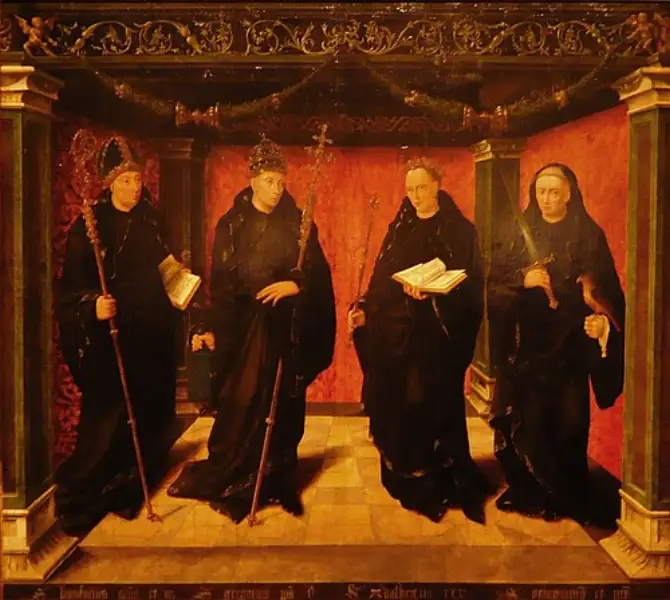
Adalbert belongs to the pre-congregation saints of the mission field: no process, no decree, only a tomb that worked and a people that remembered. His continued remembrance rests largely on the Benedictine monastery of Egmond Abbey, the first in the country, founded some two hundred years after his death by Count Dirk I of West Frisia, who made Adalbert the abbey's patron. Only in the 990s did anyone commission a Vita, which may explain why it preserves so little that is solid fact. His relics were translated to the new abbey for veneration; when the Reformation came and the abbey was destroyed, they found a safe home in Haarlem. After the community was re-established in 1935 the cult returned too, and in 1984 the relics went back — the restored skull now resting under the high altar. In 1530 a painting by Jan Joesten van Hillegom showed Adalbert beside Boniface, Gregory, and Jeroen van Noordwijk, a sign of the standing he held in the late medieval Dutch church.
§ Veneration
Legacy
Egmond Abbey, daughter of Adalbert's tomb, became the religious center of the county of Holland and the burial place of its counts — the house from which Dutch Benedictine life flowed for centuries. The modern abbey at Egmond-Binnen, rebuilt after 1935, carries the same patronage today, and the restored skull beneath its altar makes Adalbert one of the very few early medieval missionaries whose relics remain in the place he evangelized. For the Dutch church he is a reminder that Christianity in Holland began not with princes but with a Northumbrian priest in the dunes, preaching to fisherfolk under a fog he was said to command. The anniversary of his death is still kept at Egmond each June, and the abbey's parish bears his name. Archaeology and the medieval Vitae together keep his name, and the story of the fog is still told to children of the Kennemerland coast. His name is still spoken where his work was done.
§ Veneration
Timeline
- 690
Goes to assist Willibrord in the Frisian mission; per Alcuin, the missionaries land near Domburg
§ Biography
- 710
Dies at Egmond, having served as archdeacon of the new see of Utrecht; buried there, with miracles reported at his tomb
§ Introduction
- 920
Some two centuries after his death, Count Dirk I founds Egmond Abbey, the first in the country, with Adalbert as patron; his relics are translated there
§ Veneration
- 990
A Vita of Adalbert is commissioned in this decade, its thinness reflecting the long gap in records
§ Veneration
- 1935
The abbey is re-founded and his cult is reinstated
§ Veneration
- 1984
His relics, kept at Haarlem after the Reformation, are returned to the abbey
§ Veneration
The Record
- Patron of
- Egmond and North Holland·Dutch monasticism
- Symbols
- Missionary's staff·Fog over the coast (his legendary protection of Egmond)
- Canonization
- Pre-congregation
Prayer
Bibliography
Show 5 sources
- ↑ "Adelbert". New Catholic Dictionary . CatholicSaints.Info. 6 October 2017
- ↑ Lendering, Jonah. "Adalbert van Egmond (†740) – Missionaris in Holland", Historiek , June 25, 2017
- 1 2 Faber, Hans. "The Abbey of Egmond and the rise of the Gerulfings", Frisia Coast Trail, July 19, 2019
- ↑ "Blog Archive » Book of Saints – Adelbert" . Saints.SQPN.com. 1 May 2012 . Retrieved 24 April 2014 .
- ↑ Farmer, David. The Oxford Dictionary of Saints , 5th Edition Revised, p. 3, Oxford University Press, 2011 ISBN 9781156973080
Profile text adapted from the Wikipedia article, licensed CC BY-SA 4.0.
Pray with this saint every day
Save St. Adalbert of Egmond to your favorites, read the full profile, and get feast-day reminders in the Saints app.
Get the Saints AppFree on the App Store for iPhone and iPad