
c. 910-981·Feast June 20
St. Adalbert of Magdeburg
Archbishop, Apostle of the Slavs
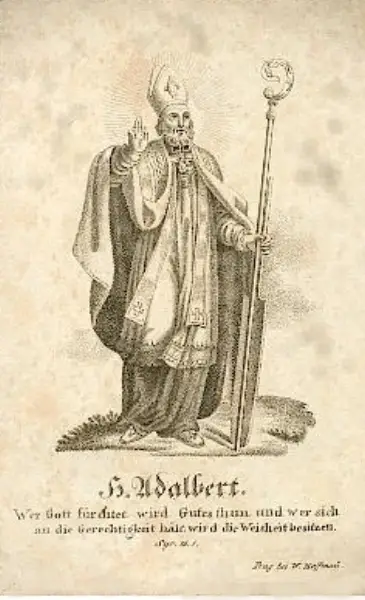
Overview
Adalbert of Magdeburg, sometimes wrongly shortened to Albert, was a German churchman of the tenth century known as the Apostle of the Slavs. Born around 910, possibly in Alsace or Lorraine, he became a monk of the Benedictine monastery of St. Maximinus at Trier. Consecrated a bishop, he was sent in 961 to Kievan Rus at the request of Princess Olga, who had asked Emperor Otto I for a missionary bishop from the Latin church; but Olga's son Sviatoslav took power just as Adalbert arrived, his companions were slain, and he barely escaped with his life. Kiev was subsequently evangelized from Constantinople and joined the Byzantine Christian world. Returning west, Adalbert spent four years at the imperial court of Mainz, then served as abbot of Wissembourg in Alsace, improving the monks' education. In 968 he became the first Archbishop of Magdeburg, the metropolitan see created to organize the mission to the Polabian Slavs, and he erected the dioceses of Naumburg, Meissen, Merseburg, Brandenburg, Havelberg and Poznań. He died on 20 June 981 at Zscherben near Merseburg.
The Complete Life
Early Life
Adalbert was born around 910, and the sources allow only a general guess at the place, Alsace or Lorraine, the western lands of the East Frankish kingdom where the tenth-century church still kept the learning that survived the Viking age. His formation was monastic: he entered the Benedictine house of St. Maximinus at Trier, one of the great monasteries of the Rhineland, whose school had produced bishops and missionaries for generations. Trier in those years stood on the frontier of the Slavic world; east of the Rhine and far beyond the Elbe lay peoples whom the Ottonian kings and their church were beginning to see as a mission field and a field of empire at once. A monk of Adalbert's ability in that setting could expect to be used: consecrated bishop, he was held ready for the work on the frontier, and the great opportunity came when a request arrived from the farthest east of all, from the princess who ruled the Rus of Kiev.
§ Life
Vocation
Princess Olga of Kiev, herself a convert, had asked Emperor Otto I for a missionary bishop from the Catholic Church, and in 961 the emperor's choice was Adalbert. The commission was extraordinary, nothing less than the turning of the vast new state of the Rus toward Latin Christianity and, by implication, toward the western empire. It failed almost at once. Olga's son Sviatoslav, a pagan and a warrior, took the crown from her about the time Adalbert arrived, and the mission party was attacked: Adalbert's companions were slain, and the bishop himself barely escaped with his life. The failure was epochal, for Kiev, spurned in the west, was evangelized instead from Constantinople, and the baptism of Rus in 988 carried the largest European state into Byzantine Christianity, a division whose consequences run to the present day. Adalbert carried the memory of that catastrophe through the rest of his life, and his later work can be read as an answer to it.
§ Life
Mission
After his escape from Kiev, Adalbert passed four years at the imperial court in Mainz, the ecclesiastical capital of Germany, before his appointment as abbot of Wissembourg in Alsace; there he devoted himself to strengthening the monks' schooling, a quiet program that fitted the Ottonian church's ideal of a learned monastic clergy. In 968 came the office for which he is remembered: first Archbishop of Magdeburg. The new province, carved out at the emperor's wish, was designed as the metropolitan base for the conversion of the Polabian Slavs east and north of the German realm, complementing the older mission provinces of Hamburg-Bremen in the north. Adalbert traveled to Rome to receive the pallium before taking possession of his see. From Magdeburg he established or organized the dioceses of Naumburg, Meissen, Merseburg, Brandenburg, Havelberg and Poznań, casting a diocesan net across the Elbe and into Poland, an ecclesiastical map of eastern Germany that in its outlines lasted a thousand years.
§ Life
Final Years
Adalbert governed Magdeburg for thirteen years and died on 20 June 981 at Zscherben, in the country near Merseburg in Saxony-Anhalt. His death removed, at about seventy years of age, the one man who had governed the Slavic mission at both its ends, the failed eastern attempt at Kiev and the growing western province on the Elbe. The work he organized outlived him unevenly: the sees of Brandenburg and Havelberg were soon destroyed in the great Slavic rising of 983, while Meissen and Merseburg endured, and Poznań became a foundation of the Polish church. Among his students at Magdeburg, tradition counts the young Bohemian Vojtěch of the Slavník family, who took the name Adalbert at confirmation in honor of his teacher and went on to evangelize the Slavs, die a martyr in Prussia and enter history as St. Adalbert of Prague, the most famous bearer of the name and, in a sense, the archbishop's harvest.
§ Life
Canonization
Adalbert's cult belongs to the pre-formal era, established by the consent of the church he governed and confirmed by usage. His feast on 20 June, the day of his death, entered the calendars of the German church, and his name was carried in the martyrologies; both the Catholic Church and the Eastern Orthodox Church list him among the saints, a double recognition that fits a man whose life's work lay on the frontier between the two worlds. The title Apostle of the Slavs, which the tradition attached to him, has often caused confusion with his student Adalbert of Prague and with Cyril and Methodius, and readers do well to keep the three apart. His shrine and memory centered on Magdeburg, the cathedral city he founded as a metropolitan see, where his successors kept his feast and where the mission to the Slavs was remembered as his doing.
§ Introduction
Legacy
The institutional legacy is vast: an archdiocese at Magdeburg, six suffragan sees, and the ecclesiastical organization of eastern Saxony, Lusatia and parts of Poland, all traced to the province Adalbert built after 968. The personal legacy passes through his student: the boy confirmed with his name became the martyr-apostle of Bohemia and Prussia, and through Adalbert of Prague the teacher's influence reached Poland, Hungary and Scandinavia, whose rulers the younger man baptized or confirmed. The Kiev episode remained what it had been, the road not taken, one of the hinge moments when Latin and Byzantine Christianity might have divided the world differently. Saint Adalbert's Cemetery in Milwaukee, Wisconsin, named for the archbishop of Magdeburg, carries his memory to the American church built by German immigrants, and modern historians of mission count him among the architects of the medieval German east.
§ Life
Timeline
- 910
Born around this year, possibly in Alsace or Lorraine
§ Introduction
- 961
Consecrated a bishop and sent at Princess Olga's request to Kievan Rus; his companions are slain and he barely escapes
§ Life
- 968
Becomes the first Archbishop of Magdeburg, travelling to Rome to receive the pallium before taking up the see
§ Introduction
- 20 Jun 981
Dies at Zscherben near Merseburg; his liturgical feast is kept on 20 June
§ Life
The Record
- Patron of
- Missionaries to the Slavs·The Archdiocese of Magdeburg
- Symbols
- Archbishop's pallium·Missionary's staff
- Canonization
- Pre-congregation; medieval cult, later formally recognized
Prayer
Bibliography
Show 6 sources
- ↑ Thorne, John; Collocott, T. C. (1990) [1964]. Chambers Biographical Dictionary . Edinburgh: Chambers. p. 7 . ISBN 0-550-16041-8 . OCLC 502219677 .
- 1 2 Campbell, Thomas (1907). "St. Adalbert" . The Catholic Encyclopedia . Vol. 1. New York: Robert Appleton Company . Retrieved 25 March 2015 – via New Advent .
- 1 2 Delaney, John J. (2005). "Adalbert of Magdeburg" . Dictionary of Saints . Image / Doubleday . ISBN 9780385515207 .
- ↑ Michałowski, Roman (2016). The Gniezno Summit: The Religious Premises of the Founding of the Archbishopric of Gniezno . Brill . p. 96. ISBN 9789004317512 .
- ↑ "Adalbert of Magdeburg" . The Oxford Dictionary of Saints . Oxford University Press . Retrieved 20 June 2020 – via Oxford Reference .
- ↑ "Generations of the local Polish community memorialized at Saint Adalbert's in the Garden District" . Milwaukee Independent . 31 October 2019 . Retrieved 20 June 2020 .
Profile text adapted from the Wikipedia article, licensed CC BY-SA 4.0.
Pray with this saint every day
Save St. Adalbert of Magdeburg to your favorites, read the full profile, and get feast-day reminders in the Saints app.
Get the Saints AppFree on the App Store for iPhone and iPad