
c. 956-997·Feast April 23
St. Adalbert of Prague
Bishop of Prague, Missionary and Martyr
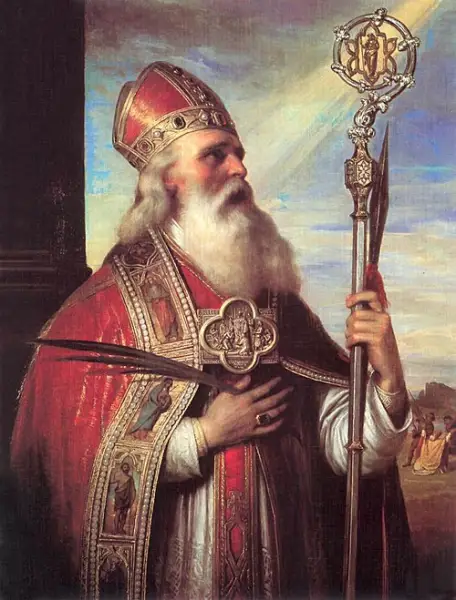
Overview
Adalbert of Prague — born Vojtěch around 956 at the gord of Libice — was a Czech missionary, Bishop of Prague, and martyr, remembered as the apostle of Bohemia and one of the founding saints of Central Europe. His clan, the Slavniks, stood with the Přemyslids among Bohemia's two dominant houses; having come through a severe childhood illness, he was handed over to God's service, and for roughly a decade he studied at Magdeburg under Adalbert of Magdeburg, receiving that name at his confirmation. Ordained by Bishop Dietmar of Prague, he was chosen as Dietmar's successor in 982 though under canonical age. Wealthy by birth, he lived austerely, gave to the poor, and preached against the slave trade, polygamy, and idolatry — and so made enemies of the worldly powers of his diocese. Twice he withdrew to Rome, living as a monk on the Aventine; between his returns he founded the abbey of Břevnov in 993, the oldest monastery in Bohemia. After the massacre of his family by Duke Boleslaus II's forces in 995 he left Prague for good, working as a missionary in Hungary and Poland. In 997 he set out to preach the Gospel to the pagan Prussians on the Baltic; on 23 April he was killed near Święty Gaj. His body was ransomed by Duke Bolesław I of Poland and buried at Gniezno; he was canonized in 999, and in 1000 the Emperor Otto III came to Gniezno to pray at his tomb.
The Complete Life
Early Life
Adalbert was born as Vojtěch in 952 or around 956 at the gord of Libice nad Cidlinou, the seat of his father Slavník, a duke ruling a province of eastern Bohemia, and his mother Střezislava, who by some accounts belonged to the rival Přemyslid dynasty. The Slavniks ranked with the Přemyslids as the two dominant houses of Bohemia, and their struggle with the dukes of Prague would in the end destroy them. Vojtěch survived a grave illness in childhood, and his parents, in payment of the debt, dedicated him to the service of God. He was well educated, studying for roughly a decade (970-980) at Magdeburg under Adalbert, the great missionary bishop whose name the young Vojtěch took at his confirmation — the name by which history knows him. He had five brothers, and a half-brother Radim, later known as Gaudentius, who would share his missions and survive him. The story of his early years was preserved by Cosmas of Prague, the Bohemian chronicler of the early twelfth century.
§ Early years
Bishop of Prague
In 981 his mentor died and Adalbert returned to Bohemia, where Bishop Dietmar of Prague ordained him priest; when Dietmar died in 982, the see of Prague passed to Adalbert despite his being below canonical age. Those who elected him had looked for an amiable, somewhat worldly young aristocrat who would not trouble the secular powers; they got a reformer. Wealthy by birth, he shunned ease and luxury and became known for his charity and austere life. Six years of preaching and prayer won him little ground among the Bohemians, whose pagan beliefs stayed deeply rooted. He spoke against Christians taking part in the slave trade, denounced polygamy and idolatry, and, once his reform proposals were tabled, ran into resistance from clergy and secular powers alike. His family's refusal to back Duke Boleslaus in an unsuccessful war against Poland made his position impossible; in 988 he went into exile in Rome, intending a pilgrimage to Jerusalem but settling instead as a monk — at Monte Cassino, and then at the Benedictine monastery of Saint Boniface and Alexis on the Aventine Hill, where he lived two years. In 992 Archbishop Willigis of Mainz, his metropolitan, demanded his return to Prague, and he obeyed.
§ Episcopacy
Břevnov, Exile, and the Prussian Mission
On his return to Prague in 992-993 Adalbert brought with him a group of Italian Benedictine monks, with whom he founded the abbey of Břevnov near Prague — the oldest monastery in Bohemia and the seed of Benedictine life in the Czech lands. But the opposition had not gone away, and in 995 it turned murderous: forces loyal to Duke Boleslaus II stormed Libice and massacred the Slavnik family, killing four of Adalbert's brothers. Adalbert laid Prague under a sentence of penance and then left his see for good, first launching an excommunication that made him permanently unwelcome, then withdrawing again to Rome and the monastic life. From there his energies turned to mission. He worked among the Hungarians, and then accepted the invitation of Duke Bolesław I Chrobry of Poland. In the spring of 997, despite warnings, he set out with two companions — among them his half-brother Gaudentius — to evangelize the pagan Prussians on the Baltic coast. It was a journey he seems to have understood as his last: he had already arranged that his body should be ransomed.
§ Episcopacy
Martyrdom
The mission to the Prussians lasted only weeks. The people refused his preaching, drove him from their settlements, and warned him away; on 23 April 997, in the region of Święty Gaj near the Baltic — then Prussian territory, now in Poland — he was killed, by most accounts struck down along with his companions by pagan priests or resisters. His half-brother Gaudentius was spared to carry the news. Duke Bolesław of Poland ransomed the missionary's body for its weight in gold and buried it at Gniezno, his capital, where it became at once a national shrine. Adalbert was about forty years old. The bishop who had twice failed to hold his own diocese had succeeded, by his death, in doing what no army had done: binding the young Polish state to the rest of Christian Europe.
§ Introduction
Canonization
Adalbert's canonization in 999, in Rome, by Pope Sylvester II, was among the fastest in the history of the Church — barely two years after his death — and one of the first formal canonizations of the second millennium. It was urged by the Emperor Otto III, the young idealist who had known Adalbert personally and revered him. In the year 1000 Otto made the pilgrimage to Gniezno — the meeting remembered as the Congress of Gniezno — to pray at the martyr's tomb and to establish the Polish ecclesiastical province, acts that marked the entry of Poland into the family of European kingdoms. Adalbert's relics were later divided, and portions were carried to Prague, where they rest in St. Vitus Cathedral; his major shrines are Gniezno and Prague, and his feast is kept on 23 April.
§ Veneration in Poland
Legacy
Adalbert is a father of three nations: patron of the Czech Republic, of Poland, and in history of the Duchy of Prussia, and patron of the Archdioceses of Prague and Esztergom. Břevnov abbey still stands as the mother house of Czech monasticism. By tradition he composed both Hospodine, pomiluj ny, the most ancient Czech hymn, and Bogurodzica, the earliest Polish anthem of record, though neither attribution has been verified. His murder on the Baltic shore became the founding martyrdom of Central European Christianity, and his iconography — a bishop pierced by spears — recalls that his most effective sermon was the one he preached by dying among the people who refused him.
§ Introduction
Timeline
- 956
Born Vojtěch at Libice nad Cidlinou into the Slavnik clan, one of Bohemia's two most powerful families
§ Introduction
- 970
Begins roughly ten years of study in Magdeburg under Adalbert of Magdeburg, later taking his mentor's name
§ Early years
- 981
His tutor dies; Vojtěch returns to Bohemia and is ordained a priest by Bishop Dietmar of Prague
§ Episcopacy
- 982
Chosen to succeed the dead Dietmar as Bishop of Prague, though still under canonical age
§ Introduction
- 988
Driven into exile by opposition from clergy and secular powers, he withdraws to monasteries in Rome
§ Episcopacy
- 992
Archbishop Willigis of Mainz demands his return, and he resumes his episcopal see
§ Episcopacy
- 14 Jan 993
Founds the monastery of Břevnov near Prague with Italian Benedictine monks
§ Episcopacy
- 995
Duke Boleslaus II massacres his five brothers at Libice; Adalbert can no longer stay safely in Bohemia
§ Episcopacy
- Jun 996
Sets out from the Aventine on a pilgrimage through France and Germany, later staying at Emperor Otto III's court
§ Episcopacy
- Mar 997
Released as a missionary bishop, he travels to the court of Duke Bolesław Chrobry at Gniezno
§ Episcopacy
- 11 Apr 997
Performs a baptismal ceremony at Gdańsk during his mission along the Baltic coast
§ Mission in Prussia
- 23 Apr 997
Killed by pagan Prussians after returning to their territory; his head is cut off and impaled on a stake
§ Martyrdom
- 29 Jun 999
Declared a saint in Rome, most likely on this date
§ Canonization and initial veneration
- 1000
Gniezno is elevated to an archbishopric; Otto III travels there to honour the saint's relics
§ Canonization and initial veneration
- 1001
Otto III founds a church dedicated to Adalbert at the hermitage of St. Romuald near Ravenna
§ Canonization and initial veneration
- 1004
Bruno of Querfurt writes the first of his two hagiographies of the saint
§ Canonization and initial veneration
- 1008
Bruno of Querfurt completes a second version of the saint's life, the Vita altera
§ Canonization and initial veneration
- 24 Aug 1038
Czech Duke Bretislav I plunders Gniezno and solemnly brings the relics into Prague
§ Theft of relics
- 1064
Gniezno Cathedral is rebuilt and the church organization of Poland is restored
§ Veneration in Poland
- 1090
A feast of the Translation of St. Adalbert appears in the liturgical calendar of Gniezno Cathedral
§ Veneration in Poland
- 1111
Bolesław the Wrymouth ends a penitential pilgrimage at the saint's tomb and donates a gold reliquary
§ Veneration in Poland
- 1127
The head of St. Adalbert is discovered in Gniezno Cathedral
§ Veneration in Poland
- 1143
The bishop of Prague declares a similar discovery of the saint's head in Prague Cathedral
§ Veneration in Poland
- 1175
The bronze Gniezno Doors, decorated with eighteen reliefs of his life, are created
§ Veneration in Poland
- 1285
Archbishop Jakub Świnka orders every Polish parish and monastery to own a written hagiography of the saint
§ Veneration in Poland
- 1928
An arm once given to Otto III is added to the bones preserved at Gniezno
§ Veneration in Poland
- 23 Apr 1997
Millennium of the martyrdom is commemorated with an ecumenical pilgrimage to his tomb at Gniezno
§ Veneration in Poland
The Record
- Patron of
- Poland·Czech Republic·Archdiocese of Prague·Archdiocese of Esztergom·Students of Polish literature·Kaliningrad Oblast
- Symbols
- Bishop's vestments·Spears (instruments of his martyrdom)·Missionary's staff
- Canonization
- Canonized in 999 in Rome by Pope Sylvester II
Prayer
Bibliography
Show 12 sources
- ↑ " "Saint Adalbert Bishop of Prague", Encyclopædia Britannica" . Archived from the original on 2020-03-17 . Retrieved 2020-01-30 .
- ↑ Stracke, Richard (20 October 2015). "Hungarian Saints: Adalbert, Martin, Stanislas, Emeric and Stephen" . Christian Iconography . Archived from the original on 2019-02-05 . Retrieved 2019-01-17 .
- ↑ Butler, Alban; Burns, Paul (1999). Butler's Lives of the Saints: April . A&C Black. p. 166. ISBN 978-0-86012-253-1 .
- 1 2 3 4 5 Bowker, John, ed. (1997). "Adalbert of Prague, St" . The Oxford Dictionary of World Religions . Oxford : Oxford University Press . pp. 15– 16. ISBN 0-19-213965-7 . OCLC 896422819 .
- ↑ "Szent Adalbert" . Katolikus.hu . Catholic Church in Hungary. Archived from the original on 2018-02-27 . Retrieved 2018-03-07 .
- ↑ Vlasto 1970 , p. 123.
- 1 2 Molnar 1978 , p. 12.
- ↑ Vlasto 1970 , p. 97.
- 1 2 Cosmas of Prague 2009 , pp. 77–78.
- ↑ Kalhous 2015 , p. 10.
- ↑ Cosmas of Prague 2009 , p. 81.
- ↑ Cosmas of Prague 2009 , pp. 87, 156.
Profile text adapted from the Wikipedia article, licensed CC BY-SA 4.0.
Pray with this saint every day
Save St. Adalbert of Prague to your favorites, read the full profile, and get feast-day reminders in the Saints app.
Get the Saints AppFree on the App Store for iPhone and iPad