
died 670 or 686·Feast June 2
St. Adalgis of Thiérache
Monk, Priest and Missionary
Overview
Adalgis of Thiérache, known in French as Algis and in Latin as Adalgisus, was a seventh-century Irish monk and missionary who worked in Picardy and is traditionally held to have been a follower of Saint Fursey. Born in Ireland to distinguished and pious parents, he was dedicated to God from childhood and educated in both sacred and worldly learning; his brothers were remembered as Saints Goban of Picardy and Etto of Fescau. With his brothers and a holy man named Eloquius he placed himself under Fursey's guidance and was ordained priest. Following a shared dream the company sailed for Gaul, were received warmly by King Clovis II at Laon, and were granted land in the Thiérache. After preaching around Arras and Laon, Adalgis settled in the forest of Thiérache with three companions, building cabins, a wooden-fenced monastic cell, and a church in honor of Peter and Paul at the place called Cellula, around which the village of Saint-Algis grew. He later made a pilgrimage to Rome, and died peacefully on 2 June, in 670 or 686; his tomb was renowned for miracles, and his relics were translated to the Abbey of Saint-Michel around 960-970.
The Complete Life
Ireland
Adalgis, whose name the French tradition renders as Algis, Algise or Aldegisus, was born in Ireland to parents remembered as distinguished and pious, who dedicated him to God from childhood and saw to his education in both worldly and spiritual learning. The Lives connect him by blood to two other Irish saints, Goban of Picardy and Etto of Fescau, remembered as his brothers, a detail that fits the family-based migration of seventh-century Irish peregrini to the continent. The decisive relationship of his youth was Saint Fursey, the Irish abbot and visionary who had founded houses in East Anglia and Gaul; Adalgis is described as his disciple or companion, and with Goban, Etto and a holy man named Eloquius he placed himself under Fursey's guidance, serving God, the Life says, with one heart and mind. It was Fursey who encouraged them to prepare for holy orders and who ordained them priests. The same tradition reports that a shared dream set them on the road, and that Adalgis, taking along his brothers, Eloquius, the godson Corbican and the servant Rodalgus, sailed for the coast of Gaul.
§ Introduction
The Cell in the Forest
Landing in France, the company made its way to the Abbey of Corbie, a great Irish-connected house in Picardy, and Adalgis began preaching in the region of Arras and Laon. At Laon the group found a warm welcome from King Clovis II, who gave them somewhere to serve the Lord and assigned Adalgis land in the area of Thiérache, the wooded border country of Picardy. After separating from his companions, Adalgis settled in the forest of Thiérache with three others; huts went up for the little party, a small church honoring the apostles Peter and Paul, and lastly a monastic cell walled with timber. The place was called Cellula, the little cell, and the village that grew around it took his name, Saint-Algis, near the Oise. From that base he evangelized the surrounding country and became a prominent preacher in the region of Hainaut between the Oise and the Helpe, territory that now straddles northern France and southern Belgium. A later pilgrimage to Rome completed his pattern: at the Basilica of Saint Peter, the Life says, a vision of the apostle granted him the relics he had asked for, which he carried home to his cell.
§ Missionary work in France
Death and Miracles
Adalgis is believed to have died peacefully, on 2 June, with the year disputed between 670 and 686, some time in or after the middle of the seventh century. His first burial was at the chapel he had raised, in the Laon region, where his tomb gained fame for the many miracles reported there. Later his remains were moved to the Abbey of Saint-Michel in Thiérache under Eilbert, castellan of Péronne, around 960 to 970, giving the cult a monastic seat; an arm of the saint was preserved as a relic at the Monastery of Maroilles, though that claim has been questioned. The most durable miracle of the tradition belongs to the landscape: when he settled in Thiérache, Adalgis is said to have pushed his staff into the soil, and a clear spring at once bubbled up, the fountain of Saint-Algis, whose water was credited with curing lepers, paralytics and the possessed. Mothers dipped their children in it on the eve of the Ascension rogation procession, asking health and strength for them, a custom that tied the saint's memory to the yearly round of village life.
§ Death
Cult and Historicity
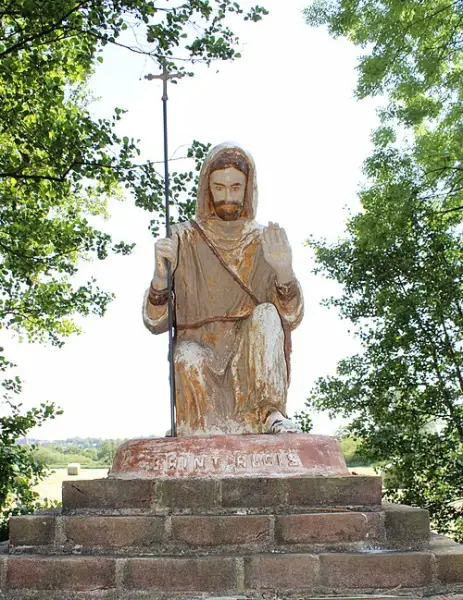
Adalgis is a pre-congregation saint, honored from early times in both the Roman Catholic and Orthodox traditions, with his feast kept on June 2 and, in some places, on July 10. His cult is fixed in the geography of the Aisne: the church of Saint-Algis, the village that bears his name, and the spring at the Saint-Algis fountain, where a statue of the saint still stands. Modern scholarship, examining the Acts of Saint Algise, has raised doubts about the traditional narrative and in particular the connection with Fursey, noting inconsistencies in the assembled traditions; the historians' caution is worth recording, since the Life as we have it was compiled to serve a cult rather than a chronicle. What survives the criticism is the broad fact of an Irish missionary presence in the Thiérache, one of many in sixth- and seventh-century northern France, and a local devotion at Saint-Algis that has continued in some form from the early Middle Ages to the present.
§ Introduction
Legacy
Adalgis's legacy is written in a French village's name. The Cellula he fenced with wood in the forest of Thiérache became Saint-Algis, and the spring his staff was said to have opened still bears him, so that his cult belongs to the kind of holiness northern France loved best: the founding saint who clears forest, builds a cell, baptizes a countryside and leaves water in the ground. He also belongs to the great Irish diaspora of the seventh century, that stream of monk-missionaries who re-evangelized Gaul and the Low Countries and whose names still dot the map from the Channel to the Alps. The disputed details of his Life matter less than the pattern it preserves, of small, persistent, local mission, and the annual rogation procession that paused at his fountain kept that pattern in the bodies of the villagers long after the written acts were forgotten. What the scholarship unsettles, the landscape confirms: a village, a church, and a spring that still runs.
§ Introduction
Timeline
- 2 Jun 670
Died peacefully on 2 June, with the year disputed between 670 and 686; buried at the chapel he had built
§ Death
- 960
Remains translated by Eilbert, castellan of Péronne, to the Abbey of Saint-Michel in Thiérache, around 960 to 970
§ Death
The Record
- Patron of
- Saint-Algis and the Thiérache
- Symbols
- Staff that struck a spring (Saint-Algis fountain)·Monastic cell (Cellula)
- Canonization
- Pre-congregation; ancient cult in northern France
Prayer
Bibliography
Show 5 sources
- 1 2 3 4 5 6 7 8 9 10 11 12 "Den hellige Adalgis av Thiérarche (d. ~686) | Den katolske kirke" . www.katolsk.no (in Norwegian Bokmål). 2009-06-02 . Retrieved 2025-06-29 .
- 1 2 3 4 5 6 7 8 9 10 11 12 13 14 15 16 17 18 19 20 21 22 23 24 25 O'Hanlon, John (1875). Lives of the Irish saints: with special festivals, and the commemorations of Holy persons . Vol. 6. Dublin: James Duffy and Sons. p. 22.
- 1 2 3 4 5 6 7 8 9 10 11 12 "Bulletin de la Société Archéologique de Vervins" . Société archéologique et historique de Vervins et de la Thiérache (in French). 2 : 107– 111. 1874 – via Bibliothèque nationale de France ; Gallica.
- 1 2 "Saint Algise" . Nominis (in French) . Retrieved 2025-06-29 .
- ↑ The Saint-Algis Fountain: Information Panel found on site at the fountain
Profile text adapted from the Wikipedia article, licensed CC BY-SA 4.0.
Pray with this saint every day
Save St. Adalgis of Thiérache to your favorites, read the full profile, and get feast-day reminders in the Saints app.
Get the Saints AppFree on the App Store for iPhone and iPad