
died 690·Feast November 20
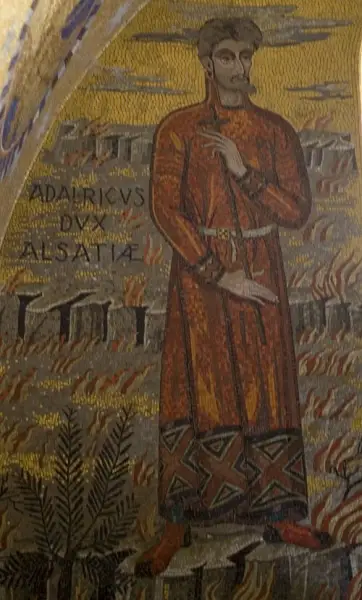
St. Adalrich (Eticho), Duke of Alsace
Duke of Alsace, Founder of Monasteries, Father of St. Odilia
Overview
Adalrich, also known as Eticho, was Duke of Alsace in the later seventh century, founder of the Etichonid family, and one of the most consequential figures of the power politics of late Merovingian Austrasia — a progenitor, some argue, of the House of Habsburg. Born into a Burgundian noble house near Dijon that had taken up monastic patronage, he climbed through the factional wars that followed Childeric II's assassination, changed allegiance repeatedly, lost and then rebuilt a dukedom in Alsace cut down to the strip between the Vosges and the Rhine, and ruled it with almost viceregal authority in an age when no Merovingian king came there again while he lived. His record with monasteries was mixed: he is infamous for suppressing Moutier-Grandval and oppressing the Sornegau around it — an oppression that led to the death of St Germanus — yet late in life he founded Ebersheim and Hohenburg, installing his daughter Odilia as first abbess of the latter. The famous legend of Odilia's blindness, her father's attempted concealment, the accidental killing of his son, and the duke's final reconciliation made his cult: he was venerated as a saint by the twelfth century, and his feast is kept on 20 November.
The Complete Life
A Burgundian Noble House
Adalrich's family came from the pagus Attoariensis around Dijon in northern Burgundy. By the seventh century's middle decades, under Duke Amalgar and his wife Aquilina, they had emerged as chief founders and supporters of monasteries across that region — a convent at Brégille and a men's abbey at Bèze — placing their own children into both abbacies. Amalgar and Aquilina were succeeded by their third child, another Adalrich, who was the father of the subject of this profile. The family pattern thus established — nobility, monastic endowment, dynastic control of church offices — was the one the younger Adalrich spent his life executing, on a larger stage and with harder hands. He married Berswinda, a relative of Bishop Leodegar of Autun, binding himself into the episcopal aristocracy of Burgundy; their children included Adalbert, his successor as duke, and Odilia, later the patron saint of Alsace. That double inheritance — patronage and control — would mark everything he afterwards did.
§ Introduction
Power Politics, 673–679
The first we see of Adalrich is among the magnates who asked Childeric II to accept the thrones of Neustria and Burgundy in 673. By March of 675, his reward being honores in Alsace and the ducal title, he stood as duke — and when Childeric was assassinated that year, the civil war began that made and unmade him. He backed Dagobert II for the Austrasian throne; abandoned his own kin Leodegar for the mayor Ebroin before 677; was granted the monastery of Bèze by Theuderic; marched on Lyon in 679 in a bid for Provence after the assassination of Hector; failed, returned to Alsace, and switched back to the Austrasians. After Dagobert II's murder, Theuderic III dispossessed him of his Alsatian lands, which fell to Bèze. What survived was a reduced dukedom — no longer reaching west of the Vosges, only the land between Vosges and Rhine down to the Sornegau — but within it, royal power had collapsed so far that no king visited the Merovingian palace at Marlenheim again in his lifetime, and Adalrich's practical authority was greater than his predecessors'.
§ Civil war of 675–679
The Monasteries: Oppression and Foundation
Adalrich's relationship with the Church of his duchy was the double one typical of seventh-century dukes: he relied on monasteries for his power, and he treated them as his property. He is remembered above all for crushing Moutier-Grandval and for throwing his weight about among the religious houses of his domain. The Life of Germanus of Grandval tells how he set out to oppress the Sornegau's inhabitants on the claim that they had rebelled against his forerunners from time immemorial: he deposed their centenarius in favor of a count of his own, drove the valley folk into exile, and finally advanced with an Alemannic host to lay the land waste; when Abbot Germanus and his provost Randoald confronted him carrying books and relics, the duke proposed a wadium of compensation, which Germanus declined for reasons never recorded — the valley was ravaged all the same, and both Germanus and Randoald were afterward killed. Yet across the years 680–700 this same man brought two monasteries into being in north-central Alsace: Ebersheim, dedicated to St Maurice, and Hohenburg, raised upon the remains of an old Roman fort that his huntsmen had come across and that he had put to his own military uses. Whether as penance for Leodegar and Germanus or from a secret desire disclosed to intimates to serve God, he built — and made his daughter Odilia the first abbess of Hohenburg.
§ Relationship with monasteries
Odilia and Reconciliation
The Life of Odilia supplies the domestic drama that completed the duke's story. Odilia was said to have come into the world blind, and Adalrich took this as divine punishment; anxious above all to keep standing before his retainers, he pressed his wife to have the infant quietly put to death. Berswinda, however, smuggled the baby away to a maid serving at the monastery of Palma. The girl was raised there until Bishop Erhard baptized her and anointed her eyes with chrism, giving her back her sight; when the bishop tried to restore her to her father, Adalrich still refused, fearing the shame of admitting a daughter raised in poverty. His son brought Odilia back to Hohenburg against orders, and Adalrich, in a rage, struck at him with his sceptre and killed him. Shamed by the killing, he allowed Odilia to reside at the abbey beneath a British nun on a bare stipend; yet near the close of his life the two were reconciled, and he named her first abbess of his foundation, surrendering the abbey to her as though it were his own possession. His death came on 20 November 690.
§ Veneration as a saint
Cult
Through his daughter, so the tradition runs, Adalrich made his peace with God, and already by the twelfth century he was honored as a saint with a local cult: pilgrims were shown his burial garments at Hohenburg, and the nuns kept an annual feast for him on 20 November. That portrait — an aristocrat who grew holy without abandoning his station — enjoyed wide favor across the Rhineland and reached even Bavaria during the medieval centuries. The Life of Odilia that carries the story was, on its face, a moral tale: by maltreating a blind daughter to save face, the duke ended far more dishonoured than confession would have left him. Historically he matters most as founder of the Etichonids, the ducal house of Alsace, and possibly as a progenitor of the Habsburgs; hagiographically he matters as one of the rare dukes in the calendar, whose sanctity is precisely the sanctity of a powerful man's late and imperfect conversion.
§ Veneration as a saint
Timeline
- 673
Backs Childeric II's accession to the kingships of Neustria and Burgundy after Chlothar III's death
§ Civil war of 675–679
- Mar 675
Recorded as Duke of Alsace, holding honores in the province granted by Childeric II
§ Civil war of 675–679
- 677
Appears as an ally of King Theuderic, who grants him the monastery of Bèze, having earlier defected to Ebroin
§ Civil war of 675–679
- 679
Marches on Lyon in a failed bid for Provençal power after Hector of Provence's assassination, then withdraws to Alsace
§ Civil war of 675–679
- 679
Dispossessed of his lands in Alsace by King Theuderic III following the assassination of Dagobert II
§ Civil war of 675–679
- 683
Confers the comital office on his son Adalbert, his eventual successor, consolidating the family duchy
§ Power in Alsace
- 20 Nov 690
Dies at Hohenburg, having reconciled with his daughter Odilia and installed her as the abbey's first abbess
§ Introduction
The Record
- Patron of
- Alsace (through his foundation at Hohenburg)
- Canonization
- Pre-congregation; regarded as a saint with a local cult by the twelfth century
Prayer
Bibliography
Show 1 sources
- ↑ His name is also given as Adalricus , Chadelricho , Hetticho , Etichon , Cathicus , Cathic , or Athich .
Profile text adapted from the Wikipedia article, licensed CC BY-SA 4.0.
Pray with this saint every day
Save St. Adalrich (Eticho), Duke of Alsace to your favorites, read the full profile, and get feast-day reminders in the Saints app.
Get the Saints AppFree on the App Store for iPhone and iPad