
c. 990 - c. 1060-1070·Feast May 3
St. Adamo Abate
Benedictine Abbot
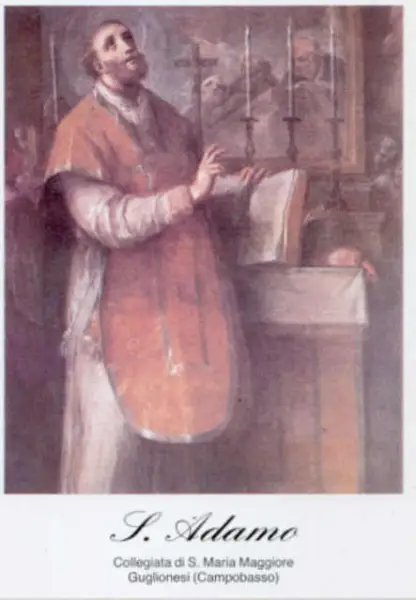
Overview
Adamo Abate was an Italian Benedictine abbot of the eleventh century, born around 990 at Petazio, the modern Petacciato in Molise, and baptized at nearby Guglionesi. Around the middle of the century he became abbot of the Abbey of Santa Maria a Mare on the island of San Nicola in the Tremiti Islands, the celebrated monastic house of the Adriatic, and he transformed it into a center of culture and of civil and religious renewal for the whole southern Adriatic world. A figure of standing in the church politics of his day, he appeared at the Council of Melfi in 1059, held under Pope Nicholas II in the presence of the Normans, and there mounted a vigorous defense of the Tremiti monastery's independence when Montecassino laid claim to it. He is also remembered as a promoter of the unification of the populations of southern Italy under Roger II of Sicily's house, decades before that unification was achieved. He died on 3 May between 1060 and 1070.
The Complete Life
Early Life
Adamo was born around 990 at Petazio, today's Petacciato, a hill town of Molise overlooking the Adriatic, and he was baptized in the neighboring town of Guglionesi, an ordinary beginning in a region where the Benedictine monasticism of the south had taken deep root. The two towns, and the islands offshore, would be the three points of his life. Molise in his century was a borderland: Lombard, Byzantine and Norman influences met there, and the great abbeys, Montecassino above all, exercised a lordship that reached across the countryside. For an able young man the monastery was the natural school, and Adamo's path to the abbey of Santa Maria a Mare, the house of the Tremiti Islands, suggests early formation in the Benedictine observance of the Adriatic coast. The Tremiti house, ancient and at times turbulent, needed in the eleventh century exactly what it received in him: a firm hand, a cultured mind and a strong ally.
§ Life
Vocation
Adamo's vocation was that of the reforming abbot. Taking charge, around the middle of the eleventh century, of the Abbey of Santa Maria a Mare on San Nicola, the principal island of the Tremiti group, he set about making the house what the sources call a center of culture and of civil and religious renewal: a monastery whose scriptorium, school and discipline radiated over the Adriatic, serving the coasts of Apulia, Molise and Dalmatia, and standing as a Christian anchor in a sea troubled by Slavic and Muslim raiding. The renewal of a monastery in that age was never merely internal; it meant restored lands, rebuilt churches, defended liberties and educated monks, all of which required an abbot who could deal with popes, princes and rival abbots. Adamo proved equal to the office, and his reputation carried him from the island to the great assemblies of the church of the south.
§ Life
Mission
Two public acts define his mission. The first was his appearance at the Council of Melfi in 1059, the council held under Pope Nicholas II that regularized the Norman position in southern Italy; there Adamo forcefully upheld the independence of the Tremiti monastery when the Abbey of Montecassino, the greatest Benedictine house of the south, sought to absorb it. Standing for the liberty of a small island abbey against a continental power, at a council designed to settle the map of the south, was an act of some courage, and the tradition of his house remembered it as his defining moment. The second was political in a longer frame: he is remembered as a promoter of the unification of the populations of southern Italy under the Hauteville monarchy that culminated in Roger II of Sicily, supporting, decades ahead of its accomplishment, the peaceable ordering of a region long divided among Lombard dukes, Byzantine governors and Norman adventurers.
§ Life
Final Years
Adamo died on 3 May, in the years between 1060 and 1070, the exact year unpreserved. His body was laid to rest at the church of San Paolo in his native Petacciato, which kept his memory in the district of his birth. Some thirty years later, in June 1102, his relics were translated, in the language of the sources stolen or carried, from Petacciato to Guglionesi, the town of his baptism, where the Benedictine was proclaimed patron saint. The event shows the mechanics of medieval cult: a town's desire for a heavenly protector, a translation that fixed the relics in a new center, and a liturgical calendar adjusted accordingly. The relics were housed in the church of Santa Maria Maggiore at Guglionesi until the sixteenth century, when Turkish raiders burned the building and the remains of the patron were lost; what could not be burned was the festival.
§ Introduction
Canonization
Adamo's sanctity was established by the normal means of the eleventh-century south: popular veneration, translation of relics and the proclamation of a patronage, with no formal process, which the church of that era did not require. The proclamation of 1102 at Guglionesi was in effect the local church's act of recognition, and the annual festival, kept from 2 to 4 June, has carried the cult for over nine hundred years, through the loss of the relics themselves in the Turkish raid of the sixteenth century. The Benedictine calendar and the local traditions of Molise preserve his feast on 3 May, the day of his death. Devotion centered on the civil identity of the town: Guglionesi, needing a protector against the sea-raiders and the fevers of the plain, found one in the abbot it had taken to itself.
§ Introduction
Legacy
Adamo's living legacy is the festival of Guglionesi, three days each June in honor of the patron the town acquired in 1102, one of the durable civic rituals of Molise. His historical legacy lies in the renewal of the Tremiti abbey, which after his abbacy continued for centuries as a religious and cultural center of the Adriatic, and in the precedent of Melfi, where the liberty of a small house was defended against Montecassino in the very council that was drawing the new map of the Norman south. As an early advocate of the political unification of the south under the Norman monarchy, he belongs to the prehistory of the kingdom of Sicily, the most effectively governed state of its century. For the small towns of Molise, Petacciato and Guglionesi, he remains the local saint, proof that holiness in the eleventh century did not only wear a bishop's ring but also an abbot's crozier on a small island.
§ Life
Timeline
- 990
Born at Petazio, today's Petacciato, and baptized in the neighboring town of Guglionesi
§ Life
- 1050
Around mid-century, becomes abbot of Santa Maria a Mare on San Nicola in the Tremiti Islands
§ Introduction
- 1059
At the Council of Melfi, authoritatively defends the Tremiti monastery's autonomy against Montecassino
§ Life
- 3 May 1060
Dies on 3 May, in the decade between 1060 and 1070; the exact year is not preserved
§ Introduction
- Jun 1102
Relics taken from San Paolo in Petacciato to Guglionesi, where he is proclaimed patron saint
§ Veneration
The Record
- Patron of
- Guglionesi, Molise·The Tremiti Islands
- Symbols
- Abbot's crozier·Benedictine habit
- Canonization
- Cult confirmed by popular veneration; proclaimed patron of Guglionesi after translation of relics in 1102
Prayer
Bibliography
Show 3 sources
Profile text adapted from the Wikipedia article, licensed CC BY-SA 4.0.
Pray with this saint every day
Save St. Adamo Abate to your favorites, read the full profile, and get feast-day reminders in the Saints app.
Get the Saints AppFree on the App Store for iPhone and iPad