
1st-2nd century·Feast August 5
St. Addai of Edessa
One of the Seventy Disciples, Apostle of Mesopotamia
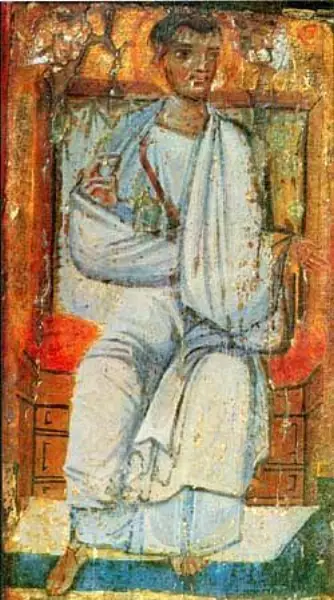
Overview
Addai of Edessa — Syriac Mar Addai or Mor Aday, Latinized Addeus, and identified in Eastern Christian tradition with Thaddeus of Edessa — was, according to that tradition, one of the seventy disciples of Jesus. A Jew born in Edessa, the capital of the small kingdom of Osroene in upper Mesopotamia, he came to Jerusalem for a festival, heard the preaching of John the Baptist, was baptized in the Jordan, and remained in Judea as a follower of Jesus. He was chosen among the seventy disciples sent out in pairs to preach in the cities. After Pentecost, Addai preached the Gospel in Mesopotamia, Syria, and Persia: he ordained priests in Edessa, brought many to conversion, and strengthened the church there; Beirut too heard him preach, and many hold that a church was founded there by him. His mission is inseparable from the legend of King Abgar of Edessa, the correspondence with Christ, and the conversion of the first Christian kingdom. Around the year 200 the anaphora now known as the Liturgy of Addai and Mari took shape and is still used by the Assyrian Church of the East, the Chaldean Catholic Church, and the Eastern Syriac churches of India that trace their origins to Thomas the Apostle. His feast is kept on 5 August, and he is honored especially as a patron of the Assyrians.
The Complete Life
The Disciple
Eastern Christian tradition makes Addai a Jew of Edessa — the modern Şanlıurfa — the capital of Osroene, a buffer kingdom between Rome and Parthia. His path to Christ ran through the Baptist: coming to Jerusalem for a festival, he heard John's preaching, received baptism in the Jordan, and then remained in Judea, joining himself to Jesus as a follower. The Gospel of Luke counts him among the seventy disciples sent out two by two to the cities and places ahead of the Lord. This is the tradition's way of giving the Syriac church an apostolic pedigree that reaches into the earthly ministry of Christ himself, and it made Addai the anchor of the claim that Edessa was the first kingdom to receive the Gospel.
§ Life
Apostle of Mesopotamia
After Pentecost, according to the tradition, Addai preached the Gospel in Mesopotamia, Syria, and Persia. In Edessa he ordained priests, converted many, and built up the church, becoming the apostle of the first city in the world to have a Christian king. His mission is told at length in the Doctrine of Addai, the Syriac work of the fourth and fifth centuries that recounts the correspondence between King Abgar of Edessa and Jesus, the healing of Abgar by the disciple, and the planting of Christianity at the royal court. Addai also preached at Beirut, where many believe he founded a church — a detail that carried his cult to the Mediterranean coast as well as inland to Persia.
§ Life
Veneration
Addai is venerated across nearly the whole family of Eastern churches: the Church of the East, the Roman Catholic Church, the Eastern Orthodox Church, the Oriental Orthodox churches, and the Church of Caucasian Albania. His feast is kept on 5 August. In the Western martyrologies he appears in the company of Thaddeus; the Roman Martyrology from the time of Baronius has commemorated Addai and Mari as the apostles of Edessa and of the Persians. He is honored in particular as a patron of the Assyrians, for whom he is the father of their church.
§ Introduction
Legacy
Addai's most living legacy is liturgical. The anaphora known as the Liturgy of Addai and Mari, which had taken shape by about the year 200, remains in use today: the Assyrian Church of the East prays it, as do the Chaldean Catholic Church in Iraq and, in India, the Chaldean Syrian Church and the Syro-Malabar Catholic Church — one of the oldest Eucharistic prayers in continuous use anywhere in Christendom. In 2001 the Catholic Church recognized its validity without the words of institution, a landmark in ecumenical relations between Rome and the Church of the East. Around Addai also stands the whole romance of Edessa: the letter of Christ to Abgar, the first Christian king, and the Syriac Christianity that carried the Gospel eastward along the Silk Road as far as China.
§ Life
Timeline
- 50
Succession lists of the Church of the East mark the start of his episcopate at Edessa around this year
§ Introduction
- 66
The same lists end his tenure around this year, when Mar Aggai succeeds him as bishop
§ Introduction
- 200
The Syriac anaphora named for him and Mari takes shape, and remains in use among the Syriac churches
§ Life
The Record
- Major works
- Liturgy of Addai and Mari (ascribed)
- Patron of
- Assyrians
- Symbols
- Disciple's mantle·Scroll of the Gospel
- Canonization
- Pre-congregation; venerated in the Church of the East, Roman Catholic, Eastern Orthodox, Oriental Orthodox, and Caucasian Albanian Churches
Prayer
Bibliography
Show 12 sources
- 1 2 3 "Saint Who? Saints Addai and Mari". Magnificat . 20 (12). Magnificat USA: 76. January 2019.
- ↑ Charles George Herbermann, The Catholic Encyclopedia (Universal Knowledge Foundation, 1913), p. 136.
- ↑ Holweck, Frederick George. A Biographical Dictionary of the Saints , B. Herder, 1924, p. 15
- 1 2 "Apostle Thaddeus of the Seventy", Orthodox Church in America
- ↑ CNA. "St. Jude Thaddeus and St. Simon the Zealot, Apostles" . Catholic News Agency . Archived from the original on August 19, 2019 . Retrieved 2022-05-29 .
- ↑ Brown, Leslie W. (1956). The Indian Christians of St Thomas: An Account of the Ancient Syrian Church of Malabar . Cambridge: Cambridge University Press. p. 281.
- ↑ Sengstock, Mary C. (1982). Chaldean-Americans: Changing Conceptions of Ethnic Identity . Center for Migration Studies. ISBN 9780913256428 .
- ↑ Herbermann, Charles George (1913). The Catholic Encyclopedia . Encyclopedia Press. p. 282.
- ↑ Neale, John Mason (2008). A History of the Holy Eastern Church: The Patriarchate of Antioch: The Patriarchate of Antioch . Wipf and Stock Publishers. p. 38. ISBN 978-1-60608-330-7 .
- ↑ Bowman, Alan; Garnsey, Peter; Cameron, Averil (2005). The Cambridge Ancient History: Volume 12, The Crisis of Empire, AD 193-337 . Cambridge University Press. ISBN 9780521301992 .
- ↑ Skolnik, Fred; Berenbaum, Michael (2007). Encyclopaedia Judaica . Macmillan Reference USA. ISBN 9780028659435 .
- ↑ Roberts, John Morris; Westad, Odd Arne (2013). The History of the World . Oxford University Press. ISBN 9780199936762 .
Profile text adapted from the Wikipedia article, licensed CC BY-SA 4.0.
Pray with this saint every day
Save St. Addai of Edessa to your favorites, read the full profile, and get feast-day reminders in the Saints app.
Get the Saints AppFree on the App Store for iPhone and iPad