
died 734 or 735·Feast December 24 (Orthodox); January 3 (Catholic)
St. Adela of Pfalzel
Widow, Abbess of Pfalzel
Overview
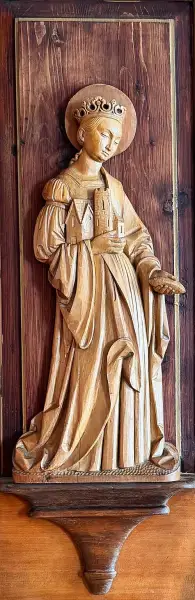
Adela of Pfalzel, also called Adula or Adolana, was a Frankish noblewoman of the eighth century who ended her life as a Benedictine nun and abbess at Pfalzel near Trier. The tradition makes her a daughter of King Dagobert II, whose wife Matilda was said to be an Anglo-Saxon princess married while he hid in Ireland, and a sister of Saint Irmina of Oeren, though neither relationship is proven. She married a nobleman named Alberic and bore at least one son; widowed, she followed the example of her elder sister and entered religion, founding or succeeding as abbess in the convent at Pfalzel around 690. There, according to one story, the young Gregory of Utrecht, her grandson or nephew, heard Saint Boniface preach and left to become his disciple despite her objections. She died on 24 December 734 or 735, leaving everything to the monastery save one estate bequeathed to her son. Her relics were moved to France in 1802 and rediscovered in 1933 beneath an altar of the church of Saint-Martin de Luché.
The Complete Life
A King's Daughter
Adela belonged to the highest Frankish aristocracy. The tradition makes her a daughter of Dagobert II, the Merovingian king of Austrasia, and of Matilda, said to have been an Anglo-Saxon princess whom Dagobert wed while he took refuge in Ireland from his foes. One brother and three sisters are given her, Saint Irmina of Oeren among them, her companion in later sanctity. Historians have never proven the royal descent, and the Bollandists warned that a similarly named abbess, Addula, has been confused with Adela on account of a forged will; the family outline must therefore be held loosely. What is not disputed is her marriage to a man named Alberic, recorded with disagreement about the number of their children, one source giving several and another a single son. Her world was the middle Moselle, the country of Trier, where Merovingian blood, aristocratic landholding and the new Benedictine foundations met, and where a widowed noblewoman of standing had, by the end of the seventh century, an established path into the religious life.
§ Life
Widow and Abbess
Once Alberic had died, Adela joined the Benedictine house at Pfalzel near Trier, and here too the sources divide on her exact role. The Acta Sanctorum credits her as the founder and first abbess of the house; the hagiographer Agnes Dunbar says instead that the house was erected for her sake by Dagobert II together with Saint Modwald, Trier's archbishop, whose sister Saint Severa was its first abbess, Adela succeeding her; Omer Englebert likewise says she founded the convent about 690, following the example of her elder sister Irmina at Oeren. Whether foundress or successor, she governed a community that became one of the notable convents of the Moselle. The most personal story connected with her concerns Saint Gregory of Utrecht: Saint Boniface stopped at Pfalzel in his travels, and the boy Gregory, her grandson or nephew according to the differing sources, was so impressed by his teaching that he became one of Boniface's most zealous disciples, in spite of Adela's objections, a small window onto the friction and energy of the missionary age inside a pious household.
§ Life
Death and Relics
Adela's death came at the monastery of Pfalzel on December 24, 734 or 735. Her will left everything to the monastery except an estate bequeathed to her son, a document whose afterlife proved longer than her tomb. In 1802, in the upheavals following the French Revolution, her tomb was removed and the coffin with its relics taken to the parish church of Saint-Martin de Luché in northern France. When the coffin was opened in 1868 the only contents were a copy of her will together with an 1802 report — a suggestive emptiness. Also in 1802, the lead tablet and the original cover of the tomb were discovered behind the church's high altar, and in 1933 her head and bones were found hidden beneath that same altar, where they had apparently been placed for safekeeping more than a century before. The wanderings of the relics trace the whole fate of monastic Europe: dissolved in Germany, sheltered in France, rediscovered by modern antiquarians.
§ Death and legacy
Cult and Veneration
Adela's sainthood is a matter of local and popular devotion rather than formal process. The Acta Sanctorum frankly reports that her sanctity is questioned, though a medieval lectionary calls her a saint and records her burial at Pfalzel. The great Benedictine scholars Luc d'Achery and Jean Mabillon referred to her not as a saint but as pious, and the Bollandists, though granting her a local and popular following, judged that her worship seems doubtful. This ambiguity shows in the calendars: her feast is kept on December 24 in the Orthodox Church and January 3 in the Catholic, with older lists also giving December 18, a day she shares with Saint Irmina. She appears in the French Martyrology and in several others alongside her sister, and Dunbar's comparative note, that Adela, Irmina and Clotilda may descend from a heathen triad of goddesses, belongs to the scholarly background of her cult rather than to its living practice.
§ Death and legacy
Legacy
Adela's legacy is the convent of Pfalzel itself, which carried her name and her memory into the modern era, and her place in the network of Merovingian holiness that connected royal women, archbishops and the Anglo-Saxon mission. If Boniface really preached under her roof, however much she objected to losing Gregory, then a small hinge of the German mission turned in her house. The uncertainties that surround her, of birth, of office, even of sanctity, are themselves instructive, showing how the memory of early medieval women depended on wills, tombs and the confusions of copyists. Her relics at Luché, twice hidden and twice found, and her double feast in East and West keep her name quietly alive, a widow who governed and endowed a house of prayer on the Moselle at the opening of the eighth century. Her double feast, December in the East and January in the West, keeps both halves of her memory in use.
§ Life
Timeline
- 690
Widowed from Alberic, founds the Benedictine convent of Pfalzel near Trier about this year and becomes its first abbess
§ Life
- 24 Dec 735
Dies at the Pfalzel monastery, leaving most of her goods to the community by will
§ Death and legacy
- 1802
Her tomb is removed and the coffin with her relics taken to Saint-Martin de Luché in northern France
§ Death and legacy
- 1868
Her coffin at Saint-Martin de Luché is opened, revealing only a copy of her will and an 1802 report
§ Death and legacy
- 1933
Her head and bones are found hidden beneath the high altar of Saint-Martin de Luché
§ Death and legacy
The Record
- Patron of
- Widows·Pfalzel and Trier
- Symbols
- Abbess's crozier·Benedictine habit·Royal Frankish descent
- Canonization
- Pre-congregation; local and popular cult recognized in medieval martyrologies, though the Bollandists noted the cult as uncertain
Prayer
Bibliography
Show 5 sources
- ↑ Dunbar, Agnes B.C. (1904). "St Adela (2)" . A Dictionary of Saintly Women . Vol. 1. London: George Bell and Sons. p. 3.
- ↑ Englebert, Omer (1951). The Lives of the Saints . Translated by Fremantle, Christopher; Fremantle, Anne. New York: Barns & Noble. p. 487. ISBN 1-56619-516-0 . {{ cite book }} : ISBN / Date incompatibility ( help )
- 1 2 3 4 5 Englebert, Omer (1951). The Lives of the Saints . Barnes & Noble. p. 487. ISBN 1-56619-516-0 . {{ cite book }} : ISBN / Date incompatibility ( help )
- 1 2 3 4 5 6 Zimmermann, Alfonso M. (1 February 2001). "Sant' Adele di Pfalzel" . Santie Beati (in Italian) . Retrieved 9 November 2024 .
- ↑ Mershman, Francis (1 June 1910). "Catholic Encyclopedia: St. Gregory of Utrecht" . New Advent . Retrieved 9 November 2024 .
Profile text adapted from the Wikipedia article, licensed CC BY-SA 4.0.
Pray with this saint every day
Save St. Adela of Pfalzel to your favorites, read the full profile, and get feast-day reminders in the Saints app.
Get the Saints AppFree on the App Store for iPhone and iPad