
c. 970-1015·Feast February 5
St. Adelaide, Abbess of Vilich
Abbess of Vilich and St. Maria im Kapitol
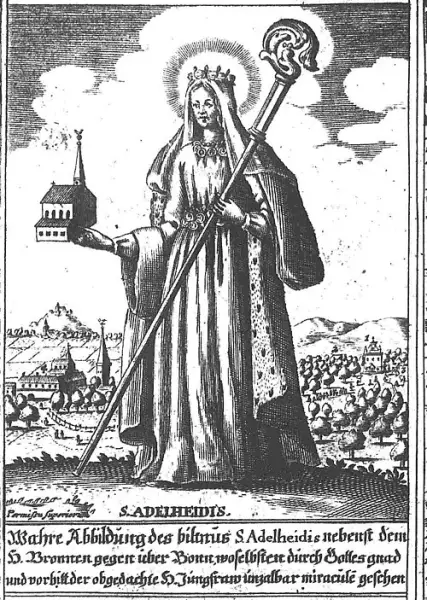
Overview
Born around 970, Adelaide — German Adelheid — was the youngest child of Megengoz, Count of Geldern, and his wife Gerberga, a family descended from King Henry the Fowler; she would become abbess of Vilich and of St. Maria im Kapitol in Cologne. Given as a child to the convent of St. Ursula in Cologne, she was educated under the Rule of St. Jerome and, her Vita says, studied philosophy. When her brother Godfrey fell in battle in 977, her parents endowed a church in his memory at Vilich and a community of canonesses there, redeeming their daughter from St. Ursula with a gift of land and establishing her as abbess. In 987 they secured from Emperor Otto III a charter putting Vilich legally on a par with Gandersheim, Quedlinburg and Essen, the great imperial convents; a papal bull confirmed this in 996. After her mother's death Adelaide changed the house's rule to that of St. Benedict — some canonesses left — and about the year 1000 she was additionally confirmed as abbess of St. Mary in the Capitol in Cologne at Archbishop Heribert's wish. During the famines that followed she became famous in Cologne for her charity. She died on 5 February, in the company of Heribert, of a sore throat.
The Complete Life
Early Life
Adelaide was born around 970 into the highest Ottonian aristocracy: her father Megengoz was Count of Geldern, her mother Gerberga a descendant in some degree of Henry the Fowler, and the family's wealth came from the Rhineland and the lower Maas. While still a small child — probably before 977 — she entered the convent of St. Ursula in Cologne; there her formation followed the Rule of St. Jerome, and her Vita records that she pursued philosophical studies: an unusually bookish upbringing for a canoness of her rank. The custom of giving a noble daughter to a convent in infancy, then redeeming her when dynastic need or piety changed, would shape her whole career.
§ Life
The Founding of Vilich
In 977 her older brother Godfrey was killed in battle. To commemorate him her parents paid for a church at Vilich — today within Bonn-Beuel — and set about founding a female community there under the observances of the canonesses. To head it they redeemed their daughter from St. Ursula with a gift of land and made her abbess of the new house. In 987 they petitioned the young emperor Otto III, winning a charter that put Vilich legally on a par with Gandersheim, Quedlinburg and Essen, the great imperial convents — independence, in law, from the local church — and a bull of Gregory V dated 24 May 996 confirmed it.
§ Life
Reformer of the Rule and Abbess of Cologne
Left to lead Vilich alone by her mother's death around 995 — her father followed three years later and was buried at Vilich beside his wife — Adelaide used her new freedom to change the rule of her house to the Rule of Saint Benedict, a stricter observance than the loose canonical life; some of the canonesses left rather than accept it. Around 1000 her sister Bertrada, abbess of St. Maria im Kapitol in Cologne, died, and Archbishop Heribert of Cologne secured Adelaide's confirmation as her successor. She now ruled two houses on the Rhine, one reformed, one metropolitan.
§ Life
Charity in the Famine
Her years in Cologne coincided with bad harvests, and Adelaide's charity became well known in the city. The Vita Adelheidis describes her relationship with Archbishop Heribert as one of caritas, friendship in the fullest medieval sense, while depicting the sisters at Vilich as feeling neglected by her absences. The double abbacy was a double burden, and her hagiographer does not hide the cost.
§ Life
Final Years
Adelaide died on 5 February in an unknown year — 1015 is the traditional date, though her birth and death dates are disputed — a sore throat carrying her off, and with her at the end was Archbishop Heribert. Her sisters at Vilich did not believe the first message about her illness and arrived after her death. Heribert wished her buried in Cologne; the sisters prevailed, and she was buried at Vilich.
§ Life
Canonization and Cult
The main source for her life is the Vita Adelheidis virginis, written around 1057 by a nun named Bertha with the aid of contemporary witnesses, and much of it is corroborated by charters, above all Otto III's 987 grant. Her cult at the well of Pützchen in Bonn — a spring said to have arisen when she prayed for the poorest during famine — became an important pilgrimage, kept every September, and survives today. In 1641 her grave in the Vilich collegiate church was opened and found empty; pilgrim numbers fell, though relics continued to be shown. She was declared Servant of God on 22 November 1922 and canonized by Pope Paul VI on 27 January 1966. In 2008 she was proclaimed the third city patron of Bonn.
§ Veneration
Legacy
Adelaide's legacy runs in the schools, churches and monasteries of Bonn and Cologne that carry her name, and in the annual September pilgrimage to the Pützchen well. Historians read her as a study in Ottonian Frauenstift culture: a daughter traded, redeemed, enthroned, reformed — and finally, by her own force, the ruler of two of the greatest women's houses of the Rhineland.
§ Veneration
Timeline
- 970
Born around this year, youngest daughter of Count Megengoz of Geldern and his wife Gerberga
§ Life
- 977
Her brother Godfrey dies in battle; her parents begin founding the convent at Vilich in his honour
§ Life
- 987
Her parents appeal to Emperor Otto III for a charter giving Vilich the status of an imperial convent
§ Life
- 995
Gerberga dies, leaving Adelaide to lead Vilich alone; she introduces the Rule of St Benedict
§ Life
- 24 May 996
A papal bull of Pope Gregory VI confirms the charter granting Vilich imperial legal status
§ Life
- 1000
After her sister Bertrada's death, Adelaide is confirmed abbess of St Mary in the Capitol in Cologne
§ Life
- 5 Feb 1015
Dies of a sore throat with Archbishop Heribert present and is buried at Vilich at her sisters' urging
§ Introduction
- 1057
Bertha writes the Vita Adelheidis virginis, the principal source for Adelaide's life, around this time
§ Sources
- 1641
Her grave in the Vilicher Stiftskirche is opened and found empty, sharply reducing pilgrim numbers
§ Veneration
- 22 Nov 1922
Is declared a Servant of God
§ Veneration
- 27 Jan 1966
Is canonized by Pope Paul VI, with 5 February fixed as her feast day
§ Veneration
- 8 Sep 2008
Is named a city patron of Bonn, only the third woman so honoured by the city
§ Veneration
The Record
- Patron of
- Bonn (third city patron, 2008)·Against sore throat (by tradition of her death)
- Symbols
- Abbess's crozier·Well of Pützchen
- Canonization
- Declared Servant of God 22 November 1922; canonized by Pope Paul VI on 27 January 1966
Prayer
Bibliography
Show 6 sources
- 1 2 3 Bertha Vilicensis; Piesik, Heinz (2003). Vita Adelheidis = das Leben der hl. Adelheid von Vilich: lateinisch und deutsch . Bonn. {{ cite book }} : CS1 maint: location missing publisher ( link )
- ↑ Schlafke, Jakob (1978), "Leben und Verehrung der hl. Adelheid von Vilich" , 1000 Jahre Stift Vilich, 978-1978 , pp. 77– 97 , retrieved 2025-06-18
- 1 2 Hamilton, Sarah (2015-08-12). Church and People in the Medieval West, 900-1200 . Routledge. p. 143. ISBN 978-1-317-32532-1 .
- 1 2 Dick, Madelyn B. (1994). Mater spiritualis: the life of Adelheid of Vilich . Peregrina translations series. Toronto: Peregrina Publ. ISBN 978-0-920669-48-8 .
- ↑ "Adelheid von Vilich" . Portal rheinische Geschichte (in German) . Retrieved 18 June 2025 .
- ↑ Index ac status causarum beatificationis servorum dei et canonizationis beatorum (in Latin). Typis polyglottis vaticanis. January 1953. p. 1.
Profile text adapted from the Wikipedia article, licensed CC BY-SA 4.0.
Pray with this saint every day
Save St. Adelaide, Abbess of Vilich to your favorites, read the full profile, and get feast-day reminders in the Saints app.
Get the Saints AppFree on the App Store for iPhone and iPad