
11th century – c. 1100·Feast January 30
St. Adelelmus of Burgos
Benedictine Abbot (Lesmes), Patron of Burgos
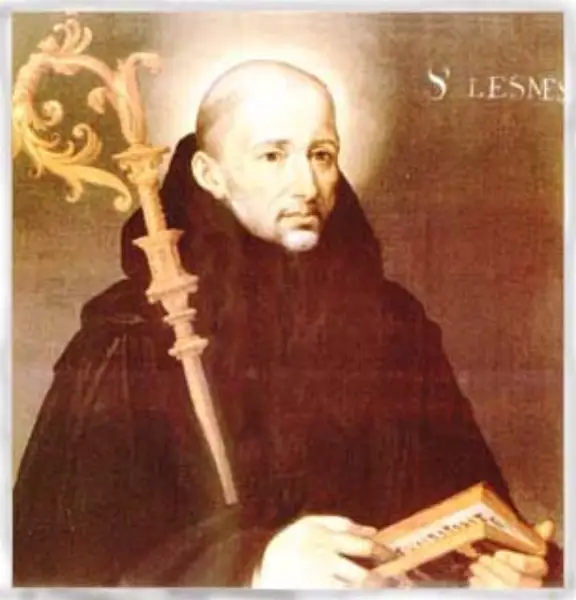
Overview
Adelelmus — Aléaume in French, Lesmes in Spanish — was a French-born Benedictine monk of the eleventh century who ended his life as the most popular saint of Burgos in Castile. Born at Loudun in Poitou, he entered soldiering as a youth, but while making a pilgrimage to Rome he encountered Robert de Turlande, who had founded La Chaise-Dieu, and abandoned the army for the Benedictine order; in time he himself led La Chaise-Dieu as abbot. Queen Constance of Burgundy, wife of Alfonso VI of Castile, was impressed by reports of his holiness and invited him to Burgos, where she and the king founded a monastery in 1079 on condition that he govern it. To the new house he soon added a hospital and a church, putting the resources of a French reform abbacy at the service of a frontier city on the road to Compostela. He even put the skills of his soldiering years to work in aid of Alfonso against the Moors. His death came around the year 1100, after which he was honored as one of the patron saints of Burgos; his remains rest in the Iglesia de San Lesmes Abad, and his feast is kept on 30 January.
The Complete Life
A Soldier of Poitou
Adelelmus was born at Loudun, in Poitou in west-central France, at some point in the eleventh century. His first vocation was arms: he joined the military at a young age, in a region and an age in which the knightly profession was the obvious career of a capable young man, decades before reformers had fully articulated the idea that a Christian could not lawfully fight for pay. The turning point came on pilgrimage to Rome — the standard dramatic device of eleventh-century conversion narratives, but here the attested one. In the course of that journey he met Robert de Turlande, the nobleman who had left the court of Auvergne to become a hermit at Chaise-Dieu and had gathered round himself one of the most successful new monastic congregations of the century. The meeting decided Adelelmus's life: he left the military and entered the Benedictine order in Robert's community. What Loudun and the army had given him was discipline; what Rome gave him was direction.
§ Life
From La Chaise-Dieu to Castile
Adelelmus rose to be abbot of La Chaise-Dieu itself, governing the great Auvergnat house that Robert had founded on the model of strict poverty and claustral discipline. His reputation crossed the Pyrenees. Queen Constance of Burgundy, the wife of Alfonso VI of Castile — a queen from the same reforming Burgundian milieu that shaped so much of late eleventh-century Cluniac Spain — heard reports of his holiness and invited him to come and live in Burgos. In 1079 she and Alfonso established a monastery in the city, its foundation conditional on Adelelmus serving as abbot. This was the standard mechanism for importing reform: find a proven French abbot, build him a house, and let his discipline form the local church. Adelelmus accepted, crossed into Castile, and spent the rest of his life there. His obedience to that invitation was the decisive act of his life and of his future cult.
§ Life
Abbot, Hospital-builder, Soldier again
In Burgos, Adelelmus quickly made the new monastery more than a cloister: not long after founding it he attached a hospital and a church, turning the establishment into a working centre of charity in a city that sat on one of the great trunk roads of Christian Europe — the pilgrimage route to Santiago de Compostela, along which flowed a continuous stream of travellers, sick and poor among them. A hospital on that road was not a pious ornament but infrastructure. The tradition also records, more surprisingly, that he used his military training to help Alfonso VI against the Moors: the ex-soldier's skills were not buried at his conversion but turned, in his own judgment, to the defence of the kingdom that had received him. He died around 1100, having spent in Castile the whole second half of a life that had begun as a Poitevin soldier. The combination of abbot, hospital-founder and occasional soldier made him unmistakably a saint of the frontier.
§ Life
Patron of Burgos
After his death Adelelmus came to be venerated as one of Burgos's patron saints, honored under the Spanish form of his name, San Lesmes. His remains lie in the Iglesia de San Lesmes Abad, the church that grew from his monastery, and his cult belongs to the large family of medieval urban patronages: no formal canonization, but the steady, practical devotion of a city that had watched him build its hospital and govern its chief monastery, and that continued to pray to him for centuries. His feast is kept on 30 January; it no longer appears in the General Roman Calendar after the twentieth-century revisions, which pruned such local cults from the universal book while leaving them intact in the dioceses that keep them. In Burgos his name remains woven into the city — street, church and calendar all carrying the memory of the French abbot who crossed the mountains and stayed.
§ Life
Timeline
- 1079
Queen Constance of Burgundy and Alfonso VI found a monastery at Burgos, on condition that Adelelmus serve as its abbot
§ Life
- 1100
Dies at Burgos around this year; afterward honored as a patron saint of the city, his remains resting in the Iglesia de San Lesmes Abad
§ Life
The Record
- Patron of
- City of Burgos, Spain
- Canonization
- Pre-congregation (medieval cult; feast no longer in the General Roman Calendar)
Prayer
Bibliography
Show 5 sources
- 1 2 Odden, Per Einar. "Den hellige Adelelmus av Burgos ( -1097)" Den katolske kirke
- ↑ Goyau, Georges. "Poitiers." The Catholic Encyclopedia Vol. 12. New York: Robert Appleton Company, 1911
- ↑ " Guide to the City of Burgos , Turespaña, p. 8" (PDF) . Archived from the original (PDF) on 2022-02-23 . Retrieved 2021-10-20 .
- ↑ Holweck, Frederick George. A Biographical Dictionary of the Saints , B. Herder, 1924, p. 16
- ↑ Diccionario de los santos (in Spanish). Editorial San Pablo. 2000. p. 64. ISBN 978-84-285-2258-8 .
Profile text adapted from the Wikipedia article, licensed CC BY-SA 4.0.
Pray with this saint every day
Save St. Adelelmus of Burgos to your favorites, read the full profile, and get feast-day reminders in the Saints app.
Get the Saints AppFree on the App Store for iPhone and iPad