
d. 27 April 1152·Feast April 27
St. Adelelmus of Flanders
Hermit and Founder of Étival (Alleaume, Adelin)
Overview
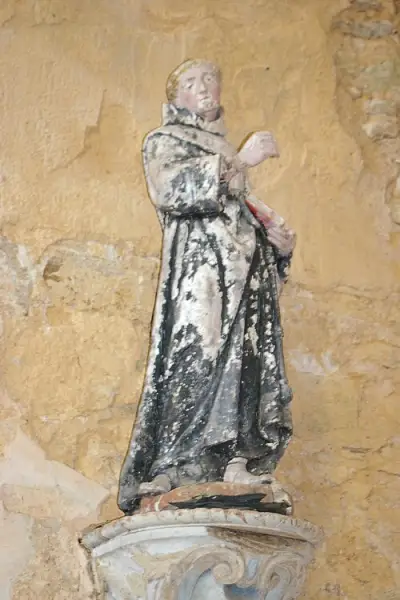
Adelelmus — in French Alleaume or Adelin — was a hermit of the twelfth century and a disciple of Bernard of Thiron. Born in Flanders, he became the companion of an aged hermit called Aubert at Saint-Ellier-du-Maine, and with him gave himself over to fasting and prayer. He attempted to join Bernard's community on the island of Chausey but found the island climate intolerable and returned to Aubert. After Aubert chose to close his life within the community of Raoul de La Futaie, Adelelmus made up his mind to establish a monastic family of his own that would take in both men and women. In 1109 he received land in the diocese of Le Mans from Viscount Raoul VII de Beaumont-au-Maine and founded Étival-en-Charnie: the male monastery, dedicated to Saint Nicholas, did not long survive him, but the nunnery, first led by the viscount's daughter Godealdis, flourished. Renowned as a powerful preacher, he passed away on 27 April 1152; his remains were laid to rest at Étival, where his statue can still be seen in the chapel of Saint Nicholas.
The Complete Life
Early Life
Adelelmus was a native of Flanders, born probably around the middle of the eleventh century. What is known of him comes not from a Vita of his own but from the biographies devoted to his masters Bernard of Thiron and Robert of Arbrissel, together with Étival's foundation charter — paper evidence that historians judge reasonably firm for a hermit of his sort. The hermit movement of the late eleventh century drew men like him out of the settled church into the forests of western France, where austerity and popular preaching were reviving religious life on the margins. He first put himself under an aged hermit called Aubert at Saint-Ellier-du-Maine, sharing with him a discipline of fasting and prayer. The era of the forest hermits produced many such pairings of an old solitary and a young disciple, and Adelelmus's apprenticeship under Aubert placed him within the wider family of new communities then spreading through Maine and Anjou.
§ Introduction
Vocation
The path to his life's work ran through failure. Adelelmus attempted to join Bernard of Thiron, the founder of the Tironensian order, in the hermit community on the tidal island of Chausey off the Normandy coast — but he found the island climate intolerable and returned to Aubert on the mainland. It is a rare and honest detail in medieval hagiography: the saint who could not take the weather. Once Aubert chose to close his life inside the community of Raoul de La Futaie — one more of the great forest founders — Adelelmus found himself without a master and determined to become one in his own right, founding a monastic family meant to gather women as well as men. Chausey's wind, salt, and isolation defeated him where harder men endured, and his return marks the beginning of the vocation he had not chosen: to be for others what Aubert had been for him. The Church keeps his memory with gratitude.
§ Introduction
Founding of Étival
The year 1109 brought Adelelmus a grant of land within the diocese of Le Mans from Viscount Raoul VII de Beaumont-au-Maine; on this ground he established the monastery of Étival-en-Charnie, set deep in the forest of Charnie near the Maine border. The male monastery was dedicated to Saint Nicholas; the nunnery was originally led by Godealdis, the viscount's daughter — a family arrangement typical of the era's new foundations, in which a lord's gift and a founder's discipline together created a religious house. Adelelmus's men's house lasted only a short while after him, yet the Étival nunnery endured; to maintain it he secured the parish of Livet. While directing these houses he also won renown as an exceptional preacher. The double community for men and women followed the pattern of several of the new houses of the west, in which Robert of Arbrissel's Fontevraud was only the most famous example. Devotion to him has never wholly ceased.
§ Introduction
Final Years
Adelelmus lived to be an old man by the standards of his century, dying on 27 April 1152, more than forty years after his foundation. He was buried at Étival, in the house he had planted, and the nunnery carried his memory through the Middle Ages. A statue of him still stands in the chapel of Saint Nicholas at Étival, a rare surviving image of a hermit-preacher of the old French west, and his grave remained the local center of his cult after his death, drawing the prayers of the Mayenne countryside. The long span between his foundation in 1109 and his death in 1152 gave Étival four decades of his presence, and the community remembered him as its father in both senses. His reputation as a preacher, noted in the sources, suggests that the hermit remained a public figure, teaching in the villages around his foundation and drawing recruits to Étival's life of prayer.
§ Introduction
Veneration
Adelelmus belongs to the pre-congregation era of local sanctity: he was received as a saint by the devotion of the diocese of Le Mans rather than by any Roman process. The diocese composed a special liturgical office for his memory, which was sung in the churches of the region for centuries. That office was suppressed in 1835, part of the nineteenth-century pruning of local French cults whose documentation was judged thin; the popular memory of Alleaume nevertheless persisted in the villages around Étival, and his name is preserved in the dictionaries of the Mayenne by Angot and Gaugain. The suppression of 1835 ended the liturgical observance but not the local memory, and the standard dictionaries of the saints of France continue to carry his entry. Local sanctity of his kind was sustained by liturgy rather than paperwork, and it is the very existence of his office that proves the depth of his cult in Maine.
§ Introduction
Legacy
Adelelmus's legacy is modest and real. He is one of the second-rank figures of the great hermit movement that produced Bernard of Tiron, Robert of Arbrissel of Fontevraud, and Vitalis of Savigny — the founders who rebuilt religious life in western France around poverty, preaching, and the inclusion of women. Étival's nunnery descended from his work, and the village of Étival-en-Charnie still carries the name of the house he founded. He is remembered, honestly, as the disciple who could not stand the climate of Chausey and went on to found something of his own anyway — a patron for those whose first vocation fails. He also remains a witness to the ordinary texture of the reform movement: land, charter, lord's daughter, parish appanage, and a preacher's voice, the whole machinery of a medieval foundation in miniature. The chapel of Saint Nicholas at Étival, with his statue, remains the physical memorial of a life otherwise known from three documents.
§ Introduction
Timeline
- 1109
Receives land in the diocese of Le Mans from Viscount Raoul VII de Beaumont-au-Maine and forms his community
§ Introduction
- 27 Apr 1152
Dies and is buried at Étival, where a statue of him stands in the chapel of Saint Nicholas
§ Introduction
- 1835
The special liturgical office kept by the diocese of Le Mans for his memory is suppressed
§ Introduction
The Record
- Patron of
- Hermits and preachers·Étival-en-Charnie and the Mayenne
- Symbols
- Hermit's habit·Preacher's staff
- Canonization
- Pre-congregation; diocesan cult at Le Mans, office suppressed in 1835
Prayer
Bibliography
Show 2 sources
- ↑ Catholic Online. "St. Adelelmus - Saints & Angels - Catholic Online" . Catholic.org. Archived from the original on 2013-12-11 . Retrieved 2013-12-10 .
- 1 2 "Alleaume d'Étival" , in Alphonse-Victor Angot and Ferdinand Gaugain, Dictionnaire historique, topographique et biographique de la Mayenne , Vol. 1 (A. Goupil, 1900).
Profile text adapted from the Wikipedia article, licensed CC BY-SA 4.0.
Pray with this saint every day
Save St. Adelelmus of Flanders to your favorites, read the full profile, and get feast-day reminders in the Saints app.
Get the Saints AppFree on the App Store for iPhone and iPad