
8th century·Feast February 2 (Benedictine calendars)
St. Adeloga of Kitzingen
Abbess
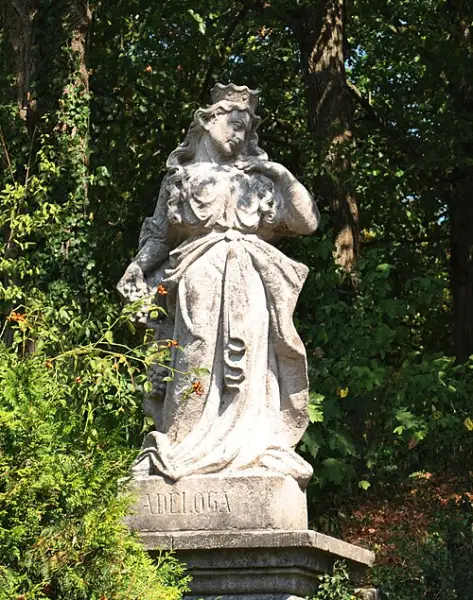
Overview
Adeloga of Kitzingen, also called Hadeloga and Adela, is a German saint of the eighth century. Her father was Charles Martel, the Frankish mayor of the palace and conqueror of the Arabs at Tours, and she was therefore a princess of the family that would become the Carolingian dynasty. Renowned for her beauty and courted by many suitors, she declined each proposal in turn, determined to give herself to God alone. Her father, so the early life relates, subjected her to deliberate cruelty and open disgrace; when she sought comfort and guidance from his chaplain, who likewise served as her spiritual director, Martel banished the pair from his court. The two journeyed to Kitzingen, in modern Bavaria, then described as a wild and desert place, and there built a convent of which Adeloga became the first abbess. Virgins were drawn to the community, which adopted the Rule of St. Benedict together with that of St. Scholastica. In time Martel made his peace with his daughter, came to see her, and endowed her convent with land. She was succeeded as abbess by St. Thecla.
The Complete Life
Early Life
Adeloga's story reaches us through an ancient biography by an anonymous author, published in the seventeenth century by the Flemish hagiographer Jean Bolland, and the picture it gives belongs wholly to the world of the early Carolingian family. Her father was Charles Martel, the mayor of the palace who, between Neustria and Austrasia, had made himself the master of the Frankish kingdom and the shield of Europe against the Arab advance; her childhood therefore passed in a household of power, campaign and calculation, in which daughters were assets of alliance to be married where the family's interest required. The biographer calls her a princess of singular beauty, and insists on the pressure of suitors, the ordinary fate of such a daughter. Her refusal of marriage was thus not a private preference but a declaration: against the whole logic of her house she set the logic of the kingdom of God, and the collision that followed, between father and daughter, between dynasty and cloister, is the entire dramatic substance of her remembered life.
§ Introduction
Vocation
The biography is frank about the cost of her choice. Charles Martel answered his daughter's refusal with what her biographer calls studied brutality and public insult, and when Adeloga sought out the one ally available to her, her father's own chaplain, who was also her spiritual director, Martel expelled them both from the palace. The pair then journeyed together to Kitzingen, in the country that would later be Franconia, a place the early account describes as wild and desert, the standard hagiographic word for a site chosen for holiness precisely because it was undesirable. There, with the chaplain's counsel, she built a convent. Her expulsion thus became, in the pattern of the lives of the royal abbesses, the paradoxical instrument of foundation: the daughter thrown out of power's house founded a house of prayer, and the wild place was made a garden. She was constituted its first abbess, governing the virgins who gathered to her, under the Rule of St. Benedict and that of St. Scholastica.
§ Introduction
Mission
Adeloga's mission was the foundation and government of the first convent of Kitzingen, one of the women's houses that spread across the German lands in the eighth century as the Frankish church took its settled form. Such a foundation did more than house the vowed: it Christianized a district. A convent brought the liturgy into a wild place, cleared and worked land, taught the surrounding population, and stood as an alternative center of authority to the warrior households, a point the story of her father's later conduct makes quietly. The reconciliation of Charles Martel with his daughter, his visit to Kitzingen and his donation of lands to the convent complete the pattern of the royal foundress' life: the ruler who had expelled her became the endower of the work he had scorned, and the dynasty that had no use for her vow found a use for her prayers. Her community continued after her death under St. Thecla, its second abbess, and became one of the historic monasteries of Franconia.
§ Introduction
Canonization
Adeloga's cult, like that of her successor Thecla and of the whole company of early Franconian abbesses, rests on the immemorial tradition of the local church, recorded in calendars and confirmed by the early biography that Bolland printed among the lives of the saints. She is listed in the Benedictine Martyrology, the roll of the saints of the black habit, which keeps the memory of the abbesses who governed the first houses. No formal canonization was ever held, the processes of the later Middle Ages not yet existing; the Benedictine tradition counts her among its blessed founders by a consent running back to the eighth century. Her feast has been kept in the local calendars of the Würzburg church province, within which Kitzingen lay, and in the general Benedictine observance, on a day near the feast of the purification.
§ Introduction
Legacy
Adeloga's legacy is Kitzingen itself, the town on the Main whose name is inseparable from the convent she founded and which remembered her, under the variants Hadeloga and Adela, as its first mother. The house she built endured through the centuries in changing forms, monastic and later educational, and the Christian identity of the district traces to the wilderness clearing of the eighth century. Beyond the locality she belongs to the great cohort of Merovingian and early Carolingian royal women who turned the power of their blood to the founding of the church in the German lands, a movement that gave Francia many of its oldest houses and its earliest saints. Her story, with its harsh father and unyielding daughter, has also kept a human freshness: it is remembered as a story about the price a vocation may exact inside a family, and about the possibility, not guaranteed but real, that the family may come round in the end, to visit, to give, and to make peace.
§ Introduction
The Record
- Patron of
- Kitzingen, Bavaria·Women religious
- Symbols
- Abbess's crozier·Crown laid aside for the veil
- Canonization
- Pre-congregation; listed in the Benedictine Martyrology
Prayer
Bibliography
Show 5 sources
- ↑ "Saint Adeloga of Kitzingen" . CatholicSaints.Info . 31 January 2010 . Retrieved 26 May 2020 .
- 1 2 3 4 5 6 McClintock, John; Strong, James (1887). Cyclopedia of Biblical, Theological, and Ecclesiastical Literature, Volume 2 . New York: Harper and Brothers, Publishers. p. 1038.
- ↑ Drake, Maurice; Drake, Wilfred (1916). Saints and Their Emblems . London: Dalcassian Publishing Company. p. 2.
- ↑ Delaney, John J. (2004). Dictionary of Saints . New York: Doubleday. p. 10. ISBN 978-0385515207 .
- ↑ Harmeling, Deborah (1996). "Tetta, 'Noble in Conduct' and Thecla, 'Shining Like a Light in a Dark Place' ". In Schmitt, Miriam; Kulzer, Linda (eds.). Medieval Women Monastics: Wisdom's Wellsprings . Collegeville, Minnesota: Liturgical Pre
Profile text adapted from the Wikipedia article, licensed CC BY-SA 4.0.
Pray with this saint every day
Save St. Adeloga of Kitzingen to your favorites, read the full profile, and get feast-day reminders in the Saints app.
Get the Saints AppFree on the App Store for iPhone and iPad