
c. 1073-1131·Feast April 30
St. Adjutor
Knight, Hermit, and Patron of Swimmers
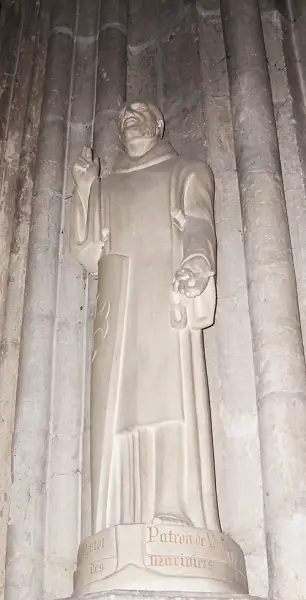
Overview
Adjutor is venerated as a saint of the Norman town of Vernon, where he was born in 1073 and where he died on April 30, 1131. As a young knight he took part in the First Crusade, and the legends of his patronage of swimmers and boaters grow out of that experience: one common account relates that he was captured by Muslims during the crusade and pressured to abandon his faith, and that when he refused, he escaped his persecutors by swimming, reaching France again and entering the Abbey of Tiron, where he lived as a recluse until his death. Other legends add that angels freed him from his captors, and that his association with the water began when he calmed a whirlpool in the Seine near Vernon by casting into it holy water together with the chains from his captivity, and by the sign of the cross. Around these stories the devotion of boatmen gathered, and Adjutor became the patron of swimmers, boaters, drowning victims, and of Vernon itself. Behind the legend stands a real twelfth-century figure: a crusader turned contemplative, remembered in his own town for more than five centuries before the modern calendars forgot him.
The Complete Life
Early Life
Adjutor was born at Vernon on the Seine in Normandy on July 24, 1073, into the knightly class of a duchy then at the height of its ambition. He would have been trained in arms and horsemanship from boyhood, in the hard school that produced the conquering generation of 1066 and its sons. In 1095 Pope Urban II preached the crusade at Clermont, and Normans answered in numbers out of proportion to their homeland's size; Adjutor joined the expedition as a knight. The First Crusade took him across Europe and Anatolia to Antioch and Jerusalem, through siege, famine, and battle. The legends of his later life, which speak of captivity and escape, are the natural crop of that experience: many crusaders were in fact captured, ransomed, or lost, and the story of a knight who kept his faith under pressure of his captors reflects what Vernon knew such men endured. When he came home, he was a changed man, and he did not return to the life he had left.
Vocation
The second half of Adjutor's life was the inverse of the first: the knight became a recluse. Entering the Abbey of Tiron, the stern Benedictine house of the Perche founded by Bernard of Tiron, he withdrew from the world as a hermit attached to that community, living in penance and prayer until his death on April 30. The transition from crusading arms to monastic enclosure was not uncommon in his century, but in his case it was remembered as dramatic, because the captive who had escaped by swimming is said to have chosen a life of deliberate confinement. The stories of the whirlpool belong here: a recluse who had tamed his own violence was naturally credited with power over the violence of the river. His vocation, in the memory of Vernon, was to stand as a link between the violent world of the knight and the peace of the cloister, proving that the same man could be both.
Spirituality
The spirituality of Adjutor, as the legends frame it, was a spirituality of chains and water. The instruments of his captivity, thrown into the whirlpool with holy water and the sign of the cross, became in the story the means by which a deadly place was made safe: violence answered not with violence but with blessing. That image summarizes the inner meaning of his conversion from knight to hermit, the laying down of arms and the taking up of prayer. As a recluse at Tiron he would have lived by the rhythm of the hours, manual work, and silence, the standard discipline of the hermits who gathered around the great monastic reforms of the twelfth century. The people of the Seine valley understood this easily: their lives depended on a river that could kill, and a saint who had survived the water and then blessed it spoke directly to their fears. His cult is a lay spirituality of dangerous work entrusted to God.
Final Years
Adjutor died on April 30, 1131, at Vernon, having lived as a recluse to the end of a life that had begun in 1073. His death, at about fifty-eight years of age, closed a career that spanned the First Crusade, captivity, escape, and decades of enclosure. The manner of his dying is not recorded; the manner of his burial, at Vernon and within reach of the river people who loved him, established his cult almost at once. April 30 became his feast, kept at Vernon and entered in the martyrologies of the region. Within a generation or two the legends had taken their full shape, the angels who freed him, the swim home, the calmed whirlpool, and the plain historical kernel, a crusader who became a hermit, had been clothed in the marvellous. That clothing was the devotion of the community, not deception: the stories said what the people believed the saint to be.
Cult and Canonization
Adjutor is a saint of the pre-congregation middle ages, canonized in effect by the devotion of Vernon and the neighbouring churches of Normandy. His cult is attested in local calendars and in the iconographic manuals of the nineteenth century, which list him among the saints with his attributes of chains and water. No formal process was ever held or needed; the town that kept his feast regarded him as its own patron and intercessor. Husenbeth's Emblems of Saints, cited in the modern article on him, preserves the record of that late survival. As with many local saints of France, the cult contracted after the Revolution and the liturgical reforms, but the patronage of swimmers, boaters, and drowning victims remains attached to his name, and Vernon has not forgotten the recluse of Tiron who was born and died within its walls. The absence of any formal process is not a defect but the ordinary condition of eleventh and twelfth century holiness.
Legacy
Adjutor's legacy is his patronage, one of the most practical in the calendar: swimmers, boaters, and the drowning have been recommended to his prayers for centuries. That patronage belongs to the great medieval family of occupational saints, in which every dangerous trade sought an intercessor who had faced its particular peril; Adjutor, the man who escaped by swimming and calmed the whirlpool, was the natural choice for the river people of Normandy. He is also remembered as one of the crusaders who came home to holiness, a type of the twelfth century's deep ambivalence about the crusading ideal. For the town of Vernon he remains a civic as well as religious figure, part of its identity since the 1130s. His life, read plainly, says that a man may spend his strength in war and then spend his years in penance, and that the second half can redeem the first. He remains a favourite figure of local Norman hagiography, one of the saints whose legends are better known than their dates.
Timeline
- 24 Jul 1073
Born at Vernon in Normandy, France
§ Introduction
- 30 Apr 1131
Died at Tiron after years as a recluse, having survived crusading captivity and a legendary escape by swimming
§ Introduction
The Record
- Major works
- Later legends of the whirlpool calmed by holy water and his chains
- Patron of
- Swimmers·Boaters·Drowning victims·Vernon, France
- Symbols
- Chains of his captivity·Whirlpool in the Seine·Hermits'scroll
- Canonization
- Pre-congregation; medieval cult at Vernon and the Abbey of Tiron
Prayer
Profile text adapted from the Wikipedia article, licensed CC BY-SA 4.0.
Pray with this saint every day
Save St. Adjutor to your favorites, read the full profile, and get feast-day reminders in the Saints app.
Get the Saints AppFree on the App Store for iPhone and iPad