
c. 1185 – 1222 or 1224·Feast February 11
St. Adolf of Osnabrück
Cistercian Bishop of Osnabrück, Almoner of the Poor
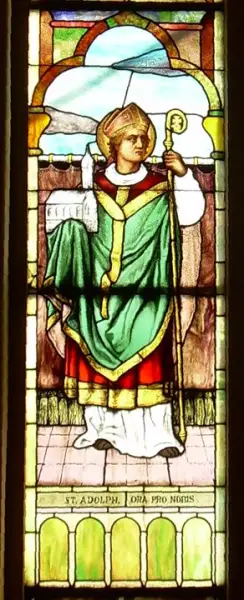
Overview
Adolf of Osnabrück, called of Tecklenburg from his family's county, was born around 1185 into the house of the Counts of Tecklenburg in Westphalia and became a Cistercian monk, bishop, and saint of the church, known in his own lifetime as the Almoner of the Poor. He began his career as a canon of Cologne Cathedral but left the dignity of a great chapter for a Cistercian monastery, where his piety became noted. In 1216 he was elected Bishop of Osnabrück, an election that followed the pope's cancellation of an earlier one, and he governed the diocese for the few remaining years of his life while maintaining the charitable programs that earned him his popular name. He died at Osnabrück on 30 June, in 1222 or 1224, still in his thirties or early forties. His cult was recognized by Pope Urban VIII in 1625, and his feast is kept on 11 February. His shrine is in St. Peter's Cathedral at Osnabrück, where he is remembered as the bishop whose emblem is a small church held in his hands.
The Complete Life
Early Life
Adolf was born about 1185 at Tecklenburg in the Duchy of Westphalia, a member of the comital family that gave the town its name; a younger son of a noble house, he was destined from childhood for the church, as such sons were, and the church of his region had two great poles to attract him: the imposing cathedral chapter of Cologne, one of the wealthiest in the empire, and the new Cistercian movement that was then transforming the religious landscape of Germany with houses of strict observance. Adolf began, as his birth dictated, among the canons of Cologne, where a canonry was a dignity and a livelihood. That he left it is the first fact the tradition records with emphasis. The step from a cathedral prebend to a Cistercian cloister, taken in the early thirteenth century, was a step down in every worldly measure, from property to poverty, from precedence to obedience, and it was precisely the step the age's best spirits were taking, from Bernard's nephews downward.
§ Introduction
Monk and Bishop
In the Cistercian house Adolf became known for his piety, and the reputation followed the pattern of the order: liturgy, manual labor, and a disciplined interior life, carried out in a community that measured everything against the Rule. His election to the see of Osnabrück in 1216 had a complication worth noting: the pope had canceled an earlier election, presumably of another candidate or on some procedural ground, before Adolf's name was put forward. He accepted the episcopate as a monk accepts an obedience. Osnabrück was a diocese of the Saxon frontier, old and poor, and it gave the new bishop exactly the field his vocation wanted: he maintained the charitable programs of the church there with such constancy that the people gave him the name by which he is known, the Almoner of the Poor. It is a striking title for a thirteenth-century prince-bishop, an office usually remembered for power and patronage; in Adolf's case the popular memory kept only the almsgiving.
§ Introduction
Death
Adolf died at Osnabrück on 30 June, in either 1222 or 1224, the sources dividing between the two years; he was still a young man by the standards of the episcopate, in his late thirties or very early forties at most. His episcopate had lasted only six to eight years, a short tenure that makes the strength of his local cult the more notable. He was buried in his cathedral church of St. Peter at Osnabrück, and the tomb became the center of the devotion that followed. The Cistercian order counted him among its saints, as did the diocese and city of Osnabrück, whose people had known him personally; the transmission of his memory was thus carried from the first by those who had received his alms, which is perhaps why the memory itself is so simple, unencumbered by legends of visions or marvels, and reduced to the essential fact of a bishop who gave.
§ Introduction
Canonization
Adolf belongs to the large class of medieval saints whose cult arose locally, among the people who had known them, and was regularized only centuries later. The formal recognition came in 1625, when Pope Urban VIII confirmed his cult, a step that in the law of the time gave authoritative standing to an existing liturgical observance rather than creating a new one. His feast is kept on 11 February in the diocese, and his shrine remains in St. Peter's Cathedral at Osnabrück, the center of the local observance. The confirmation of 1625 placed him, administratively, in the company of the many German bishop-saints whose cults Urban VIII's congregation reviewed in those years, sorting the genuine medieval traditions from the legendary accretions; Adolf passed the review easily, his record being short, documented in its essentials, and almost entirely free of the improbable, which the examiners of that era could seldom say.
§ Introduction
Legacy
Adolf's legacy is contained almost entirely in his title. The Almoner of the Poor is remembered in Osnabrück as the bishop whose government was a charity, and his emblem in art, a bishop holding a small church, has been read both as the church of his cathedral and as the church entire, held in the hands of a man who knew it was given him to carry, not to own. For the Cistercians he is one of the bishops the order gave to the German church in the great thirteenth century, proof that the white monks could produce not only abbots and mystics but diocesan pastors. For the modern diocese of Osnabrück his memory has had a certain usefulness as a model of episcopal simplicity, invoked when the office's temporal dignity threatens to eclipse its service. He stands in the sanctorale as a small, clean figure: a nobleman who chose poverty twice, and died young having given away what he was given.
§ Introduction
Timeline
- 1185
Born at Tecklenburg into the family of the Counts of Tecklenburg
§ Introduction
- 1216
Chosen as Bishop of Osnabrück once the pope had voided an earlier election
§ Life
- 30 Jun 1222
Dies at Osnabrück on 30 June, though some sources give 1224
§ Introduction
- 1625
Pope Urban VIII recognizes his cultus
§ Veneration
The Record
- Patron of
- Osnabrück·The poor·Bishops
- Symbols
- Bishop holding a small church·Alms for the poor·Cistercian habit
- Canonization
- Cult confirmed in 1625 by Pope Urban VIII
Prayer
Bibliography
Show 5 sources
- 1 2 Jones, Terry. "Adolphus of Osnabruck" . Patron Saints Index . Archived from the original on 23 February 2007 . Retrieved 4 March 2007 .
- ↑ "Saint Adolphus of Osnabrück". Saints.SQPN.com. 2 May 2012. Web. {2012-9-20}. http://saints.sqpn.com/saint-adolphus-of-osnabruck
- ↑ Monks of Ramsgate. "Adolphus". Book of Saints, 1921. Saints.SQPN.com. 2 May 2012. Web. {2012-9-20}. http://saints.sqpn.com/book-of-saints-adolphus
- ↑ Catholic Online. Feast days in February http://www.catholic.org/saints/f_day/feb.php
- ↑ Same feast day: Benedict of Aniane , Our Lady of Lourdes , Paschal
Profile text adapted from the Wikipedia article, licensed CC BY-SA 4.0.
Pray with this saint every day
Save St. Adolf of Osnabrück to your favorites, read the full profile, and get feast-day reminders in the Saints app.
Get the Saints AppFree on the App Store for iPhone and iPad