
c. 624–704·Feast September 23
St. Adomnán of Iona
Abbot of Iona, Hagiographer, Lawgiver (Eunan)
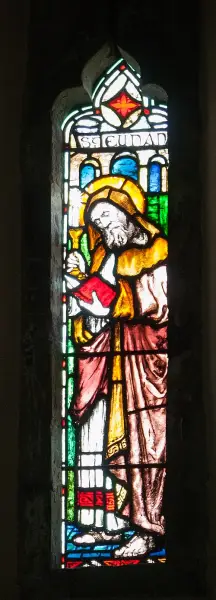
Overview
Adomnán, also known in Ireland as Eunan, was ninth abbot of Iona from 679 until his death in 704, and the most learned man of the early Gaelic Church. Born about 624 in Donegal, a kinsman of Columba on his father's side and a member of the Cenél Conaill branch of the Uí Néill, he joined the Columban federation of monasteries around 640 and rose to govern its mother house. His Life of Columba, probably composed during 697–700, stands as the most significant surviving piece of writing from early medieval Scotland and a principal source for the Picts and for the life of Iona. His treatise De Locis Sanctis, based on the travels of the Frankish bishop Arculf, described the pilgrimage places of the East for a western audience. In 697 he promulgated the Cáin Adomnáin, the Law of Innocents, at the Synod of Birr, setting non-combatants — above all women, children and clergy — outside the violence of warfare. He adopted the Roman Easter dating, failed to bring his own monks with him, and died on 23 September 704. He is joint patron, with Columba, of the diocese of Raphoe.
The Complete Life
A Kinsman of Columba in Donegal
Adomnán's birth came around 624; his father was Rónán mac Tinne and his mother Ronat, who belonged to the Cenél nÉnda. On his father's side he was a relative of Columba himself, and belonged to the Cenél Conaill, the Northern Uí Néill lineage that claimed the saint as its own. His birthplace was probably in or near Raphoe, in the fertile east of what is now County Donegal, not far from Derry; some of the childhood anecdotes he tells of himself in the Vita Columbae seem to confirm at least an upbringing there. His monastic life may first have taken shape at a Columban house named Druim Tuamma, with Durrow a strong candidate among the others, and he probably entered the Columban familia — the federation of monasteries under Iona — around 640. On Richard Sharpe's reading, his arrival at Iona fell within Ségéne's abbacy, which ended at Ségéne's death in 652; whenever he came, he attained there a level of learning rare anywhere in early medieval Northern Europe.
§ Life
Abbot of Iona
In 679 Adomnán succeeded Columba to become the ninth abbot of Iona, taking over the spiritual headship of a monastic federation that spanned Ireland and the Gaelic west of Scotland. His abbacy was unusually diplomatic. He enjoyed a friendship with Aldfrith, the scholar-king of Northumbria, who stayed with him at Iona in 684; in 686 Adomnán was in Northumbria to obtain the freedom of sixty Gaels captured in a Northumbrian raid two years earlier, at the request of King Fínsnechta Fledach of Brega. He made several further journeys to the English. On the Easter question his position was unwelcome at home: it is thought that under the influence of Abbot Ceolfrith in Northumbria he adopted the Roman dating of Easter agreed at Whitby, and Bede implies that when he returned and tried to persuade the brethren of Iona, he was resisted — some read the tradition as a schism in which the abbot was alienated from his own community and went to Ireland to argue the Roman case there instead.
§ Life
The Cáin Adomnáin: Law of the Innocents
Adomnán's most original act was legislative. In 697 he promulgated the Cáin Adomnáin — the Law of Adomnán, or Lex Innocentium, the Law of Innocents — at the Synod of Birr, in the presence of Irish, Dál Riatan and Pictish notables. The measure aimed to place whole classes of people beyond the reach of warfare's violence: women, children, clergy and other non-combatants were placed under protection, and the text — which its preface connects with an angel's visitation and with the death of Adomnán's own mother in a massacre — fastened penalties on those who harmed them. It is the earliest known attempt in the Gaelic world, and one of the earliest anywhere, to write the immunity of civilians into law. The law was renewed after his death: in 727 his relics were carried to Ireland to re-promulgate it, and returned to Iona in 730. Few early medieval texts speak so directly to the modern conscience about the protection of the helpless in war.
§ Cáin Adomnáin
Writer and Legacy
Adomnán's masterpiece is the Vita Columbae, probably written between 697 and 700, a Life of Iona's founder that borrows its shape in part from Sulpicius Severus's Life of Martin but arranges its material thematically rather than chronologically, presenting Columba as a figure comparable to the heroes of Gaelic tradition. No other surviving piece of writing from early medieval Scotland carries anything like its importance, and it is a vital source for the Picts and for the inner life of the Gaelic monasteries. His other great work, De Locis Sanctis, records the pilgrimage travels of the Frankish bishop Arculf through the Holy Land, Egypt, Constantinople and Rome, as told to Adomnán at Iona; he presented a copy to King Aldfrith. Gaelic poetry on the Battle of Dun Nechtain is also attributed to him. He died in 704, aged about eighty. His feast is 23 September; he is joint patron with Columba of the diocese of Raphoe, whose cathedral in Letterkenny bears both names, and churches, schools and a GAA club across Donegal keep the name St Eunan.
§ Works
Timeline
- 624
Born around this year, probably near Raphoe in County Donegal, a kinsman of Columba
§ Life
- 640
Probably joins the Columban monastic federation under Iona around this time
§ Life
- 679
Becomes the ninth abbot of Iona after Columba
§ Iona Abbey
- 684
Receives King Aldfrith of Northumbria as a guest at Iona
§ Iona Abbey
- 686
Travels to Northumbria and secures the freedom of sixty Gaels captured in a raid
§ Iona Abbey
- 692
Leaves Iona to rebuke King Fínsnechta for remitting the Leinster Borumha tribute
§ Iona Abbey
- 697
Promulgates the Cáin Adomnáin, or Law of Innocents, before notables at the Synod of Birr
§ Cáin Adomnáin
- 700
Completes the Vita Columbae, written probably between 697 and 700
§ Works
- 23 Sep 704
Dies at Iona; his death and feast are commemorated together on 23 September
§ Death
- 727
His relics are brought to Ireland to renew the Cáin Adomnáin
§ Death
- 730
His relics are returned to Iona
§ Death
The Record
- Major works
- Vita Columbae (Life of Columba)·De Locis Sanctis (On Holy Places)·Cáin Adomnáin (Law of the Innocents, promulgated)·Attributed Gaelic poetry, including a poem on Bridei's victory at Dun Nechtain
- Patron of
- Roman Catholic Diocese of Raphoe (joint patron with St Columba)
- Canonization
- Pre-congregation; venerated in Catholic, Orthodox and Anglican tradition
Prayer
Bibliography
Show 12 sources
- ↑ "St. Adamnan, Kilmaveonaig", The Scottish Episcopal Church
- 1 2 3 Wetherill, Jeffrey. "Adomnán, Iona, and the Life of St. Columba: Their Place Among Continental Saints", The Heroic Age , No. 6, Spring 2003
- ↑ Sharpe, 1995, p.44.
- 1 2 3 Smyth, Alfred. Warlords and Holy Men: Scotland AD 80–1000 , Edinburgh University Press, 1984 ISBN 9780748601004
- 1 2 Grattan-Flood, William. "St. Adamnan." The Catholic Encyclopedia. Vol. 1. New York: Robert Appleton Company, 1907. 11 Mar. 2014
- ↑ Healy, John. Irish Ecclesiastical Record , 3rd series, Vol 3 (1882), 408-419
- ↑ Annals of Ulster 697.3.
- ↑ Butler, Alban. The Lives of the Saints , Vol.IX, 1866 . Archived 2012-06-03 at the Wayback Machine
- ↑ Nilsson, Sara E. Ellis. "Miracle Stories and the Primary Purpose of Adomnán's Vita Columbae ", The Heroic Age , No. 10, May 2007
- ↑ Bullough, Donald A., "Columba, Adomnán and the achievement of Iona: Part I", The Scottish Historical Review ,43, pp. 111–130, 1964
- ↑ Picard, Jean-Michel. "The purpose of Adomnán's Vita Columbae", Peritia , 1, pp. 160–177, 1982.
- ↑ Annals of Ulster 727.5.
Profile text adapted from the Wikipedia article, licensed CC BY-SA 4.0.
Pray with this saint every day
Save St. Adomnán of Iona to your favorites, read the full profile, and get feast-day reminders in the Saints app.
Get the Saints AppFree on the App Store for iPhone and iPad