
died 308·Feast March 5
St. Adrian of Batanea
Martyr
Overview
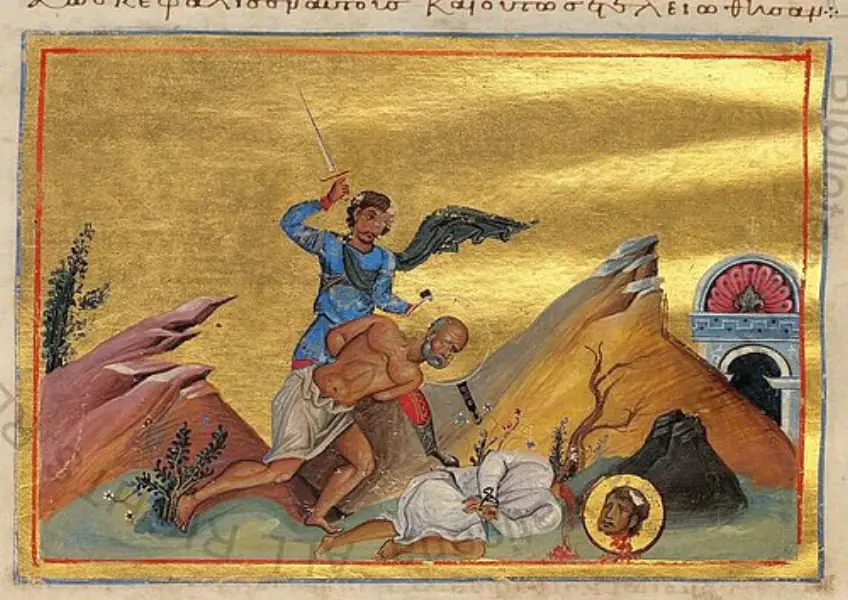
Adrian of Batanea was a Christian martyr of the early fourth century who traveled from his home in Batanea, the Hauran country east of the Sea of Galilee, to Caesarea Palaestina, where he died in the year 308 together with Saint Eubulus. Their purpose in traveling there was to visit the Christian community of Caesarea and minister to it, a congregation steeped in the blood of its martyrs through the years of the persecution of Diocletian and his successors. Asked their purpose at the city gates and telling the truth, they were arrested at once by order of Firmilian, the governor whose name Eusebius has made a byword for cruelty, and were tortured in prison. On 5 March Adrian was exposed to a lion in the amphitheatre; the animal wounded him without killing him, and a sword finally ended his life. Eubulus, offered freedom two days later if he would sacrifice to the idols, refused and suffered the same fate. Eusebius records that they were the last of the many martyrs killed in the twelve years of persecution at Caesarea.
The Complete Life
Early Life
Adrian's life before his final journey is unrecorded, and his designation tells us only his country: Batanea, the biblical Bashan, the rolling lava and farmland of the Hauran east of the Jordan and the Sea of Galilee, a region of Greek-speaking villages that had taken to Christianity early and thoroughly. A man of Batanea in the generation after the first persecutions had grown up in a church of the countryside, served by village clergy, with the memory of the gospel's passage through Galilee and the Decapolis close at hand. That he was free to travel, and minded to use his freedom to serve a congregation under persecution, suggests a man of some substance and evident conviction. He belongs to the class of believers whom Eusebius occasionally names, the visitors and helpers who came to the afflicted churches of Palestine from the quieter districts around, bringing the risk of Caesarea upon themselves by their own choice rather than by the accident of residence.
§ Further reading
Vocation
Adrian's vocation, insofar as the record shows it, was the volunteer's: he and Eubulus set out for Caesarea not under compulsion but to visit and minister to the congregation there, a church that for years had been losing its members to the tribunal and the arena. The decision was understood by everyone concerned, including the guards at the gate, for what it was. Asked on arrival the purpose of their journey, they answered truthfully, and the answer was sufficient for immediate imprisonment: to admit that one had come to serve an illegal congregation was to confess the crime. The exchange at the gate is the moral center of the story, and it has the ring of the authentic; the persecutions at their height made honesty itself the instrument of martyrdom, and the acts of the Palestinian martyrs are full of such moments, in which no violence was needed to begin the process, only the refusal to lie.
§ Introduction
Mission and Martyrdom
The mission ended where it had begun, at the hands of Firmilian, governor of Palestine, whose twelve years of office Eusebius documented with the names of his victims. Tortured in prison with his companion, Adrian was brought out on 5 March 308 and thrown to a lion in the amphitheatre of Caesarea. The beast mauled him without killing him, a common enough outcome that the acts record without embarrassment, and the execution was completed with the sword. Two days later Eubulus stood before the same judge, was offered his life for a sacrifice to the idols, refused, and met the same death. Eusebius, the contemporary historian of the Palestinian church, notes that these two were the last of the many martyrs killed at Caesarea in that persecution, which places Adrian at the very end of a long line, in the city that had seen the deaths of scholars and soldiers, bishops and boys, throughout the twelve years of terror.
§ Introduction
Canonization
Adrian's place among the saints was settled by Eusebius of Caesarea himself, whose Martyrs of Palestine preserved the circumstances of his death and whose greater Ecclesiastical History carried the record to the whole church. From the historians the name passed to the martyrologies, and the feast of Adrian of Batanea on 5 March, with that of Eubulus on 7 March, stands in the eastern and western calendars to this day. No process of canonization attended it; the church of the fourth century held the martyrs of the great persecution to be saints by the fact of their deaths, needing only to be named. The double commemoration, master and companion two days apart, reflects the order of their execution, and has kept the two men joined in the liturgy for seventeen centuries, an unbroken observance maintained by churches that now, in the lands of their birth, keep the memory under conditions their judge could not have imagined.
§ Further reading
Legacy
Adrian's legacy is modest in extent and clean in outline: he is remembered as the traveler who told the truth at the gate, and his death, with Eubulus', closed the roll of the martyrs of Caesarea's twelve years. For the historian he is a small but firm datum in Eusebius' careful accounting of the persecution, one of the named individuals who keep the statistics human. For the church of the Hauran and Galilee, ancient and much reduced in its historic heartland, he is a local saint, a man of Batanea, and his commemoration on 5 March keeps a thread of continuity with the Christianity of the Roman province of Arabia. For all readers he poses the question his story turns on: what would we say, asked at the gate what we have come for, if the answer were fatal. His answer has been remembered because it was simple, and because he had already decided it on the road.
§ Introduction
Timeline
- 308
Sets out from Batanea with Eubulus to minister to the Christians of Caesarea in Palestine
§ Introduction
- 308
Questioned at the city gates, the two tell the truth and are imprisoned on Governor Firmilian's orders and tortured
§ Legend
- 5 Mar 308
Exposed to a lion in the arena, he is mauled but survives, so an executioner dispatches him with the sword
§ Legend
- 7 Mar 308
Two days later Eubulus refuses an offer of freedom to sacrifice to idols and suffers the same martyrdom
§ Legend
The Record
- Patron of
- Those who volunteer for danger·Prisoners awaiting execution
- Symbols
- Lion·Sword
- Canonization
- Pre-congregation; ancient cult recorded by Eusebius
Prayer
Bibliography
Show 4 sources
- ↑ Husenbeth, Frederick Charles. Emblems of Saints: By which They are Distinguished in Works of Art , Longman, Green, Longman, and Roberts, 1860, p. 3
- 1 2 Butler, Alban. Lives of the Saints , Benziger Brothers, 1894
- 1 2 Shea, John Dawson Gilmary. “Saints Adrian and Eubulus, Martyrs”. Pictorial Lives of the Saints , 1889. CatholicSaints.Info. 1 February 2014 This article incorporates text from this source, which is in the public domain .
- ↑ Monks of Ramsgate. “Hadrian and Eubulus”. Book of Saints , 1921. CatholicSaints.Info. 1 September 2013 This article incorporates text from this source, which is in the public domain .
Profile text adapted from the Wikipedia article, licensed CC BY-SA 4.0.
Pray with this saint every day
Save St. Adrian of Batanea to your favorites, read the full profile, and get feast-day reminders in the Saints app.
Get the Saints AppFree on the App Store for iPhone and iPad