
died 1549·Feast August 26 (September 8); also May 17 (30) for the finding of his relics
St. Adrian of Ondrusov
Venerable Monk, Abbot and Martyr, Wonderworker
Overview
Adrian of Ondrusov, born Andrew Zavalushin, was a Russian nobleman of the sixteenth century who became a monk, a founder, and finally a martyr. A wealthy landowner whose estate lay near the monastery of Alexander of Svir, he met the saint while hunting in 1493, and the encounter changed the course of his life: he returned again and again for counsel and began supplying the needs of Alexander's ascetics. In time he gave away his position and was tonsured a monk at Valaam on Lake Ladoga, taking the name Adrian. Blessed to live as a hermit on one of the rocky islets of the Valaam archipelago, he drew disciples, and around that settlement the Ondrusov monastery grew. His reputation reached Tsar Ivan the Terrible, who endowed the community and, in 1549, asked Adrian to stand godfather to his daughter Anna. Returning from Moscow after the baptism, Adrian was killed by robbers near the village of Obzha on 26 August 1549 — the feast of his namesake, Adrian of Nicomedia. Two years later his brethren recovered his remains and buried them within the wall of his church. He is venerated as a wonderworker, with feasts on 26 August and on 17 May, the finding of his relics.
The Complete Life
A Nobleman's Estate
Andrew Zavalushin was born into the Russian nobility, master of the rich Andreevschina estate not far from the wild stretch of country where Alexander of Svir kept his monastery. The Russia of his youth was the Russia of Ivan III: expanding, pious, and in its northern forests still half wilderness. A landowner of his standing lived by hunting, tribute, and the management of dependent villages, and nothing in that life pointed toward the cloister. The turn came, the chronicle says, by accident — a hunt in 1493 that crossed the path of the holy man of the Svir, and a conversation that no source records but that no reader of Russian hagiography needs spelled out. The worldly nobleman began, quietly, to visit; then to support; then to envy the poverty he was supplying.
From Hunter to Hermit
The progression from patron to monk took years, as it does in all honest conversions. Andrew carried provisions to Alexander's ascetics and took counsel from the elder, letting the arrangements of his old life loosen one by one. When the step finally came, he did not join the Svir community itself but went to Valaam, the great monastery of Lake Ladoga, where he was tonsured with the name Adrian. Some years later he received a blessing for the still harder life: solitude on a peninsula of the Valaam archipelago, a rock and forest hermitage in the latitude of white nights. It was a choice with a lineage — Valaam claimed the heritage of Sergius of Valaam and the northern Thebaid — and Adrian proved equal to it, gathering around his cell the men who would become his first brethren.
Founder at Ondrusov
The hermitage became a monastery, and the monastery became the center of Christian life for the Ladoga shore. As abbot, Adrian governed the community that had grown up around his solitude — a common enough paradox in monastic history, the hermit made father. His reputation for holiness spread far enough to reach the court: Ivan the Terrible, in the first years of his reign, developed what the sources call a profound respect for Adrian and enriched his monastery with lands. In August 1549 the Tsar asked the abbot to stand godfather to his daughter Anna — an extraordinary honor for a northern hegumen, and a measure of how far the monk of the rocks had traveled in the world's esteem. Adrian went to Moscow for the baptism, and set out for home.
Murder on the Road
Near the village of Obzha, on the way back from Moscow, robbers killed the abbot. The date fell on 26 August 1549 — the feast of Adrian of Nicomedia, the great martyr whose name he bore, a coincidence the breviaries did not fail to note. Who the killers were and what they wanted the sources do not say; travel in sixteenth-century Russia carried its risks, and a monk returning from the Tsar's court may have been thought worth robbing. Two years later, on 17 May 1551, his monks recovered his remains and laid them in the wall of his church at Ondrusov, the honor ordinarily paid to a founder. The Russian Church reads his death as a martyrdom: a confessor's life ended by violence, and sanctified by it.
Veneration
Adrian is venerated as a venerable martyr and wonderworker in the Russian Orthodox Church. His cult is among the northern Russian traditions that never required formal process — the monastery kept his tomb, the people kept his memory, and the Church calendar eventually fixed it. He is commemorated twice in the year: on 26 August (8 September on the Gregorian reckoning), the day of his repose, and on 17 May (30 May Gregorian), the finding and translation of his relics. For churches on the Julian calendar the two dates are given in both reckonings, as is customary for the northern saints.
Legacy
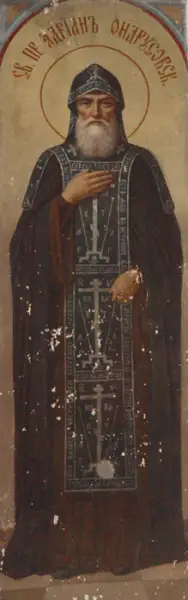
Adrian belongs to the last generation of the great northern flowering of Russian monasticism — the Thebaid of the lakes and forests that ran from Sergius of Radonezh through Kirill of Beloozero and Alexander of Svir down to the abbots of the sixteenth century. His story compresses the whole pattern into one life: noble wealth renounced, an elder's counsel obeyed, Valaam as the school, a hermitage that became a monastery, and a death by violence on the road. The Ondrusov monastery carried his name into modern times, and the icon of him — a schema-monk, sometimes shown with the church whose wall received his relics — keeps the memory green in the Russian Church.
Timeline
- 1493
While hunting near his estate, accidentally meets St Alexander of Svir and begins seeking his guidance
§ Introduction
- Aug 1549
Tsar Ivan the Terrible asks him to serve as godfather to his daughter Anna
§ Introduction
- 26 Aug 1549
Killed by robbers near the village of Obzha while returning from Moscow to his monastery
§ Introduction
- 17 May 1551
His brethren find his remains and bury them in the wall of his church
§ Introduction
The Record
- Patron of
- Monastics·Victims of robbery and violence
- Symbols
- Monastic schema·Monastery wall (his relics were buried in it)
- Canonization
- Venerated in the Russian Orthodox Church as a venerable martyr and wonderworker
Prayer
Profile text adapted from the Wikipedia article, licensed CC BY-SA 4.0.
Pray with this saint every day
Save St. Adrian of Ondrusov to your favorites, read the full profile, and get feast-day reminders in the Saints app.
Get the Saints AppFree on the App Store for iPhone and iPad