
martyred 5 March 1550·Feast March 5 (Julian; March 18 Gregorian); relics uncovered November 19 / December 2
St. Adrian of Poshekhonye
Hegumen, Founder and Martyr
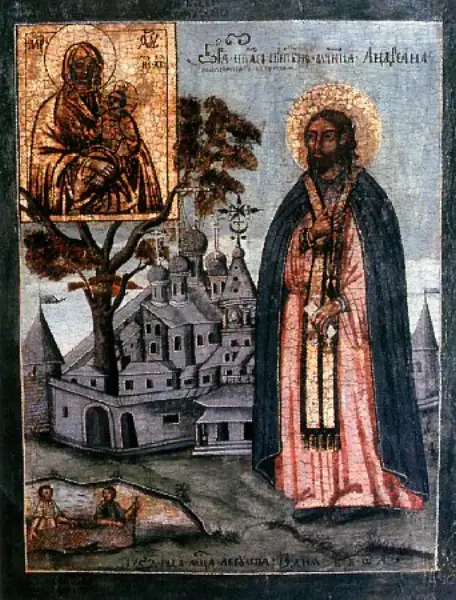
Overview
Adrian of Poshekhonye was a Russian Orthodox monk, iconographer, and founder of the Dormition Monastery on the river Votkha in Poshekhonye, north of Yaroslavl. Born at Rostov near the end of the sixteenth century to pious parents named Gregory and Irene, he took the monastic tonsure at the monastery of Saint Cornelius of Komel, where he was ordained hierodeacon and where he learned the painting of icons. When his spiritual father Cornelius had been dead for three years, Adrian obtained a blessing to establish a new monastery in honor of the Theotokos. Metropolitan Macarius of Moscow approved the undertaking and granted a charter, ordaining Adrian hieromonk and raising him to the rank of hegumen. The house grew in the northern forests until Great Lent of 1550, when, on the evening of 5 March, armed robbers burst into the monastery, tortured Adrian mercilessly, and murdered him. His brethren buried him in the monastery church of the Prophet Elijah. On 17 December 1626 his relics were uncovered and found incorrupt, and they were placed in an open reliquary for veneration; his feast is kept on 5 March, with commemorations on 23 May with the saints of Rostov and Yaroslavl and on 19 November for the uncovering of his relics.
The Complete Life
Rostov and Komel
Adrian was born at Rostov, in the heart of old Muscovy, near the end of the fifteenth century, the son of pious parents named Gregory and Irene. The Russia of his youth was completing its recovery from the Mongol centuries, and its northern forests were filling with monasteries as settlers and monks moved together into lands that had known neither. Adrian received his monastic tonsure at the monastery of Cornelius of Komel, the Korniliev Monastery north-east of Vologda, one of the strictest houses of the northern revival, where he was ordained hierodeacon. There too he learned the craft of the iconographer, the painting of holy images according to the inherited canon, a trade he carried with him for the rest of his life and which gives his memory its particular color: a monk who was also a working painter of the sacred. His formation was completed under Cornelius himself, one of the great elders of the Russian north, whose death began the chain of events that led Adrian to found his own house.
§ Introduction
Founder on the Votkha
Once Cornelius, his spiritual father, had been dead three years, Adrian was blessed to depart Komel and raise up a monastery in honor of the Theotokos. The place chosen lay on the river Votkha in Poshekhonye, the wild country north of Yaroslavl, and the foundation received the highest sanction available: Macarius, Metropolitan of Moscow, blessed it and issued a charter for it, ordained Adrian a hieromonk, and raised him to hegumen rank, so that the new abbot set out with both ecclesial authority and the patronage that made settlement legal. The pattern was the classic one of the Russian north: a charismatic elder, a royal or metropolitan charter, a river site, and a community of monks who cleared forest, built cells and church, and drew peasants to settle around them. The Dormition Monastery, named for the falling-asleep of the Mother of God, became the center of Adrian's remaining years and the field of his work as priest, iconographer and abbot.
§ Introduction
A Martyr's Death in Lent
The end came in Great Lent of 1550. On the evening of 5 March, armed robbers burst into the monastery and, finding the abbot, tortured him mercilessly and murdered him. The sources give no more circumstantial account, but the setting speaks: an isolated house, the last weeks before Easter when the monks were weakest from fasting, and bandits who expected treasure in a foundation whose income they had watched grow. The Russian Church received Adrian as a martyr, a victim not of a pagan governor but of the violence of the age, and his brethren buried him in the monastery's church of the Prophet Elijah. Seventy-six years later, on 17 December 1626, his relics were uncovered and found to be incorrupt, the sign by which Russian tradition recognizes God's favor on a saint. The remains were moved into the monastery church and set in an open reliquary beside the right kliros — the stand where the choir stood — so the faithful could venerate them directly.
§ Introduction
Veneration
Adrian belongs to the Russian Orthodox Church's vast number of pre-congregation saints, recognized by the immemorial consent of the Church confirmed by the uncovering of his incorrupt relics in 1626. His liturgical commemoration is layered: the main feast on 5 March, the day of his death, which falls on 18 March of the modern Gregorian calendar for churches using the Julian calendar; the Synaxis of the Saints of Rostov and Yaroslavl on 23 May, kept alongside every other holy one of that region; and a feast of the Uncovering of his Relics, kept on 19 November because that was the day the relics were found. This triple commemoration, personal death, regional fellowship and the discovery of the relics, is the standard Russian pattern for a monastic founder whose cult is tied to a physical shrine, and it kept the Dormition Monastery at Poshekhonye a place of pilgrimage into modern times. The open reliquary at the right kliros made his shrine one of the known stations of the Yaroslavl countryside.
§ Introduction
Legacy
Adrian's legacy is that of the northern Russian monastic colonization compressed into one life: a boy of Rostov formed at Komel, a founder with a metropolitan's charter on an unnamed river, an iconographer governing a house in the forest, and a martyr of Great Lent whose incorrupt body vindicated his work three generations later. The Dormition Monastery he founded carried his cult, and the robbers who killed him unintentionally fixed it, since a murdered hegumen is remembered where a long-lived one might have been forgotten. His association with icon painting gives the faithful a practical emblem of the house's work. In the calendar of the saints of Yaroslavl, kept each May, he stands with the elders and bishops of the north, and his March feast each year recalls a Lenten murder that the Church read, from the first, as a confession of Christ. His life joins in one frame the icon, the charter, the forest and the sword.
§ Introduction
Timeline
- 5 Mar 1550
Tortured to death by robbers who burst into his monastery on the evening of 5 March, during Great Lent
§ Introduction
- 17 Dec 1626
Relics uncovered and found incorrupt, then translated to an open reliquary in the monastery church
§ Introduction
The Record
- Patron of
- Poshekhonye and the Yaroslavl region·Iconographers (by tradition)
- Symbols
- Hegumen's staff·Icons (his trade)·Relics found incorrupt
- Canonization
- Pre-congregation (Russian Orthodox); relics found incorrupt in 1626 and venerated since
Prayer
Profile text adapted from the Wikipedia article, licensed CC BY-SA 4.0.
Pray with this saint every day
Save St. Adrian of Poshekhonye to your favorites, read the full profile, and get feast-day reminders in the Saints app.
Get the Saints AppFree on the App Store for iPhone and iPad